News

Ardbeg Supernova 2014 – “SN2014 to its friends” – At The Whisky Exchange – Scotch Whisky News

Whisky Exchange Header

Ardbeg Supernova 2014 – SN2014 to its friends

Ever since the label leaked in the US this past April, the internet has been awash with rumours about a new whisky from Ardbeg. Finally, the details have been announced and we can let you into the secrets of the latest Ardbeg Committee Release – Ardbeg Supernova 2014, aka SN2014.

Dr Bill Lumsden after the experiment

Ardbeg whisky maker Dr Bill Lumsden in a space suit. Any excuse to dress up…

The third release under the Supernova name, this whisky celebrates the return to earth of The Ardbeg Space Experiment. That’s rather an over-the-top name for a project where vials of Ardbeg new make spirit and wood shavings where held on the International Space Station for a couple of years, to see how wood/spirit interaction changes in a microgravity environment. Specifically it’s all about terpenes, but as I gave up chemistry after GCSE, I’ll stop there.

The samples are now on their way back to earth (or are already here, if they came back on the Soyuz that landed this morning) with Friday 12 September as Ardbeg’s big day – the reuniting of the space samples with the control samples that were left on the earth, and the release of Supernova 2014.

The first edition of Supernova appeared during a slightly silly time, when the Islay distilleries were competing to produce the peatiest whisky. While Ardbeg might not have won the war (that accolade goes to Bruichladdich’s Octomore whiskies) they certainly came out of it with some credit: Jim Murray crowned Supernova 2009 the Scotch Whisky of the Year and Second Finest Whisky in the World in 2010.

If you’re looking for the earlier editions, we do have still have a few bottles, but they’re starting to become hard to find: Ardbeg Supernova 2009 and Ardbeg Supernova 2010.
This new edition steps back from the silliness, but still packs a flavoursome punch.

Ardbeg Supernova 2014

Ardbeg Supernova 2014, SN2014, 55%, £125

Nose: Big mulchy peat, with sweetness and brine. There are some soured cream notes, with grassiness and a touch of herbal mint. More savoury herbal notes come in, along with coal smoke and burning seaweed. There’s also a bit of straw and hay, adding to a decently farmy background.
Palate: Softer than the nose suggests, at least at first. Gentle, sweet orange peel starts, but intensifies with charred peel, mint leaf, damp earth and pungently sweet peat smoke. Liquorice notes sneak in behind, with ferns, TCP and brine. Dark chocolate bitterness is joined by a hint of cherry fruit, with rich loam and wood smoke adding a dryness.
Finish: Sweet smoke – both peat and wood – dark chocolate and ashy touches. Menthol hints linger.
Comment: It may be quite light in colour and relatively fresh on the nose, but it’s still a beast. There are darker notes underneath the initial feisty smoke, and a fair whack amount of complexity. It’s Ardbeg looking fondly back on the crazy days of the late noughties.

It’s an Ardbeg Committee Exclusive release, exclusive to Ardbeg Embassies in the UK, and will be available from Friday 12 September in our London shop. We will start start selling it online on Wednesday 17 September at 1pm – first come, first served.

However, if you’d like to try before you buy, we will have some to taste at The Whisky Exchange Whisky Show in October. The folks at Ardbeg will be bringing along a huge 4.5 litre bottle for their stand, and we will be saving a few bottles to go on sale in the shop during the show. We still have some tickets for the Sunday of the show, so head on over to our tickets page to grab one.

Whisky Magazine Update Autumn 2014 – Whisky News

Whisky Magazine, 'Celebrating the whiskies of the world'

With the Autumn upon us, the next issue of Whisky Magazine publishes on December 2 and with this we announce the Icons of Whisky, North America results. Ian Buxton looks at the architecture of a variety of Whisky Distilleries and we take a look at the region of Australia & Tasmania reviewing various distilleries with Martine offering us some culinary delights using the regions whisky. We stay with food with a focus on whisky and chocolate.

Blair and Davin continue their Great Whisky Adventure to San Francisco in the issue published January 23, 2015 and they also review Artisanal Distilling in this region. The Travel Focus is Japan and we look at the developments of whisky. Continuing with our global awards we reveal the winners of the Icons of Whisky, Scotland together with the results of The Independent Bottlers Challenge.
________________________________________

Editorial Features

Issue No.123
Special Features
Whisky Travel: Australia & Tasmania
Whisky & Chocolate
Icons of Whisky, North America awards announced
Publication Date: December 2

Issue No.124
Special Features

Whisky Travel: Japan
Artisanal Distilling
Publication Date: January 23

________________________________________

To find out more about advertising in these two issues, or to receive details on the full year, contact:
Dave Sweet
Senior Vice President
dave@whiskymag.com
________________________________________
Whisky Magazine
Celebrating the whiskies of the world

Follow us on twitter [@WhiskyMagazine]
Like us on Facebook www.facebook.com/WhiskyMagazine

Journalist’s Canadian Whisky Primer – Canadian Whisky News

A 26-ounce Canadian whisky primer for journalists, editors, and publishers AND Whisky Intelligence Readers!

Davin de Kergommeaux

Hiram Walker Distillery, Windsor, Ontario, Canada. The largest distiller of beverage alcohol in North America.

1. The story of Canadian whisky offers a distilled and bottled history of Canadian settlement and commercial enterprise. 

2. When Jesuit missionaries arrived here in the 1600s they left no record of distilling, but they did try (with limited success) to make wine for use in their liturgies. 

3. Later, in the 18th and 19th centuries when large groups of settlers arrived in Canada they often brought small stills with them. 

4. Despite what you might expect, when the early Scottish and Irish settlers began distilling here in Canada it was rum and not whisky that they made. 

5. The history of distilling in Canada, like many things Canadian, varies province by province. For example, the shift from distilling rum to whisky began as settlers moved west into Ontario. Why? Because of its distance from the sea. This made it expensive for producers to acquire molasses, (which they preferred over grain) as sea-going vessels transporting Caribbean molasses to Canada could not navigate beyond Montreal. 

6. Whisky making in Canada is really an imported Scottish tradition, right? Not quite. The first commercial whisky distillers were mostly English and German. Not surprisingly, there were Americans of English or German descent who were keen to expand business opportunities here in Canada. As for those Scottish and Irish immigrants, they made no contribution to creating the Canadian whisky we know today. They were, however, enthusiastic consumers of rum. 

7. There is much conjecture that United Empire Loyalists arriving here from the U.S. late in the 18th and early 19th century were responsible for introducing distilling to Canada. Nice story, but not one supported by the historical record. There is no evidence that this happened or that they ever distilled commercially.


Three fine Canadian whiskies. Gibson’s Finest, Canadian Club Black Label (Japan only), Alberta Premium Dark Horse.

8. Although Scotch whisky enthusiasts will swear that Aeneas Coffey invented the column still, Coffey stills were not the norm here in Canada. Those early Canadian column stills were of American and European design, adapted to suit Canadian conditions. 

9. Canadian whisky was, from the start, an integrated commercial enterprise. The early distilleries were generally associated with flourmills from which they sourced their grist. 

10. With an abundance of locally grown wheat, it’s not surprising that for the most part, in the early days, the grain of choice for making Canadian whisky was wheat. In those days, wheat whisky was so common that it was actually called “common” or “straight” whisky. 

11. When and how was the switch made from common or straight whisky to rye? It was German and Dutch immigrants who wanted more flavour in their whisky. They suggested adding small amounts of rye-grain flour to the mashes. They called this new whisky style “rye” and it quickly became so popular that “common” wheat whisky all but disappeared. 

12. Several key figures were responsible for establishing the Canadian whisky style. James Gooderham Worts arrived here from England in 1831 and William Gooderham arrived the following year. Another immigrant from England was Henry Corby who arrived in 1832. Then, in 1841, Joseph Seagram was born here. He was of English descent but his whisky style was influenced by his German-Canadian customers. In 1857, J.P. Wiser crossed the border in to Canada from the U.S., bringing his German heritage and American distilling methods with him. Two years later and also from the U.S., Hiram Walker arrived, bringing with him his English family heritage and expectations of quality whisky. Gooderham, Worts, Corby, Seagram, Walker: these are the dynastic and iconic names of Canadian whisky.

 
Several Canadian distilleries produce whisky using only rye grain. Collingwood 21, Lot No. 40 and Mastersons are each 100% rye grain Canadian whiskies, as are Alberta Premium, Jefferson’s Rye, Lock Stock & Barrel, WhistlePig, Grand Grizzly and Pendleton 12.

13. Canadian whisky was and remains a southbound cross border enterprise. Early on, commercial Canadian distillers made inroads into American markets, and the U.S. quickly became the primary market for Canadian whisky. This is still the case today as American drinkers buy about 70% of the whisky that Canada produces. 

14. In 1865, two years before Confederation, Canadian whisky was the best-selling whisky in the U.S. period. And it remained that way until 2010 when bourbon overtook it. It is now number 2 in the U.S. market, and practically neck-and-neck with bourbon. Canadian whisky is still the best selling whisky in North America. 

15. Where there’s booze there’s legislation (and taxation) and Canada leads the way. In 1890, Canada became the first nation to pass legislation requiring that whisky be aged. More than a quarter of a century later the British government followed suit. The Scotch ageing legislation of 1916 was actually modeled on Canada’s. This is not an assertion but a fact. I have researched the official correspondence that confirms this. 

16. Canada’s whisky ageing legislation was intended to facilitate tax collection, and it had a dramatic commercial impact. It meant that it was no longer economical to operate small distilleries, leaving whisky production exclusively to the larger distilleries, most of which were already ageing whisky anyway. 

17. Prohibition may have had a moral tone to it in the U.S., but it also threatened the formerly lucrative cross-border sales of Canadian whisky. In 1920 when the U.S. declared Prohibition, Canada’s largest market suddenly dried up, creating serious financial difficulties for most of Canada’s commercial distilleries. They continued to export some whisky to the U.S. but in volumes so reduced that Corby’s, Gooderham & Worts, and Seagram’s faced near bankruptcy. Hiram Walker’s distillery fared slightly better but not for long. It was eventually sold for about half its commercial value. Moreover, much of the whisky reaching the U.S. from Canada was Scotch and Irish whisky imported to Canada for sale in the U.S. 

18. Fast forward to today. Canadian whisky sales are in a resurgence. The most recent statistics (from 2013) indicate that Americans bought almost 17 million 9-litre cases of Canadian whisky that year.  

19. And where does Canadian whisky come from? There are eight commercial distilleries in Canada and each one of them is undertaking expansion and/or modernization projects because of the continually increasing demand for Canadian whisky. Production is racing to keep pace with demand. 

20. Canada’s commercial distilleries span the country and include three in Alberta (Highwood, Black Velvet, and Alberta Distillers), one in Manitoba (Gimli), three in Ontario (Hiram Walker, Canadian Mist and Forty Creek), and one in Quebec (Valleyfield.) 

21. These are distinct distilleries. Each one follows its own production processes and methods making it meaningless to talk about whisky “regions” in Canada. 

22. What is it, then, that makes Canadian whisky so distinctive? Here is a 5-point overview of key production factors that, when taken together, distinguish Canadian whisky from all other whisky styles. 

a. Like single malt Scotch, Canadian whisky is generally the product of a single distillery. With occasional exceptions, Canadian distillers do not exchange barrels or buy whisky from each other. Thus, Canadian whisky can perhaps best be described as “single distillery whisky.” 

b. In general, unlike their U.S. counterparts, Canadian whisky makers do not use mash bills. In Canada each grain type is milled, mashed, fermented, distilled, and matured separately, and only then mingled together as mature whisky. American distillers combine their grains before making whisky. Canadian distillers combine them afterwards. Like all things Canadian, there are exceptions: Canadian Club and Black Velvet distil their spirits separately, like everyone else, but mingle these spirits before maturing them. 

c. Regardless of grain type, Canadian distillers generally make two whisky streams which they later combine after maturation. This is similar to how blended Scotch is made. 

One stream (called “base whisky”) is distilled to a high alcohol content and, although it still includes many grain-derived congeners, when matured it facilitates the full expression of congeners derived from the wood. (Congeners are the chemicals that give whisky its flavour.) Some distilleries make only one type of base whisky, while others make several. This base whisky is most often matured in barrels that have already been used one or more times. The first use reduces the influence of oak caramels, tannins, and vanillins, allowing other wood-derived congeners to contribute to the flavour in greater proportions. This is one source of the “elegance” of Canadian whisky. 

The second stream (called “flavouring whisky”) includes whiskies that are distilled to a low alcohol content in order to emphasize grain-derived congeners. These flavouring whiskies are commonly made from rye, wheat, barley, and corn – and each is distilled and matured separately. Flavouring whiskies are generally matured in new virgin barrels or in a mix of new and used barrels. 

d. Each type of grain spirit within each stream is matured in optimal conditions for that particular spirit. This requires the use of different barrel types and chars for each grain, as well as different periods of maturation depending on the characteristics of the particular spirit. 

e. The addition of non-whisky flavouring − the so-called 9.09% rule − is sometimes talked about on chat boards, although it is poorly understood. This is a practice that is not nearly as prevalent as some people suggest. It is more of a footnote to a discussion of the elements of Canadian whisky production. 

In a nutshell, to aid U.S. producers, American tax law provides financial incentives for foreign spirits that include some American-made spirits. For high-volume bottom-shelf whiskies this is a substantial tax break. For lower-volume whiskies it is often not worth the effort. Thus, some Canadian whiskies made for the U.S. market include American spirits even though the version of the same whisky made for the Canadian market (and the rest of the world) often will not. As well, in some cases, regardless of the intended market, small amounts of foreign spirit will be added to enhance certain flavours.  

This is further complicated by the use of the words “wine” and “sherry” to describe some of these additives, even though the actual liquid used bears little or no resemblance to what the general public perceives wine or sherry to be. Moreover, all spirits added to Canadian whisky under this rule must have spent at least 2 years maturing in wood.


Like single malt Scotch, Canadian whisky is generally the product of a single distillery and thus, can best be described as “single distillery whisky.”

23. In addition to the eight Canadian distilleries mentioned above, two small Scottish-style distilleries (Glenora and Shelter Point) have been established in Canada in the past two decades. Recent years have seen a burgeoning of a craft distilling movement in Canada and there are some 30 of them at the last count. About half a dozen of these micro-distilleries are already making − or are planning to make − whisky. 

24. One issue that confuses some whisky writers is that unlike in the U.S. and the U.K., Canada does not unify all of its whisky laws, rules, and regulations in one tidy legislative place. Distilling in Canada is a matter, first of all, of provincial regulation even though many aspects of its production and export fall under federal regulation. Consequently, two levels of government and many provincial and territorial government departments and agencies, share these responsibilities. Each of them makes rules specific to its areas of legislated responsibility. To complicate matters further, provincial rules vary across the country. While it is not incorrect to rely on the basic definition of Canadian whisky from the Food and Drug Act, it is incorrect to draw the conclusion that this is the only regulation that whisky makers must comply with in Canada. 

25. The Food and Drug Act includes this definition:

Canadian Whisky, Canadian Rye Whisky or Rye Whisky 

a. shall:

i. be a potable alcoholic distillate, or a mixture of potable alcoholic distillates, obtained from a mash of cereal grain or cereal grain products saccharified by the diastase of malt or by other enzymes and fermented by the action of yeast or a mixture of yeast and other micro-organisms,

ii. be aged in small wood for not less than three years,

iii. possess the aroma, taste and character generally attributed to Canadian whisky,

iv. be manufactured in accordance with the requirements of the Excise Act and the regulations made thereunder,

v. be mashed, distilled and aged in Canada, and

vi. contain not less than 40 per cent alcohol by volume; and 

b. may contain caramel and flavouring. 

26. Finally, a key resource for all these matters of history, production, commerce, regulation, and − perhaps most important of all: the delicious taste of Canadian whisky − my book, Canadian Whisky: The Portable Expert, published by McClelland & Stewart 2012 and 2014 is a well stocked bar of valuable information.  

This primer is a carefully researched overview of key points about Canadian whisky to assist journalists and others writing about it. These points may be quoted freely with credit to the author. Davin de Kergommeaux is also the author of Canadian Whisky: The Portable Expert, the definitive book about Canadian whisky. 

These notes were first published in this format, September 3, 2014.

WINNER, GOURMAND BOOK AWARDS 

BEST SPIRITS BOOK CANADA 2012 

WINNER, 2013 IACP BOOK AWARDS

WINE, BEER AND SIRITS 

Canadian Whisky: The Portable Expert is published by McClelland & Stewart and distributed by Penguin Random House. It is available from most book shops and on-line book sellers.

Ralfy Publishes Whisky Review #484 – American Whiskey News

ralfy

www.ralfy.com bourbon-trips with Whisky Review 484 – Rock Town Young Bourbon Whiskey Batch 17

New Arrivals & Back in Stock at K&L California – Whisky News

kl_logo_trans

TOP PICKS

  • Nikka 17 Year Old Taketsuru Pure Malt Japanese Whisky 750ml ($139.99)
    Named for Nikka’s founding father Masataka Taketsuru, the 17 year old has long been coveted by the American market, which could only read the bombastic tasting notes from international travelers and whisky fans living abroad. The Nikka 17 is one of the most celebrated of the available portfolio and really brings the goods flavorwise — round and soft with dried fruits and an earthy, meaty flavor on the profile, this is not only of the best Nikka whiskies we’ve ever carried, but one of the best Japanese whiskies period.

BACK in Stock

United States – Bourbon and Rye

  • Old Potrero Single Malt Straight Rye Whiskey 750ml (1 btl limit) – 2 available ($69.99)
  • Tuthilltown Hudson Manhattan Rye (375ml) – 12 available ($49.99)

K&L Wine Merchants
http://www.klwines.com/
Phone: 877-KLWines (toll free 877-559-4637)
Email: wine@klwines.com
San Francisco, Redwood City, Hollywood CA

Just Whisky “Silent Distilleries” – Scotch Whisky News

jw-logo_whiskyintelligence

Hopefully you enjoyed our recent guide to approaching whisky auctions and points to consider before making a bid. One area that was only briefly touched upon is what to consider collecting or investing through auctions? It’s a topic many pundits could easily devote thousands of words to given the current whisky boom. 

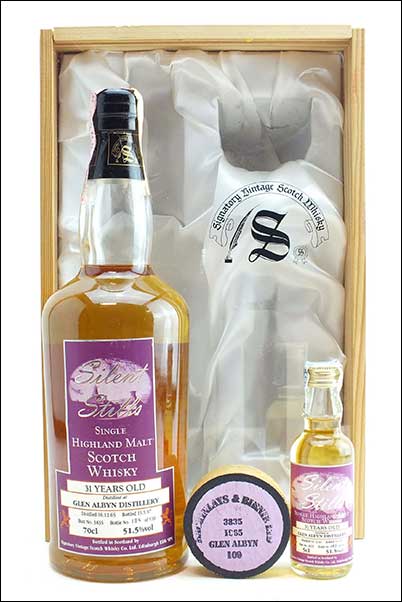
In essence what we’re doing with this piece is focusing on a specific bottle in our upcoming September auction which is a distinctive Glen Albyn from independent bottler Signatory, who now own Edradour distillery. At the same time we can also highlight the growing popularity of the independent bottlers who have become the main source (excluding some of Diageo’s annual special releases and the odd official release) of whisky from closed distilleries. As a side note it is worth visiting Edradour as the distillery shop always stocks a great of Signatory releases. And if you take the distillery tour, then the warehouse visit will confirm the independent bottler has an impressive array of casks. 

AA JW 1

Now we say ‘closed’ but other popular terms include ‘silent’ and ‘mothballed’ to name but two. Generally, the terminology applies to distilleries that are no longer in production. The distillery may have been completely bulldozed from existence (Glen Mhor), kept in suspended animation (Glen Keith which has only recently reopened) or still stands in some form today such as Convalmore or Rosebank. It is worth highlighting that while Convalmore and Rosebank distilleries still have a physical presence, the equipment within may have been sold off, stolen or been left to the elements, to decay such as Brora. 

Many of these distilleries closed during the early 1980’s when the whisky industry experienced a surplus in demand. Over 3 decades later and we are nearing the end of the potential lifespan for what few intact casks remain. Diageo for instance do not comment on how much they have left to bottle for Brora, Port Ellen etc. and the same veil secrecy applies to rest of the industry. Eventually we will reach a point where the only remnants of certain distilleries are in unopened bottles – it very likely that for some we’re already at this point. 

This means that there is a growing interest and demand in acquiring whisky from a distillery such as Glen Albyn, which was 1 of 3 distilleries in Inverness that no longer exist today. Closed in 1983 and subsequently demolished in 1986, this Signatory release was distilled in 1965 before being bottled at 31 years old. Even in 1997, Signatory it seems appreciated the rarity of its casks by releasing the bottle with an accompanying miniature – although from the lots we’ve seen over the years these tend to be unopened anyway! At least the option exists if you wish to experience what Glen Albyn can offer without having to open up the full bottle. The final piece of the jigsaw is a decorated cask bung, which completes the edition that numbered just 530 in total. 

Whisky from Glen Albyn does have a variable reputation … Read more at Just Whisky’s Blog

More From Single Malts Direct – Scotch Whisky News

SMD LOGO

Here is a photograph of a couple of pipers enjoying some Glencadam whisky in our ‘Whiskies of Scotland’ marquee at the Lonach Highland Gathering a couple of weekends ago. Below is another selection of whiskies and other drinks that we have on offer at

www.singlemaltsdirect.com.

Slainte, Ronnie Routledge.   

Bunnahabhain 1986 25 Year Old Whiskies of Scotland

£107.50 ex VAT

£129.00 inc VAT

53.9% ABV | 50cl

Springbank Society Newsletter September 2014 – Scotch Whisky News

springbank-society1

Springbank Society Newsletter

September 2014

I hope you have all had a great Summer and the weather has been kind to you wherever you are. We were very lucky here in Campbeltown with some beautiful weeks of sunshine and it’s with weather like that we all really appreciate the amazing beaches and scenery we have on our doorstep. There has been an increased number of visitors around the town this Summer and it’s a great sight to see.

NEW SPRINGBANK WEBSITE

I’m extremely excited to tell you that we are now in the first stages of having a brand new, 21st century approved website designed for us! If you have visited our current website I’m sure you will agree that it is a little out of date and in need of a modern make over. Glasgow-based Graphic Design Agency, Made Brave will be designing the fresh new website for us and with a number of high end clients under their belt, we are confident they will be able to deliver a website which will reflect the quality of our products.

Andrew and Martin from Made Brave visited us at the weekend and spent two days shooting different parts of the distillery. From just glancing at a few of the creative shots they took, we know we are in safe hands with them. We hope to have the website up and running before the end of this year so I will keep you posted on the progress – I can’t wait to see how it looks!

CAMPBELTOWN MALTS FESTIVAL 2015

Following the success of The Campbeltown Malts Festival 2014, where Campbeltown’s three distilleries worked together to create a 3 day whisky festival, I am pleased to say that the dates for next year have been confirmed. Once again Springbank, Glengyle and Glen Scotia will team up and will hold the Campbeltown Malts Festival 2015 from Wednesday 20th-Friday 22nd May. Like previous years, the Springbank Open Day will fall on the Thursday (21st) with a variety of other events happening on the Wednesday (20th) and Friday (22nd). As always, we have already been thinking of ways to make it bigger and better than the last and we would love your ideas on how you think we could do this! If you have any suggestions on things you would like to see or anything you think could work better then please so share! We would love to hear any feedback you have, although please don’t be too harsh as I may take it personally!

WHISKY SCHOOL DATES 2015

The dates for the Springbank Whisky School 2015 have now been announced and spaces are filling up quickly. For all our new members who maybe haven’t heard of it before, we started the Whisky School in 2007 and it’s where we offer enthusiasts the chance to come and work in the distillery for a week long ‘course’. During the week they will gain knowledge and experience in all stages of the whisky making process including malting, mashing, distilling and bottling as well as gaining some well earned ‘tasting’ experience!!

The dates for next year are:

Term 1: ” Week commencing Monday 18th May 2015

Term 2: ” Week commencing Monday 25th May 2015

Term 3: ” Week commencing Monday 1st June 2015

Term 4: ” Week commencing Monday 8th June 2015

Term 5: ” Week commencing Monday 15th June 2015

Term 6: ” Week commencing Monday 22nd June 2015

Term 7: ” Week commencing Monday 29th June 2015

To find out prices, availability or get some more information, please email Janet at whiskyschool@springbankwhisky.com.

DISTILLERY & SALES TEAM NEWS

We have been very busy at the distillery this Summer with both our day-to-day shop tours and Sales Team visitors. Visitor numbers during the Summer months have seen a steady increase from last year and it’s great to see so many people coming all the way to Campbeltown to visit us.

At the distillery, we are currently in the 5th week of malting which will take us up until Friday 31st October. After this, the guys will head up to Glengyle Distillery where they will start mashing on Wednesday 5th November until we break up for the Christmas holidays.

The Autumn and Winter months are always a busy time for the Sales Team who will be out and about at various shows around the world. Ranald, Melanie, David and Grant have their calendars full for the next few months meaning it will be a very quiet (and peaceful!) office for the rest of us!

I am also very excited to be working my first ever show at the beginning of October! I’m finally being trusted on a trip away and will travel down to London along with David and Grant for the Whisky Exchange Whisky Show which takes place on the first weekend of October. I will hopefully be able to bring a sample of the new Society bottling (due out in October) with me so I hope to see some of you there!

UPCOMING RELEASES & INFORMATION ON CURRENT BOTTLINGS

We have recently bottled two new releases which will be hitting shops this week.

The first bottling is the third in the series of Longrow Red. You may remember in 2012 we released Longrow Red which was matured in Cabernet Sauvignon Casks and in 2013 we released a version which was matured in Shiraz Casks. The 2014 edition has been matured in Fresh Port Casks and is magnificent! It is 11 years old and bottled at 51.8% with 9,000 bottles available for worldwide distribution. The price for this is £55.00 and as a Society Member, you will get your 10% member discount, meaning it will cost you £49.50.

The tasting notes for the new Longrow Red are as follows:

Nose: Beautiful sweet fresh summer fruits. Creamy with a hint of peat and classic cigar box notes.

Palate: Very smooth and elegant, particularly for an 11 year old. Good peat influence with the port casks providing lots of juicy current notes: Lingonberries!

Finish: A soft oaty creaminess provokes thoughts of brie and cranberry on oatcakes. Long and sweet.

The second new release this week is the Hazelburn 10 year old which will join the Hazelburn 12 to make up the two core products in the Hazelburn range. The 10 year old is bottled at 46% and is made up of 100% bourbon casks. This will retail at £38.00 and members will of course get their 10% discount on this bottle making it £34.20. The tasting notes for this are:

Nose: Stewed pears and baked apples are followed by honeycomb and fudge notes.

Palate: A lovely and rich whisky with vanilla and honey flavours. Liquorice follows with a refreshing zestiness.

Finish: A refined milk chocolate cream finish which is oily and chewy.

We will be releasing another three exciting bottlings in October/November, including a new Society bottling, so as soon as I have more information on these I will send you all the details!

Earlier this year, we re-designed the packaging for the Longrow 18 year old so that it fitted in with the other products in the Longrow range. Now our Springbank 18 year old has also been given a make over with a more  striking colour of purple being used on the label and packaging. The whisky is of course the same – it’s just been given a new look!

Over the past two years, prices at Springbank have only increased in line with duty. Unfortunately with increased production costs (water, oil, electricity, barley and casks are all more expensive than previously), it’s necessary to update our current retail price list. The 10 core products in our range along with their updated prices are listed below:

• Hazelburn 10yo: ” £38.00 (-10% Society discount) = £34.20

• Hazelburn 12yo: ” £50.00 (-10% Society discount) = £45.00

• Springbank 10yo: ” £38.00 (-10% Society discount) = £34.20

• Springbank 12yo: ” £47.00 (-10% Society discount) = £42.30

• Springbank 15yo: ” £53.50 (-10% Society discount) = £48.15

• Springbank 18yo: ” £78.00 (-10% Society discount) = £70.20

• Springbank 21yo: ” £180.00 (-£10.00 for Society Members) = £170.00

• Longrow: ” ” £38.00 (-10% Society discount) = £34.20

• Longrow Red: ” £55.00 (-10% Society discount) = £49.50

• Longrow 18yo: ” £84.50 (-10% Society discount) = £76.05

SHIPPING OUT-WITH THE UK

In the last newsletter, I told you that we had found a new shipping company who are able to ship worldwide for us. The service seems to working very well for almost all countries and we have had some very happy customers who have been impressed by the quick and easy service which has been provided. The main problem we have experienced is when trying to send to some states within the USA, as due to strict laws on importing, they have not been allowed into the state. At the moment we are having problems shipping to the following states:

• California

• Illinois

• Missouri

• North Carolina

• New York

• Oregon

• Pennsylvania

• Washington

• Texas

We are currently working on a way round this problem but unfortunately until we find a resolution we will not be able to ship to the above 9 states. If you live in a state which is not listed then it should be possible to get bottles shipped to you. If anyone would like another copy of the shipping prices for different countries then please let me know and I can get this emailed over to you.

Anyway, I think that is all the news I have at the moment so thank you for reading and I will be in touch in the next few weeks with news of the upcoming bottlings.

Slainte,

Mairi

For the Springbank Society

 To join the Springbank Society please contact them at society@springbankwhisky.com

Whisky Wednesday Reviews Darkness Macallan 12yo PX Finish – Scotch Whisky News

Joseph

This week Joe Ellis reviews the Darkness Macallan 15 Year Old PX Finish Master of Malt Bottling. 

http://youtu.be/fX0L2VTrbgo 

http://Twitter.com/whiskytube

https://www.facebook.com/whiskytube

Also Whisky Wednesday will be publishing a special review on the 17th – his 100th review! – WI

Penderyn & Brown’s Hotel Special Offer – Welsh Whisky News

Penderyn & Brown’s Hotel Special Offer

2014 is the centenary of Wales’s most famous writer, Dylan Thomas. To celebrate Penderyn Distillery and Brown’s Hotel Laugharne (Dylan’s favourite pub and now a tastefully refurbished ‘pub with rooms’) have partnered up to bring you this special offer that brings together three elements – liquor, literature & Laugharne:

• A two-night B&B midweek break* in Brown’s for two people

• A Penderyn masterclass on the first night hosted by Brown’s Hotel resident expert, Sam Cowlam

• A guided tour around Laugharne with Brown’s Hotel manager, Jon Tregenna, an expert on local history

• A two-course evening meal from Brown’s Hotel tasty ‘bar meals’ menu

The two-night break is for a Monday & Tuesday night, or a Wednesday & Thursday night, and costs just £225 (usual price £338**).

Full details can be found on Brown’s website

All enquiries to Brown’s Hotel on 01994-427-688 between 8am and 4pm,
or email: info@browns-hotel.co.uk.

*All rooms subject to availability. **Normal price of two midweek rooms based on two people sharing is £190. A two course bar meal can cost up to £14 per person. A Whisky Masterclass at Penderyn Distillery is £45 per head, and a 90 minute guided tour of Laugharne £15 per head.


Powered by WordPress