News

Irish Whiskey Renaissance – New Distilleries: Carlow and Horse Island – Irish Whiskey News
Irish Whiskey Renaissance 

New Distilleries: Carlow and Horse Island 

Ernie – Ernst J. Scheiner, The Gateway to Distilleries at www.whisky-distilleries.net

Ireland in Kentucky

The most westerly European and Irish Dingle Distillery went into production last year (please see https://www.whiskyintelligence.com/2012/12/new-on-the-irish-whiskey-map-dingle-distillery-irish-whiskey-news). The Dingle Founding Fathers cannot wait to see their whiskey to be bottled in December 2015. More Irish distilleries are to come in the near future: Tullamore, Belfast Titanic, Carlow and Horse Island.

A surprising news came from the U.S.: „The Vendome whiskey stills, used by Alltech’s Lexington Brewing Company and made in Louisville, Kentucky, were shipped over (to Ireland) on 22 August (2012). The whiskey will be distilled in Carlow Brewing Company in Bagenalstown, Co. Carlow.“  The pot stills were used by Alltech Lexington Brewing Company to distil Town Branch Bourbon www.kentuckyale.com/town-branch.

In the Heart of the Bluegrass-Country the Lexington distillers were also making an Irish type of whiskey.  Both whiskeys received gold medals at the 2012 World Spirit Awards www.world-spirits.com.

Alltech’s founder and renowned scientist Dr. T. Pearse Lyons revived whiskey distilling in Lexington, Kentucky, in 2008 which had stopped at the beginning of the Prohibition in in 1920.  Lyons is of Irish background, he worked as a biochemist in the Irish whiskey industry with the Irish Distillers Group and has been a master brewer for Storehouse Guinness, Dublin. The successful entrepreneur set up Town Branch Distillery not to distil Bourbon but Kentucky’s first double distilled single malt whiskey  Pearse Lyons Reserve  www.kentuckyale.com/pearse-lyons-reserve.

Today’s onion shaped pot stills were manufactured by Forsyths of Rothes in Scotland. The first new Kentucky malt was filled in a first-fill Bourbon cask in September 2008 and presented at the World Equestrian Games in 2010 (Alltech is the main sponsor). The annual production capacity is about 450.000 litres of new make spirit.

See: http://www.kentucky.com/2012/09/26/2351606/new-alltech-distllery-to-open.html

Tables turned: back to the roots 

„Global animal health and nutrition company Alltech is moving (parts of ) its whiskey business to Ireland,“ was the news which surprised the people of Co. Carlow.  Back to the „heimatland“ was the notion. The Irish master brewer and distiller who was born in Dundalk, Co. Louth, just cannot deny his whiskey roots, another of his whiskey dreams came true in Carlow. Lyons is now the only independent distiller to produce whiskey in the U.S. and Ireland.

He said: “A truly momentous event has happened as the first stills are shipped from Kentucky to Ireland, completing the cycle with this fantastic craft finally returning to its place of origin. This will set the stage for a new Irish whiskey with a Kentucky flair.”

Carlow Brewing Company, also known as O’Hara’s Brewery, founded in 1996 by the O’Hara family, was chosen as the Irish production site. It is a good address, they are proud of their beer: „The renowned O’Hara’s Irish Stout, won two gold medals at the International Brewing Awards, a high profile industry competition, and this success attracted a lot of international attention.“ See www.carlowbrewing.co.

Managing director Seamus O’Hara was exited about the new joint venture which would bring new jobs to Carlow.  His craft brewery will also act as an importer of the Kentucky Bourbon Barrel Ale which is brewed by Alltech Lexington Brewing and Distilling Co.  The American ale is specially matured for six months in Kentucky Bourbon casks to add more flavours and aromas of the whiskey to the beer.

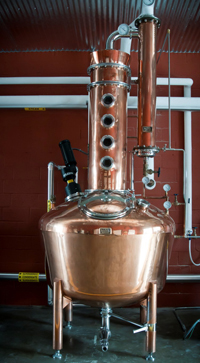
The two Kentucky stills were set up in the Carlow Craft Brewing House and distilling began in November 2012. The wash still has a capacity of 1,900 litres and the spirit still 1,000 litres. The American stills are constructed with a boil pot and a column on top which allows to distil different spirits. The spirit is made of  100%  malted barley only. They use their own developed distiller’s yeast with a fermentation period of the wash for  about 65 hours (Dr. Lyons has got a doctor’s degree in yeast fermentation) and run a double distillation to produce a malt whiskey which is non-peated at the moment.  The micro-distillery is fully manual. The spirit will mature in casks from The Lexington Brewing and Distilling Company in warehouses on site. Lyons said: „This way we will keep the Kentucky-Ireland connection alive.” See  www.alltech.com.

A new Irish-American whiskey dynasty is born as Dr. Lyons’ son Mark also received his PhD in brewing and distilling from Heriot-Watt University in Edinburgh, Scotland. 

Island Whiskey Horse 

Another whiskey distillery will be built in the South of Ireland. Horse Island, just south of Cork, is privately owned by Adrian Fitzgibbon. His company Roaring Water Farm & Enterprises (growing of crops combined with farming of animals) handed in a planning application at Cork County Council (see for further details the application form, no. 12752 of December 2012).

The application plan comprises a mash and fermentation house, a still house and a visitor centre,  a restaurant-cafè with a whiskey-bar and two warehouses. A sea water pump and waste water treatment plant with water tanks are also planned.

The distillation unit comprises a set of three pot stills to produce a triple distilled new make. They intend to distil Irish pot still whiskey which is traditionally made of unmalted and malted barley.

The grain and malted barley will be delivered by a roll-on-roll-off ferry and silos may store about 32 tonnes of grain. The production water will come from a well in the island and the cooling water will be sourced from the sea. The expected annual production capacity will be around 900.000 litres of new make spirit. The whiskey will mature on the island, the draff will be fed to livestock on the island. There are plans to employ about 20 peopl.  „Production should start in 2014.“

You may spent your holidays in Horse Island, there are three luxurious cottages available: www.4beachnuts.com/property/485

About the Author: Ernie – Ernst J. Scheiner M.A. was a director in an adult education centre and teaches “Germans how to drink whisky.” Ernie offers courses on whisky distilling and writes for newspapers and magazines in Germany.

He is the editor of The Gateway to Distilleries at www.whisky-distilleries.net which gives an excellent insight into the whisky industry of Scotland, Ireland and Continental Europe. Contact: info@whisky-distilleries.net
MCLEANSCOTLAND On Tour With Russian Guests – Scotch Whisky News

MCLEANSCOTLAND on tour with Russian guests. 

GlenDronach & BenRiach distilleries asked MCLEANSCOTLAND, one of the top whisky tour operators in Scotland, to manage a 4 day visit for 14 Russian guests in 2012.   The group are distributors for  the 2 distilleries in Russia.  Whilst in Scotland they sampled  many drams, enjoyed the Scottish scenery and excellent food including a whisky dinner at GlenDronach Distillery.

MCLEANSCOTLAND arranged transportation and daily visits including both distillery tours and tastings, a day trip to Inverness with lunch, a visit to Speyside Cooperage to watch casks being made and repaired and a farewell dinner.

““They were a very nice group to work with, I enjoyed myself immensely, drinks of each evening proved lots of fun, even though things were sometimes lost in translation!   I would welcome them again at any time. 

Paul McLean, Senior Partner, MCLEANSCOTLAND, Perth.  www.mcleanscotland.com

Royal Mile Whiskies “SHIPPING TO USA IN 2013 – IMPORTANT” – Scotch Whisky News

Unfortunately the way we ship alcohol to North America will change as of next week.

The Civil Aviation Authority is stopping the transport of high alcohol products in non-freight aeroplanes, as they are now classing these liquids as ‘dangerous goods’.

We are currently evaluating alternative solutions, but this is a complex issue and will take some time. As such Royal Mile Whiskies are to suspend shipping to North America as of the 8th January 2013 until further notice.

Obviously, we have enjoyed and greatly appreciated your custom in the past and we hope to be able to serve you again in the future.  We know this is as disappointing for you as it is for us and we will do what we can to find a legal and cost effective method of shipping as quickly as we can. We should also point out that it is not just Royal Mile Whiskies that will be affected by these new regulations and all companies shipping alcohol over 24% alcohol using non-freight shippers will also be subject to the same regulations.

If you want to stock up before these new regulations take effect, there should be time for one last order at current costs before our courier stops collecting from us on 8th January. We would need to receive the order by 12 noon (GMT) on Monday 7th January.  Please note that we will not be able to order ‘Out of Stock’ products from our suppliers in time to complete web orders before the deadline, so suggest that you order products that show ‘Good Availability’.  If there is an item out of stock we will get in touch very quickly to let you know.

Please also note that due to public holidays our offices will be closed on New Year’s Day and the 2nd January. We realise this is bad timing, however, we wanted to give you as much forewarning as possible. We will be back in the office on Thursday 3rd January to answer any queries you may have.

Once again all of us at Royal Mile Whiskies thank you for your business and wish you well for the New Year.

From the RMW team

The Malt Maniacs Publish A New E-pistle – Scotch Whisky News

Nabil has written a very interesting E-pistle on the “supertaster” phenomenon that manifests itself by a higher concentration of taste buds on the tongue:

http://www.maltmaniacs.net/E-pistles/Malt-Maniacs-2012-09-Supertaster.pdf

Happy reading and Happy New Year,

Ralfy Publishes Whisky Review #329 – Scotch Whisky News

www.ralfy.com celebrares the ending of another year with Whisky Review 329 – Whisky of the Year 2012

D&M California Closed January 1st through 8th 2013 – Whisky News

We are sprucing up the place and will be open for business again on January 8th. During this time our retail store on Fillmore street and our Website will be unavailable. Please stop in and see our new digs after January 8th.

Happy Holidays from all the staff at D&M!

WorldWhisky.org – A New Whisky Site – Whisky News

The latest (and first) two posts from WorldWhisky.org.

http://www.worldwhisky.org/2012/12/list-of-popular-whisky-apps-for-smartphones-and-tablets/

http://www.worldwhisky.org/2012/12/categorized-index-of-twitter-whisky-accounts/

All the very best for 2013!!!

Happy New Year!

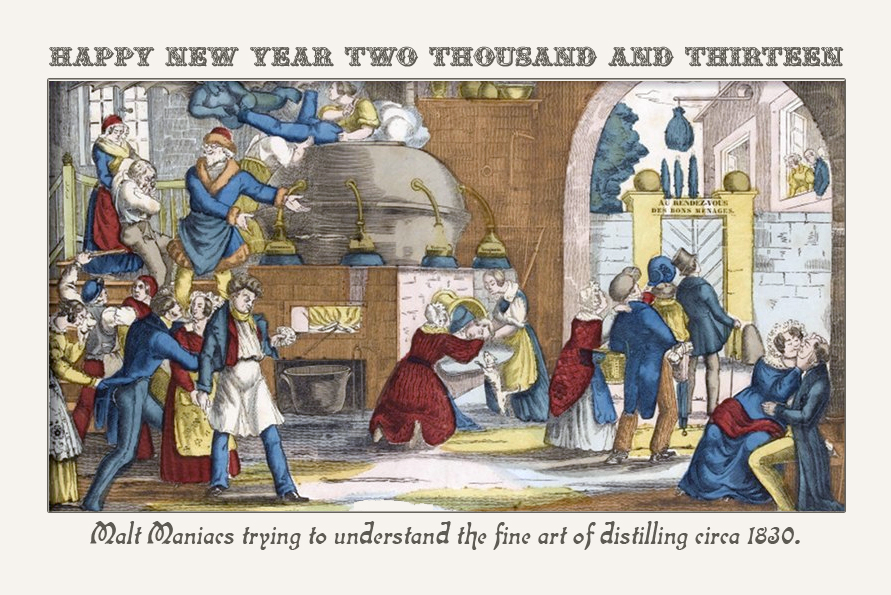
Happy New Year From The Malt Maniacs!

JAPANESE WHISKY ‘The blessing of nature and the wisdom of man.’ by Mark Davidson – Japanese Whisky News

JAPANESE WHISKY

‘The blessing of nature and the wisdom of man.’

Unlike the Scottish and Irish whisky industries the Japanese can trace the start of their production back to a clearer date. Although will that date be the turning of the first turf at the first distillery site, or the moment the first spirit runs off the still, what about the first bottling? Perhaps it should begin with the first action to set the ball rolling. This is harder to pin point.

We know western influence in Japan sped up after a trading agreement led to American goods being brought in to the country in the mid 19th century. From this point unusual products like beer and bread became known and as we have since seen the Japanese are masters of assimilation usually followed by improvement. Foreign spirits were known as ’yusho’ with gin making an impression as early as 1870. For whisky this initially meant a very loose translation of the imported Scottish article. After 1912 and a reversing of high taxes and tariffs applied to domestic spirits as compared with imports it was not long before business men saw an opportunity to make a Japanese whisky. What was needed was an individual with production knowledge. Enter our hero, Masataka Taketsuru, a young scientist from a family of sake producers. As a chemist he was first employed in 1917 by Settsu Shuzo, a spirit making company. The company’s owner, Kihei Abe, decided to send his gifted employee to Scotland to study the science of whisky making. At this time the Japanese economy was in good shape thanks to the demands set on the allies’ industries during the first world war requiring assistance from abroad.

Having first studied in Glasgow, but not sitting exams, Taketsuru sought tutelage from production expert J. A. Nettleton in Elgin. Unfortunately due to Nettleton’s high fees Taketsuru had to settle for five days work experience at Longmorn distillery in April 1919. Following this he enjoyed a further two weeks at Bo’ness distillery then finally a five month spell at Hazelburn distillery in Campbeltown commencing in January 1920. His guide at Hazelburn was recently instated and introduced a laboratory at the distillery to assist in the improvement of the plant’s apparently uninspiring product. This must have pleased the young Japanese chemist, especially since his question to the manager of Longmorn: ‘is there any distillery in Scotland where a microscope would be used?’ was met with the reply ‘no, I do not think so’.

Returning to Japan, with a Scottish bride, Taketsuru found his situation was not ideal. His employer wished not to make ’proper’ whisky but was content to make an ’ersatz’ style. Further, due to the end of the war Japan’s economy had slowed and his company were unable to afford the high costs of producing the real thing even if they wanted. Meanwhile Shinjiro Torri, the nephew of a ‘foreign drinks’ maker, had an idea to employ a Scottish distiller within his company (later to be known as Suntory). With Taketsuru looking for work the gap was filled and a ten year contract was signed in 1923.

Almost immediately the two had disagreements. Taketsuru saw the northern island of Hokkaido was the ideal location for a distillery thanks to its coastal situation and cool climate- in keeping with his experiences of Scotland. However his employer was concerned with the island’s distance from the main market and the overheads involved with such a far off site. Thanks to the proximity to Kyoto, the local transport network and proven water quality Yamazaki was chosen to host Japan’s first distillery. After a devastating earthquake building started in 1923 being completed in November 1924. The following year Taketsuru had to return to Scotland to seek advice from his mentor, now at Cragganmore distillery since the closure of Hazelburn earlier that year. Despite detailed studies and scientific methods of investigation Taketsuru had yet to master the drying stage at the end of malting as well as the complexities involved in still firing. Problems solved the first whisky was released on the first of April 1929.

Just before the first release Torri bought a brewery and put Masataka in charge. Perhaps he was unhappy with the direction Masataka was taking his product, the initial release ‘Shirofuda’ was not popular due to its full character, and wanted to remove him from direct involvement with production. Alternatively it could have been the case that Torri wanted his son to take a more important role within the company. Whatever, Masataka was further from his goal of creating a whisky comparable to what he had seen in Scotland.

Waiting until his contract ended Masataka set out on his own. Backing came principally from three respected business men, two of which probably got to know Masataka thanks to his wife Rita’s job teaching English. This time Masataka got his way, thanks again to good connections some cheap reclaimed land was made available in Yoichi on Hokkaido. Nearby both peat and barley were available but a grace period was honoured and initially only apple cider was produced, it was felt leaving your sponsor to set up a rival firm was just not cricket. Whilst trading under the name ‘Nihon Kaju’ (changed to ‘Nikka’ in 1952) difficulties due to a lack of experience, high cost and complications of shipping the apple drinks to market the business failed. Turning to whisky it still took six years of losses before the first whisky was sold in 1940. Once again it took a war to bolster business. Luckily for Masataka Japanese military officers liked a dram and with imports stopped his brand was in favour.

However by the 1950s Masataka’s sponsors were concerned the business was not performing. The feeling that his devotion to following the Scottish lead was unrealistic, lower grade ‘whisky’ was cheaper and more popular, tastes at the time were less discriminating. Around this time two elder share holders sold out to Asahi brewers. With 51% of shares the new owners forced in a light whisky which became the second best selling in the country. A parallel can be drawn here with Suntory’s experience, the follow up to their unpopular and heavy first release became, and still is, very popular: ‘Kakubin‘.

Come the 1960s and Nikka’s first coffey still was installed at the Nishinomya bottling plant ‘Tochgi‘. This was followed in 1969 by the company’s second malt facility at Sendai, later called Miyagikyo. At the time the biggest distillery in the world and intended to make a more Lowland style although heavily peated versions are made. Their well received Nikka Coffey malt is also made there.

It was after his death, in 1979, that Masataka Taketsuru’s commitment to making Scottish whisky came full circle- in 1989 the company bought Ben Nevis distillery. During this year the company’s growing interests also included the purchase of a cognac distillery. Throughout his career he seldom compromised, for example waiting ten years for the Scottish to introduce the steam heating of stills before using the method himself shows his respect for his teachers.

‘Whisky! I don’t eat much, I get eight hours sleep and for the past 40 years I’ve been drinking a full bottle of good whisky every day’-

–Masataka Taketsuru

Some notes:-

Karuizawa malt and Kawasaki grain distilleries are owned by Sanraku-Ocean (aka Mercian since the 1990s after the company’s successful wine business). The company accounts for around 4% of the Japanese whisky market. Karuizawa is currently mothballed, it insisted on using Golden Promise barley and mostly used sherry casks for maturation. Unlike Nikka and especially Suntory the distillery is small and concentrated on making only one style of whisky: a big slightly peated make through small stills.

Kirin-Seagram also holds a 4% share. Kirin tied in with the former Canadian company Seagram and benefited from access to its partner’s nine Scottish distilleries. This allowed the make from Gotemba distillery to be mixed with malts imported from Scotland, in the mid 80s the majority of bulk exported Scotch was shipped to Japan. Gotemba was opened in 1973 and conversely makes a light malt and a heavy grain. Like other Japanese distilleries it sits at high altitude (620m). The present incarnation of the owning company inherited the Four roses Bourbon when Seagram divested its drinks interests.

Suntory claim about two thirds of the market. Their empire stretches overseas to include production of spirit in Brazil, Mexico and Thailand as well as owning Bowmore, Auchentoshan and Glengarioch. The company also owns a 25% stake in Macallan, with other interests stretching from ice cream to the Encyclopedia Britanicca. Not unlike Teachers the company had a chain of ‘pubs’ throughout Japan ensuring their product was very accessible while promoting loyalty. Yamazaki distillery doubled in size in 1958 and while malting stopped in 1972 (currently all malt is imported- mostly from the UK) production continued to expand after both 1980 and 1989 saw further increases in capacity. The distillery temporarily ceased production in 1987/88 to allow work to progress. There are now six pairs of stills, all different shapes and sizes which along with varying methods of heating and condensing, angles of lyne arms, yeast and barley strains, peating levels, cut points, maturation wood choices and environments, two mash tuns (one wooden, one stainless steel) not to mention the permutations of matching wash and spirit stills the range of possibilities for flavour is very broad. All this is due to the small number of distilleries in Japan and also to the lack of reciprocal trading between producers making comprehensive blending difficult without innovations during distillation. Other developments include producing malt spirit via continuous stills, producing grain spirit through pot stills and even bamboo filtering is used for one variant- a la Lincoln County process oriental style. In 2009 Yamazaki single malt was the 8th best selling single malt in the world even only on account of domestic sales.

Suntory’s second malt distillery Hakusha was once there world’s biggest boasting a yet unparalleled 55 million litre capacity and storage for 800 000 casks, all this at 700m above sea level.

In 2003 Suntory decided to push exports, thanks to a down turn in popularity of Japanese blends in the 1990s the part played by malts in the strategy is significant, much in the way Scotch whisky has seen a development in the interest of single malts. A mark of the company’s determination to succeed in the west is perhaps the launch of its blend Hibiki 12yo in Europe before release in the home market.

The remainder of sales are shared between Nikka and twenty other companies, the latter accounting for again 4% of business. Included in these smaller firms is Takar Shuzo who in 1986 were the first Japanese company to take direct interest in Scotland with the purchase of Tomatin distillery as well as the Antiquary blend. Tomatin was at one point the largest malt distillery in Scotland. When the partner in the business Okura sold their 20% stake they were replaced by Maruben. There is also the new Chichibu distillery. Ichiro Akuto, whose family started in the drinks trade in 1625 as sake brewers, wanted to replace the distillery built by his father in the 1980s but demolished in 2004. His new still is performing well and there are plans to use local barley and peat to produce a 100% Japanese whisky. He uniquely used Quercus Mongolica (Mizunara/water oak) for the wash backs as well as maturation. The wood has a reputation for leaking and since Hokkaido’s forests were cleared for pasture the species is now rare in Japan.

FIN

Mark Davidson…

Of a distinguished Banff 1968 vintage Mark Davidson has a short but full body and so marries well (& subsequently producing two limited editions), frequently seen at whisky fairs in Scotland yet curiously difficult to find outside his domestic market it is hoped his inaugural launch on the Canadian scene will be well received. He is at home in independant bottling circles being most commonly found in the William Cadenhead livery where he has enjoyed a 13 year finishing period, however as a stand alone single expression under the Jolly Toper brand he can come into his own while being a fine mixer.


Powered by WordPress