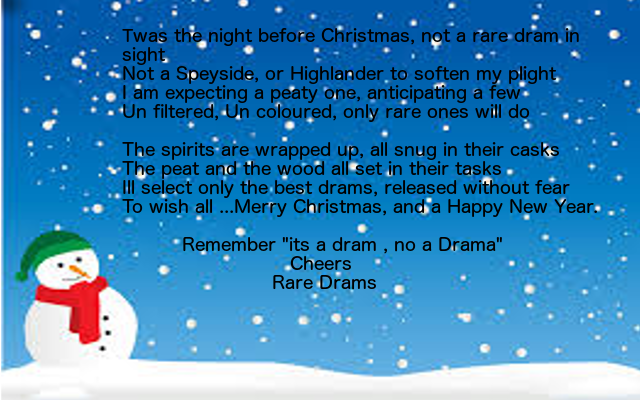
MERRY CHRISTMAS & A HAPPY NEW YEAR FROM RALFY!
December 24th, 2017
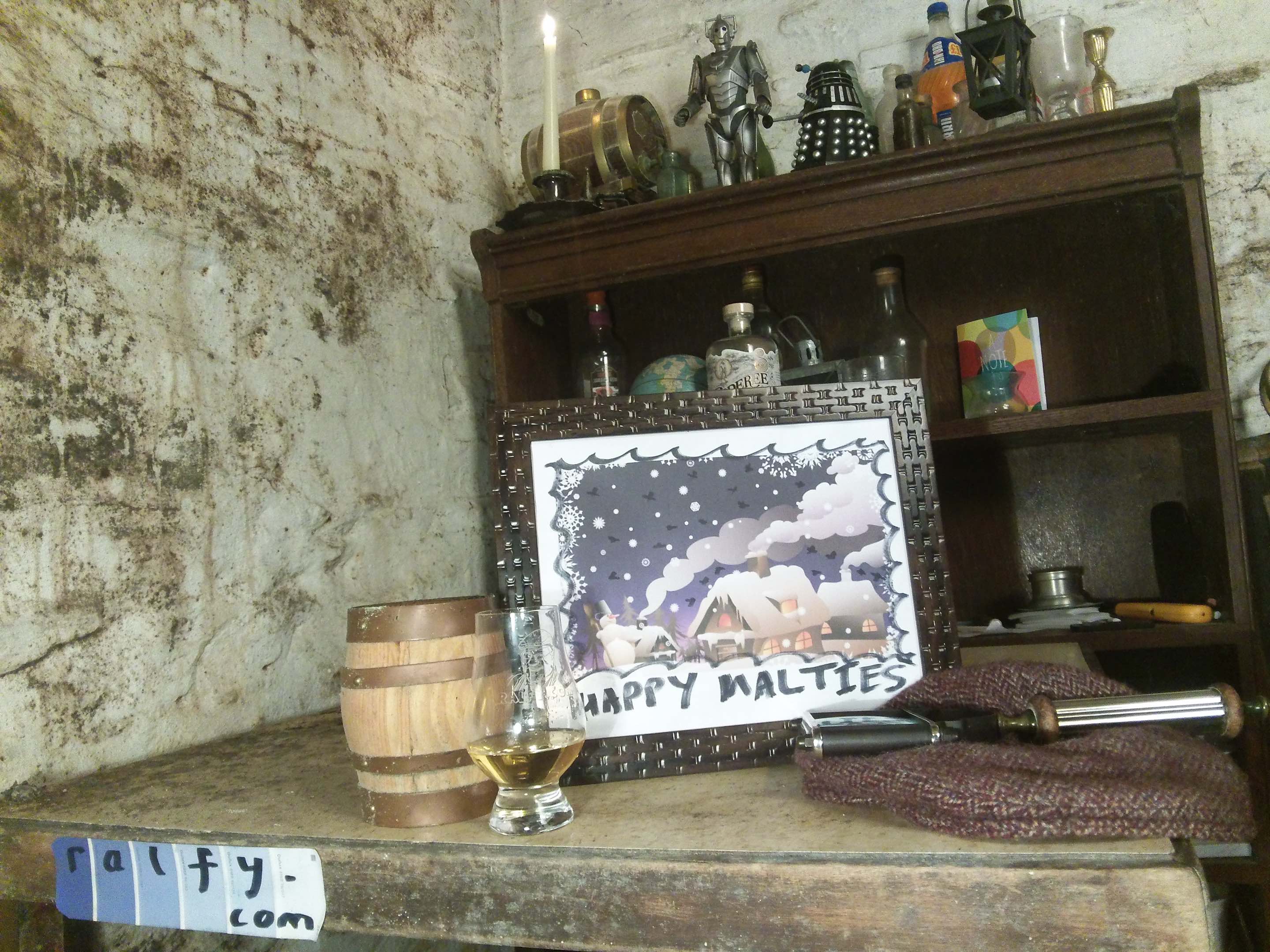
MERRY CHRISTMAS & A HAPPY NEW YEAR FROM RALFY!

MERRY CHRISTMAS & A HAPPY NEW YEAR FROM RALFY!
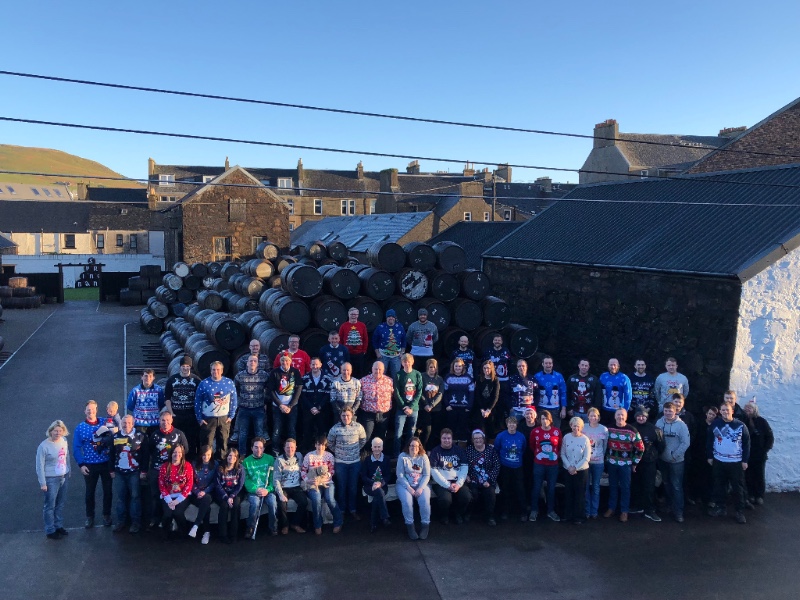
From everyone at Springbank, have a very Merry Christmas and a Happy New Year!

KWM Whisky Advent 2017 Day 24 – Kilchoman 2007 KWM 10 Year
The Isle of Islay is the home to some of the most iconic distilleries in Scotland: Bowmore, Ardbeg, Lagavulin, Laphroaig, Bruichladdich and more. It is a Mecca for whisky lovers the world over, and when Anthony Wills had a dream to open his own distillery Islay was the only place to do it. He didn’t want to build a large modern distillery when the barley is trucked in and the spirit trucked away. The industry has changed a lot over the last century, and some of the charm and tradition has been lost along the way. With Kilchoman (pronounced Kil-ho-man) Anthony wanted to build a farm distillery, returning Islay’s whisky industry to its roots.
Kilchoman not only malts some of its barley on site, but it grows it in the fields surrounding the distillery. The distillery was founded at Rockside Farm on the Western side of Islay. For a few short years it was the westernmost distillery in Scotland. An even smaller distillery on the Isle of Lewis bares this honour today. Rockside farm is located a mile inland from the beautiful white sands of Machir Bay, and beyond that lies thousands of miles of open ocean until you hit the east coast of Canada. For most of the 11+ years it has now been producing whisky there was a bit of an uneasy relationship between Kilchoman and the farm, that came to an end a couple years ago, when the distillery literally bought the farm.
In addition to producing the whisky on site, Kilchoman is also one of the few distilleries in Scotland to bottle on site. Would it disappoint you to learn that some of the best know whisky brands in Scotland are reduced to bottling strength with de-ionized city tap water? Both Kilchoman and Bruichladdich Distillery on Islay bottle their whiskies with the same water they use to produce them.
With more than a decade of distilling behind it, and demand that seemingly outstrips supply each and every year, Kilchoman has a lot of wind in its sails. The distillery is in the midst of a big expansion, at least by Kilchoman’s standards, with production set to more than double from 200,000L a year, to more than 450,000L a year. This might sound like a lot, but it is still less than 1/8th of Laphroaig’s production and not even 7% of Caol Ila’s. But still fans of this bold but smooth Islay malt, can expect to see a lot more of it in the decades ahead.
And more importantly, this year we have a special treat. To help us celebrate our 25th Anniversary, Founder and Owner Anthony Wills was kind enough to let us select and bottle one of Kilchoman’s oldest casks. Our 2007 Kilchoman is the oldest whisky from the distillery to be sold in Canada, and it doesn’t disappoint. A sign of even greater things to come!
Kilchoman 2007 KWM – 56.6% – Ex-Bourbon Barrel – Andrew’s Tasting Note: “Nose: creamy, decadent and briny with a whiff of smoke from the coals of a smouldering beach fire; classic Kilchoman fresh lemon, goat cheese and Old English Butterscotch; smoked mussels and pan seared scallops. Palate: big, sweet, oily and malty; sweet vanilla and butterscotch morph into tendrils of vanilla, chewy malt and tarry-medicinal-peat; more lemon and goat cheese, firm toasted oak, fennel and Dutch licorice; underneath it all a thick layer of ripe orchard fruits. Finish: bold, long and rich yet smooth and so so salty: more Dutch licorice, juicy malt and tarry-peat; the smouldering beach fire returns with some sweet vanilla, lemon and orchard fruit. Comment: we are honoured that Anthony Wills was willing to share one of these precious early vintage Kilchomans will us; bottled just days past its 10th birthday!” – $200 for 700ml – or – $30 of 50ml

Festive Greetings! We trust you are all well and easing yourself into the holiday season. Or if you’re like the majority of us here at Springbank you’re kicking yourself for leaving everything to last minute, trying to find retailers who will still deliver before Christmas (not many to the bottom of the Mull of Kintyre) and trying to find enough places around the house to hide your Springbank collection before the Father in Law arrives.
As we will shortly close the distillery and office for Christmas we thought we would send you a final newsletter for 2017 to recap on a very busy year and preview the start of 2018.
2017 has undoubtedly been one of the distillery’s busiest, with major renovations works to our famous malt barns, installation of a new bottling line, lots of new production staff, our busiest Malts Festival ever and 5 newborn babies just the tip of the iceberg!
The sales team have been active as usual travelling across the globe to participate in 49 whisky shows and conduct almost 100 tastings. No bungee jumping or tastings aboard Nuclear Submarines this year although Ronan claims to have scaled 2,128m to the top of Mont Pilatus in Luzern for an epic Springbank selfie after Whisky Schiffs…(He thinks we don’t know there is a cable car all the way to the top) and Melanie enjoyed a whisky evening at the UK’s Ambassador residence in Budapest. She was disappointed that no Ferrero Rocher was offered.
The Society continues to grow with an additional 548 new members this year while more and more fans make the pilgrimage to visit us in Campbeltown with visitor numbers increasing 17% from 2016.
In a parody of the Twelve Days of Christmas we can festively summarise our year as;
12 new staff,
11 weeks renovations,
10 year old local barley,
9 thousand bottles,
8 weeks whisky school,
7 missed flights,
6 hours peat smoke,
5 newborn babies,
4 ton mashes,
3 new flagpoles,
2 weeks Christmas holidays,
and 1 new bottling line!
2018 is set to be just as busy with more renovations, full time malting, the Campbeltown Malts Festival (23rd-25th May) and who knows how many newborns!
New Releases
What better way to beat the January blues than tucking into some of our new releases. February will be a busy month with three Springbank heavy-weights hitting the shelves;
Springbank 12yo cask strength 56.3%
The latest 12yo cask strength follows the normal maturation recipe of 70% sherry and 30% bourbon and will be bottled at 56.3% ABV.
Springbank 25yo
The 5th annual release of Springbank 25yo will be available worldwide in limited quantities. This version departs from recent editions of the 25yo where maturation combined bourbon and sherry casks into a final port pipe vatting, whereas this edition has been matured exclusively in refill sherry casks, characterising the whisky with the soft rich fruits associated with classic Springbanks.
Longrow Red 11yo 55.9%
This Longrow Red Cabernet Franc from De Toren Private Cellar in Stellenbosch, South Africa is the follow up from the previous Malbec release from the same winery. It will be bottled at cask strength having spent an initial nine years in bourbon barrels before a final two in Cabernet Franc barriques.
The Sales team will be straight into a busy travel schedule. Here’s where you can catch up with them in the coming months;
Sales Team Events
January
12-13th Harrow Whisky Festival, The Grim’s Dyke Hotel, London (Grant)
13th Arctic Whisky Festival,Tromsø, Norway (Ronan)
15-22nd Canada Tasting Tour (Melanie)
15-16th Edmonton retailer visits and tastings
17th Edmonton Whisky Festival www.edmontonwhiskyfestival.ca
18th Calgary Whisky Festival www.calgarywhiskyfestival.ca
20th Victoria Whisky Festival www.victoriawhiskyfestival.com
21 – 22nd Vancouver Whisky Classique www.whiskyclassique.com
19-20th Whisky Weekend Amsterdam, Holland. www.whiskyamsterdam.nl
(Kilkerran only event) David
February
26th Feb – 2nd Mar: Australia Tasting Tour. Ranald will be representing Springbank down under in partnership with Cadenhead’s who will also be touring. David will also be in the country on these dates for a Kilkerran tasting tour.
March
2-4th DramFest, Christchurch, New Zealand. www.dramfest.co.nz
(Ranald & David)
5-12th New Zealand tasting tour. (Joint Springbank, Kilkerran & Cadenhead tour with David, Ranald and Cameron)
8-10th Whiskyschiffs Luzern www.whiskyschiff-luzern.ch
10th Fife Whisky Festival www.fifewhiskyfestival.com (Grant)
16-17th Midlands Whisky Festival www.whiskyfest.co.uk (Grant)
19-23rd Norwegian Tasting Tour. Dates and locations tbc (Ronan)
That’s all from us for 2017, our office is closed from 1pm Wednesday 20th December 2017 until 4th January 2018. The Campbeltown Cadenhead’s shop will be working on reduced opening hours and tours;
Wednesday 20th December 9am – 1pm (10am & 11.30am tour only)
Thursday 21st December 9am – 5pm
Friday 22nd December 9am – 5pm
Saturday 23rd December 9am – 5pm
Sunday 24th December 12pm – 4pm (No tours)
Monday 25th December Closed
Tuesday 26th December Closed
Wednesday 27th December Closed
Thursday 28th December 11am – 4pm (1.30pm tour only)
Friday 29th December 11am – 4pm (1.30pm tour only)
Saturday 30th December 11am – 4pm (1.30pm tour only)
Sunday 31st December Closed until Thursday 4th January 2018
From everyone at Springbank, have a very Merry Christmas and a Happy New Year!
To join the Springbank Society please contact them at society@springbank.scot
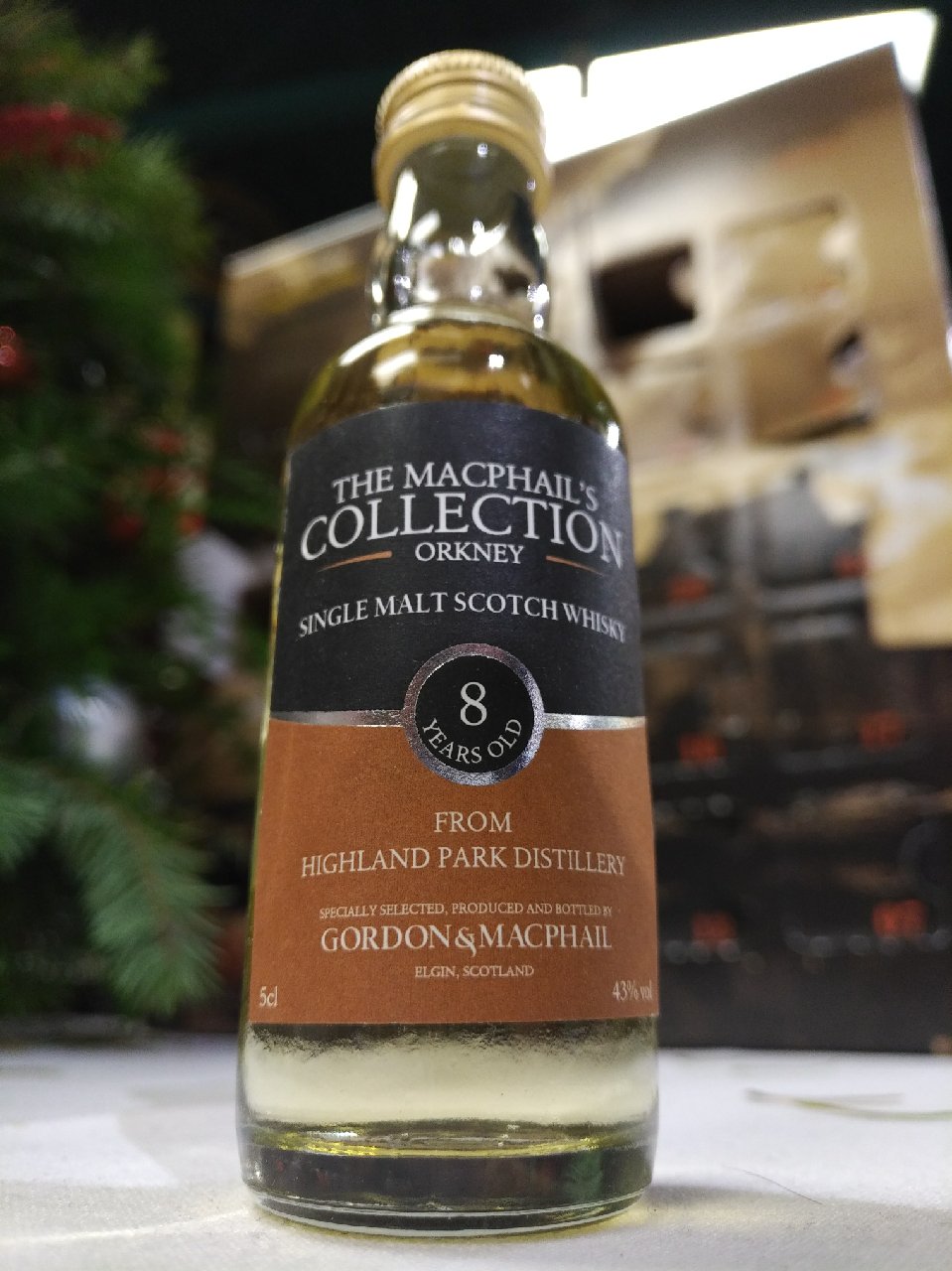
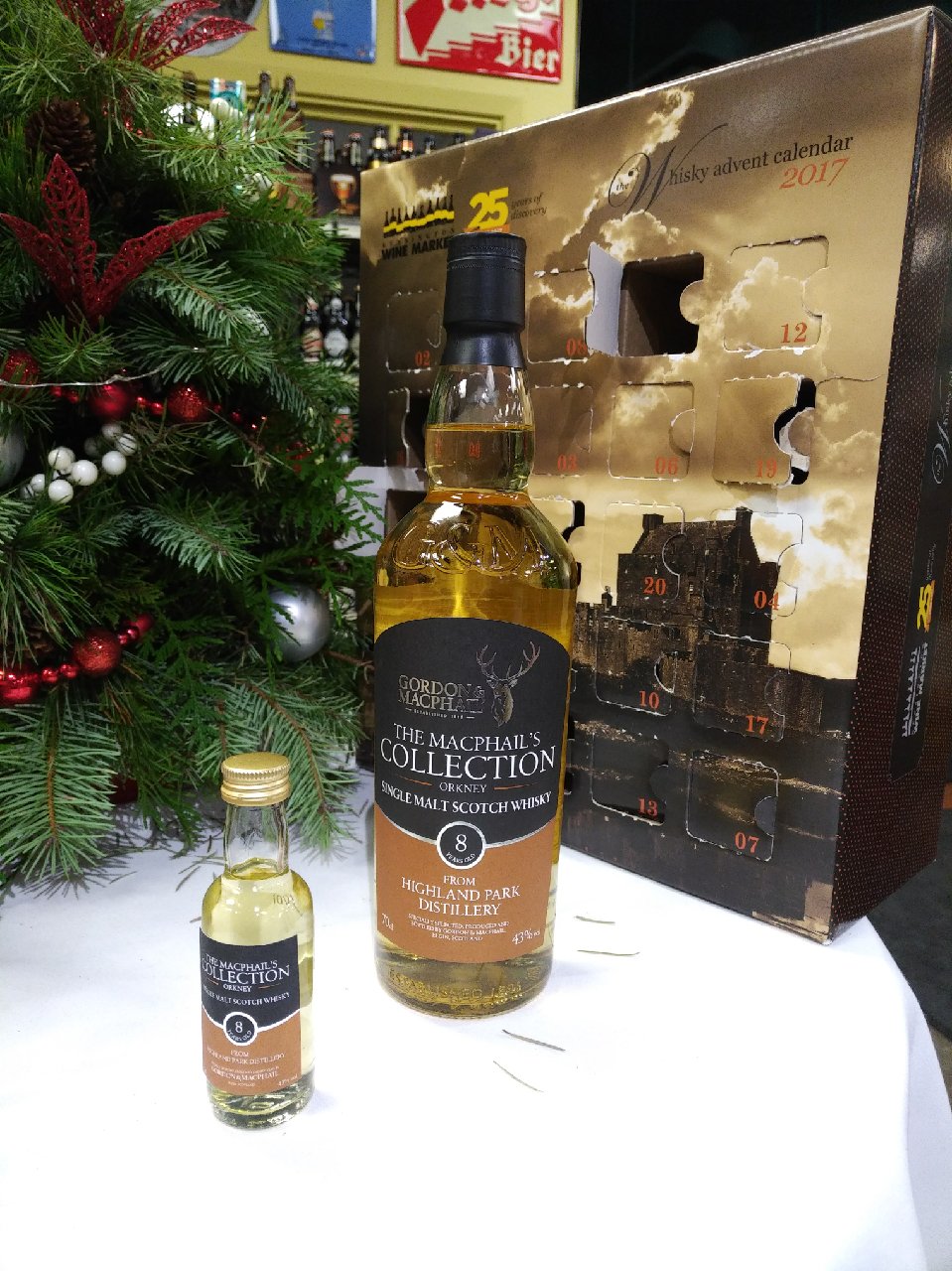
KWM Whisky Advent Day 23 – Gordon Macphail Highland Park 8 Year
Highland Park was until recently Scotland’s northernmost distillery. Officially established in 1798 it was also one of the first to be licensed. But the distillery’s actual origins are shrouded in the mists of time, and the fog which frequently blankets the Orkney archipelago. The distillery was either founded by the legendary and larger than life priest Magnus Eunson, or a farmer named David Robertson. There is also some indication the distillery may have originally been called Rosebank, and later Kirkwall. But for today lets work on the assumption the distillery was established as Highland Park by Magnus Eunson.
Before he took his distillery legit, he was said to have been a prolific illicit distiller and smuggler. In one tale he caught forewarning of a raid by the exciseman, or gauger… Legends suggest he hid his barrels in a church and covered them with a white cloth. When the guagers arrived they found the men kneeling in prayer. Eunson is said to have whispered “small pox”, and that was all the taxmen needed to hear!
Highland Park is one of the most beautiful distilleries in Scotland, tucked into the hills on the outskirts of the Orkney capital of Kirkwall. The buildings are built from an assortment of dark stones, which if memory serves, would have originally served as ballast in the many ships that visited the island. The island was the final stop most British ships traveling to Hudson Bay would have made. They would have taken on provisions including fresh water and whisky. One of the earliest purchasers of whisky from the island would have been British traders sailing for Hudson’s Bay. By the 1850s Highland Park had a reputation for good quality single malt, and was also supplying the biggest blended whisky brands: Ballantines, Dewars and Chivas with stock.
Highland Park is one of less than a dozen distilleries to retain its tradition floor maltings. This malting accounts for about 20% of Highland Park’s production, and is heavily peated with Orkney peat. Orkney peat is famous for having a lighter more delicate impact than other Scottish peats, owing to the archipelago’s geography and climate. The Orkneys are so far north, and exposed to such power winds, that few trees can take root. As a result the islands peat does not contain any wood or crucially pine needles, which give a more acidic, medicinal profile. The 20% of heavily peated malt is blended with unpeated malt from the mainland before mashing.
Gordon Macphail Highland Park 8 Year – 43% – Refill Sherry Hogshead & Ex-Bourbon Barrels – Andrew’s Tasting Note: “Nose: honeyed and waxy; very herbal and floral with heather honey, the whiff of a distant sea breeze and kippers in a pan; diced pineapple and dried apricots. Palate: creamy, waxy and subtly smoky; floral, heather honey, very maritime and savoury with more kippers; more dried apricots and pineapple cubes; still floral and herbal. Finish: a touch nutty with cigar ash, fading fruits, honey and cream. Comment: this is young but a maturity beyond its years; very pleasant, layered and approachable; a gateway whisky for those afraid of peat. ” – $75 for 700ml
Orkney 17 Year Old – 2000 | North Star
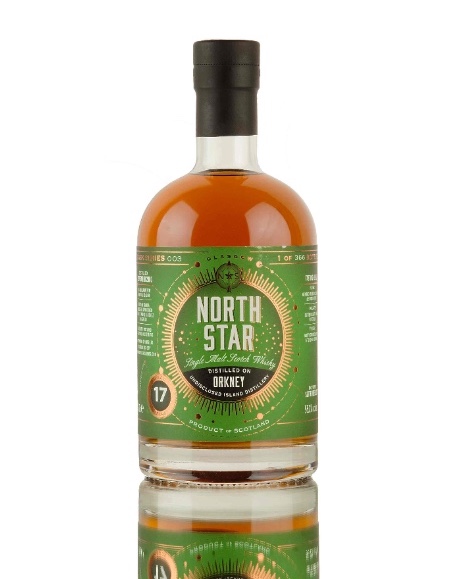
An exciting new release from North Star Spirits, distilled September 2000 at an undisclosed distillery on the Isle of Orkney, matured for 17 years and finished in a ex Pedro Ximénez sherry hogshead. Only 366 bottles of this single malt Scotch whisky were bottled September 2017 at 55.2% vol.

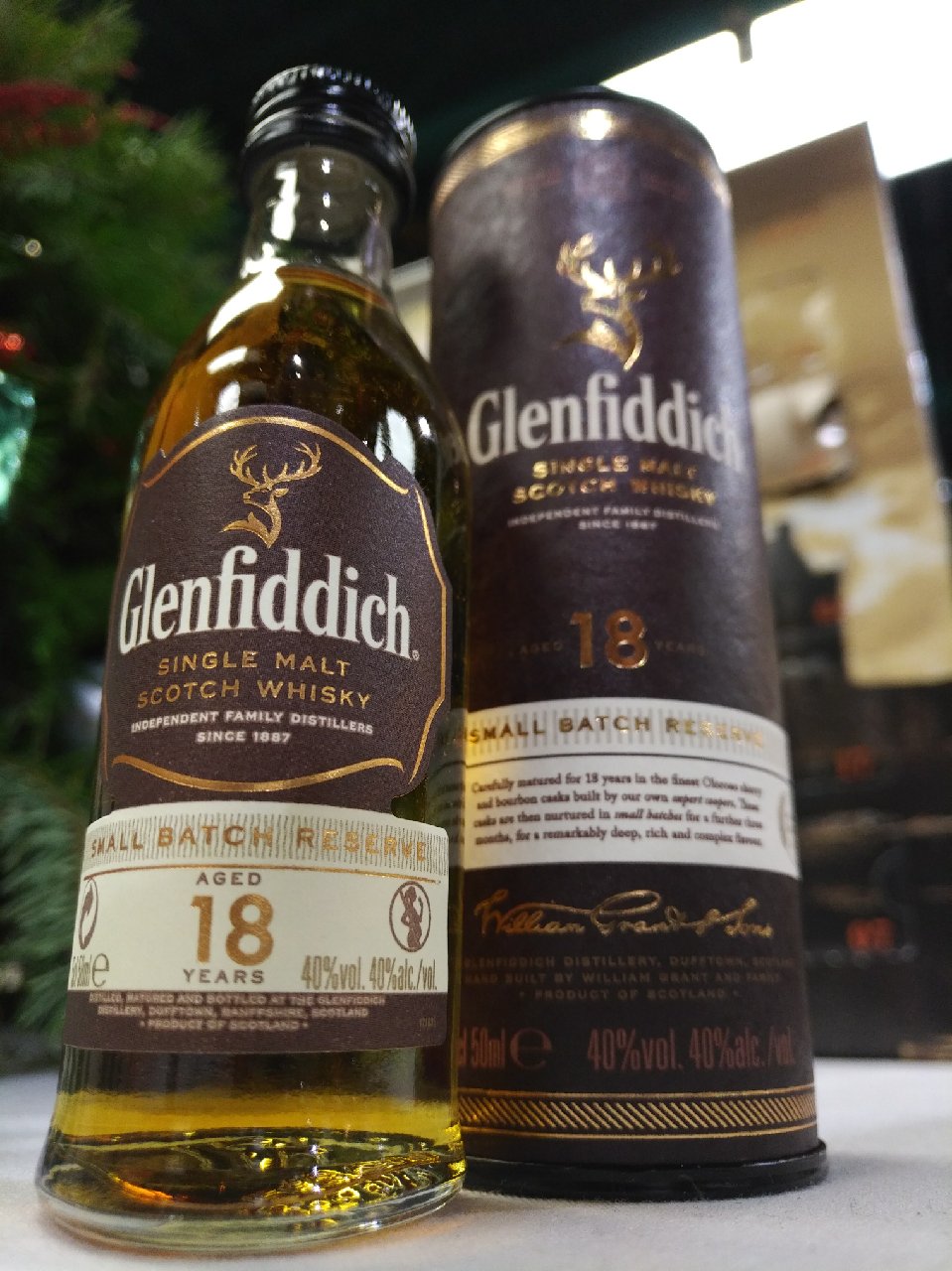
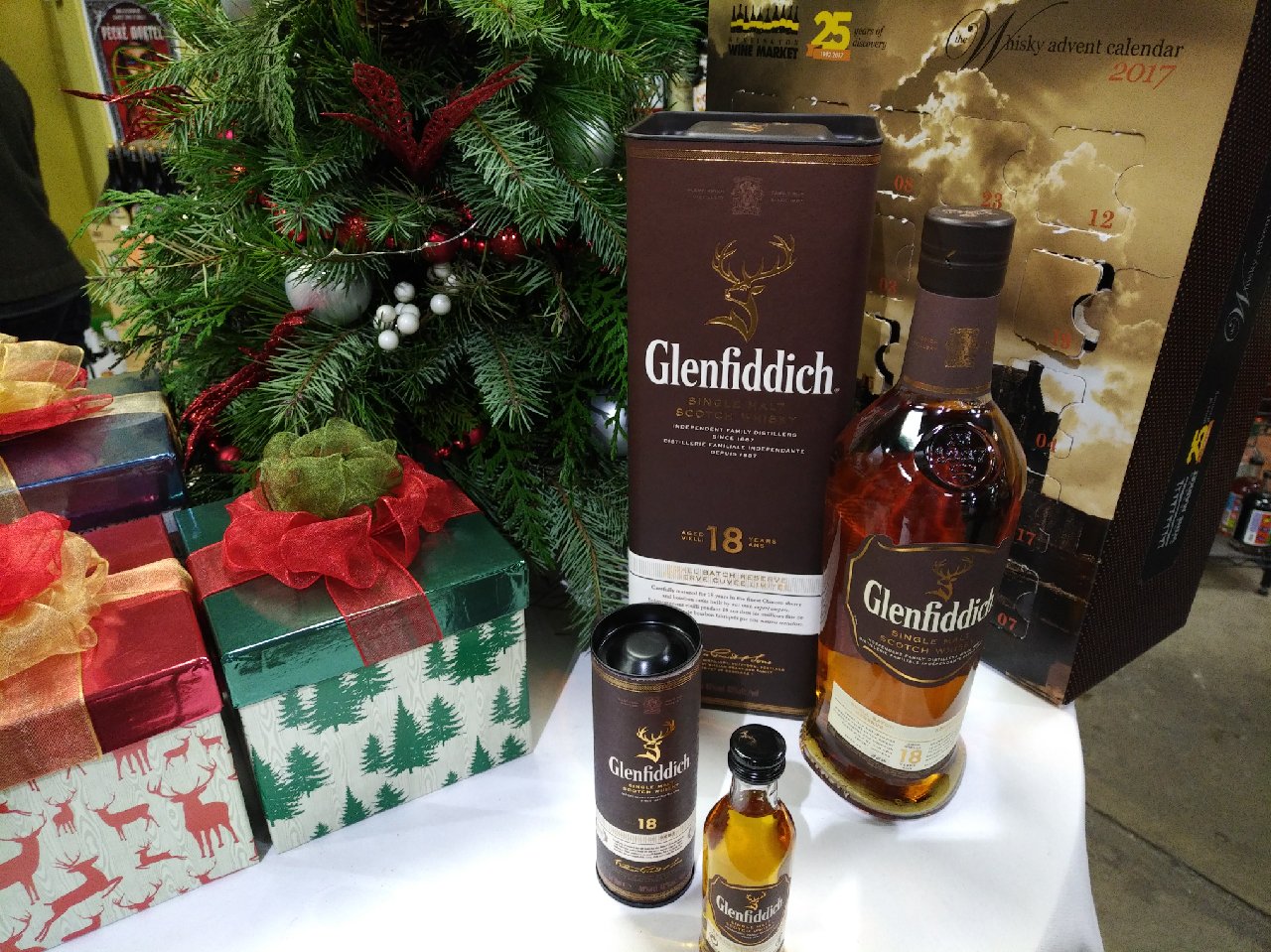
KWM Whisky Advent 2017 Day 22 – Glenfiddich 18 Year
For the second time in the 2017 Whisky Advent Calendar we are featuring a distillery bottled Glenfiddich, and we are excited to do so, because revisiting the Glenfiddich 18 Year is a little like reconnecting with an old friend. While some things changes, others standfast and hold true. The family owned firm of William Grant & Sons, parent company of Glenfiddich and Balvenie distilleries is a good example of this, as their 6th generation starts to get involved in the business.
In some ways it is remarkable that the firm is still family owned and going strong. In 1953 William Grant Gordon, the 3rd generation of owners, passed away, bequeathing the firm to his sons. Charles and Sandy were young, 26 and 22 years of age at the time. Many a business might have suffered from such a loss, but William Grants was in safe hands. Charles continued to grow the Blended Scotch whisky side of the business and built the firms grain distillery, Girvan in 1963. A malt distillery was run at the facility from 1968 to 1965, called Ladyburn. In 2007 William Grants opened a new malt distillery on the site called Ailsa Bay.
The other son, Sandy, is the one credited with taking Glenfiddich single malt global. The firm heavily promoted their product in print and on television. They sold an impressive 4,000 cases in their first year, a figure that grew to 174,000 cases in just a decade. Glenfiddich has been the World’s bestselling single malt whisky, with the exception of 2014, when for a year Glenlivet took that honour. Demand for the distillery’s single malt is continuing to grow today. The distillery currently produces a little over $13 million litres of spirit a year, but this figure is set to sky rocket with a whole new production site set to open!
Glenfiddich 18 Year– 40% – Oloroso Sherry & Ex-Bourbon – Andrew’s Tasting Note: “Nose: creamy and tropical, treacle sauce and maple butter; melons, mango and papaya; chocolate shavings and cinnamon dusted on top of a foamy cappuccino. Palate: still creamy, tropical and fruity with maple syrup and more subtle treacle notes; more mango, papaya and flambéed banana; more dark chocolate shavings and cinnamon, soft leather and some salted caramel. Finish: long, coating and fruity. Comment: it is nice to revisit the old standbys and remind yourself how pleasant they can be.” – $153 for 750ml – or – $13for 50ml
How do you make the world’s peatiest whisky?
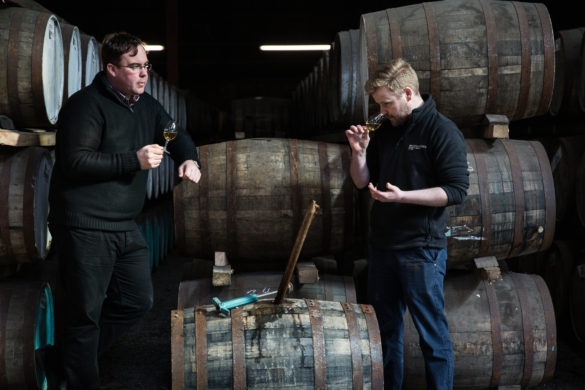
I recently spent some time with Bruichladdich’s production director Allan Logan, learning about how they make the fabled Octomore – including Octomore 8.3, the world’s peatiest whisky. Allan, part of the two-man team that took over the distillery when Jim McEwan retired, is exceptionally passionate about provenance and peating, as well as and making great whisky. Here’s what I learned from him about making a peat monster… don’t try this at home?
Distillery Manager Allan Logan and Head Distiller Adam Hannett
As humans, we’re pretty sensitive to peat and can detect its smoky, meaty, delicious presence at very low levels. But what we’re sensing isn’t actually peat – it’s the chemical compounds called phenols which are released when peat is burned. There are lots of different phenols, furthermore, each one creating slightly different flavours: everything from smoky, meaty guaiacol, to musty and medicinal o-cresol (if this were the beauty industry they’d all have funky names like superphenol or baconol+, but sadly we’re stuck with what we’ve got).
Phenol levels are measured in PPM – Phenolic Parts per Million. Somewhat confusingly, though, that number is measured from the malted barley (the stuff dried by the burning peat) and not the final spirit. So you’re not drinking 309ppm when you drink Octomore 8.3, but the barley the whisky was originally made with was peated to that level (don’t get me wrong though, it still tastes super peaty).
Why don’t they measure the PPM in the whisky? Allan explains: ‘it’s an industry standard to talk about phenol on the malt, not the spirit, because the latter changes and there are so many variables.’ Adding that even the barley measurements can be misleading, due to the fact that there are about six different methods of doing it, Allan also says that Bruichladdich has debated publishing the PPM of the whisky instead of, or perhaps alongside, the barley figure – something to look out for in future?
It’s no longer a case of burning whatever peat happens to be near the distillery because it’s a cheap and convenient source of fuel. Nowadays distillers can pick and choose their peat depending on the desired effect, because different types of peat – whether that be cuts from higher or lower in the peat layer, or from varying parts of the country – have different effects on the barley. If you’d like to read more about this, I recommend this great article on peat terroir by Dave Broom in online whisky magazine scotchwhisky.com
Ironically, Bruichladdich, which has a strong focus on provenance, has struggled to use local peat: ‘We’ve done some experiments with local peat on Islay,’ says Allan. ‘Wwe couldn’t get the PPM above 44. We did it in exactly the same way as we use the peat from Aberdeen and we just couldn’t get the same result.’
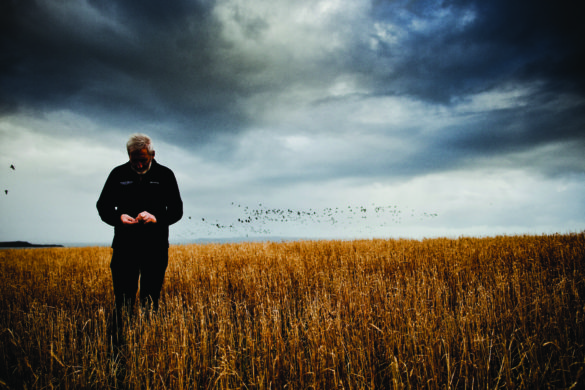
Once you’ve got your hands on some really peaty peat, you then have to get its phenols into your barley – which in the case of Octomore 8.3 comes from Islay’s Octomore farm, where it’s grown by James Brown, known to Bruichladdich as ‘the godfather of soil’.
Most distilleries and maltings – places that produce barley for whisky-making – use a traditional method: they burn the peat for around 25 hours then dry the barley with fan-driven hot air.
Bruichladdich, however, has worked closely with its maltings Bairds to evolve the process and make much peatier barley than can normally be produced. As Allan explains: ‘The secret of Octomore is that we’re basically cold-smoking it for five days. The trick is to get smoke not heat, if you heat the barley and dry the barley it eventually will not absorb any more phenolic content.’ They have developed two key techniques to achieve their aims: recycling the smoke so it passes more than once through the grain, and misting the grain with water so that more smoke can stick to it – but not enough so that it starts growing.
Despite this diligence and innovation, there is actually no way to know what the PPM value of the barley will be until the process is finished. ‘The PPM will change based on the time of year, the moisture of the peat, even how agile the guy stoking the fire is!’ says Allan.
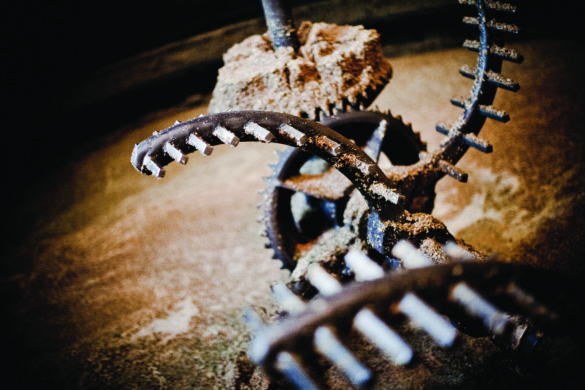
Having painstakingly put all the peat into the barley, the distiller now spends the rest of the process shaking it out. ‘You lose phenols during mashing, fermenting and distillation’ explains Allan. ‘Depending on how you distil you can lose anything between 60-80% of the original PPM, so when you’ve made your spirit you could find you’re anything like 80% less than you started with.’ Taking the back-of-a-napkin approach, this means that Octomore 8.3 could, in reality be as low as 61.8ppm – low being a relative term…
Bruichladdich isn’t, however, focused on making the peatiest-tasting whisky in the world. Allan and the team actually discard quite a large number of the chunkier phenols when they distil, by letting a larger-than-usual proportion of the spirit run into the ‘heads’ (the first, highest-alcohol portion of liquid which comes off the still, which is always redistilled). By sacrificing these phenols, Allan explains, they create a more balanced whisky that has more to offer than heavily robust smoke. ‘It’s more elegant, and we get the flavours of the distillery, the fermentation, the malted barley as well.’
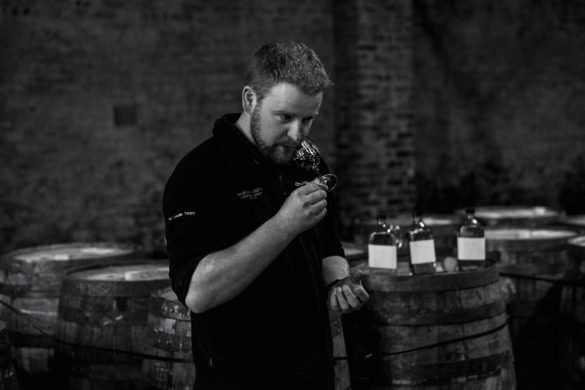
The Bruichladdich team chooses not to add water to Octomore before it’s barrelled, as Allan explains: ‘We want the whisky not to take on too much influence from the barrel in the early years; we want it to have the DNA of the spirit.’ In addition, Octomore is also always bottled at cask strength, because the oils are held together at higher strength and preserve the whisky’s flavours and nuances. As any Octomore drinker will tell you, as soon as you add water the phenols open up and it becomes much smokier – but the flavours also quickly disappear.
In a few short years Octomore’s whiskies have risen from the initial 80ppm to 309ppm. But is there an upper limit? There’s certainly no concrete number, but there are many barriers to further progress, including physical limits to how much barley can absorb.
For Bruichladdich, in any case, it is clear that its focus is on producing fine and enjoyable whiskies, rather than merely chasing numbers.