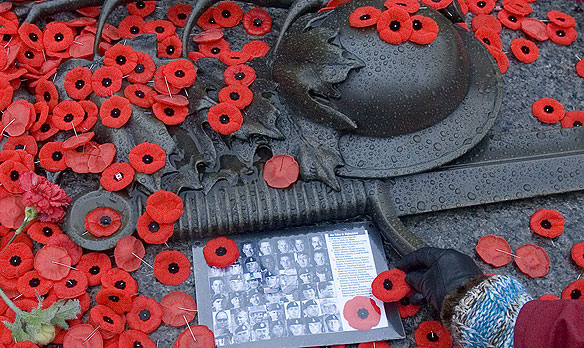
Remembrance Day: Lest we forget
November 11th, 2012


Whisky in Edinburgh
For all its artful science whisky making can be condensed into three words: – mature distilled beer. Well actually if we return to the first spirit produced in Scotland, probably accidentally when the condensed vapour of some boiling alcoholic mix was discovered to be curiously tingling on the tongue and mysteriously uplifting to our protagonist’s mood, the concept of maturing out the rough edges was yet to come. So essentially the primitive distiller would recognise the sights, tastes and aromas in a modern stillroom but the wider picture of a global beverage produced on a gigantic scale and treated as serious industry with state of the art technology would be beyond our ancestor’s ken.
So it is that the story of brewing and distilling in Scotland’s capital has evolved from near alchemical research through the preserve of the royal apothecary, a private past-time, the development of a true industry, the run away boom of Victorian years, the near fatal blows of greed, war and recession, then the eventual recovery years up to most recent times with the industry’s rationalisation and current healthy state if not centred, as it once was in the board rooms and bonds of Edinburgh and Leith but not always distant from ‘Auld Reekie’.
Travelling back in time distilling would have been the preserve of those powerful centres of study and science – the monasteries. At this stage the elixir would be used for its tonic like properties and not for its pleasurable qualities. As the practitioners found themselves looking for a role in the open community their skills at the alembic saw the dark art of the water of life more commonly enjoyed by the masses.
However for the capital the right to distil was bequeathed exclusively to the surgeon-barbers in 1505 as they were given “an associated monopoly of making and selling within the city” under King James IV’s reign. In this formative period of surgical development whisky would have been valuable as an anaesthetic.
Being a seat of crown and court as well as a centre of population Edinburgh naturally had a market for all sorts of alcoholic restorations, be it low strength beer to sanitise the water (Edinburgh‘s hard water was ideal for brewing pale ales, the first IPA being made at the Holyrood brewery), imported French wine or Dutch genievre or uisge beatha. In the time of the enlightenment there was heavy drinking on the High street, conspicuously by those of ‘high rank and official dignity‘. Much business was attended to in the taverns and oyster cellars found down closes off the Royal Mile with a deal being sealed over a draft or dram. Indeed so significant was the brewing industry in Edinburgh that it turned from a small scale seasonal winter employer to an activity within large breweries all year round. By the early twentieth century Edinburgh employed nearly half of all people in the trade. In 1900 there was an incredible 14 breweries in the Canongate area alone with a further ten in other parts of the city. Thirty years earlier it was said that the South back of the Canongate was more famous for breweries than any other street in the UK.
The common view of the smuggler being the reserve of highland hideaways can be contrasted with the urban scene. In 1777 there were 200 convictions for illicit distilling while an estimated 400 illegal operations compared to 8 licences. With ease of access to market through he warren of streets and closes and the tell tale smoke plumes being indistinguishable in the reek from a thousand lums Edinburgh truly was a hotbed of distilling dissent. For example in 1815 a still was discovered in and arch of South Bridge while another was discovered in the cellar of the Free Tron church. An earlier incident illustrates the popular feelings for smugglers. In 1736 two Fife smugglers were to be executed for stealing money from a Collector of Customs. Despite a near successful assisted break out from Edinburgh’s Tolbooth one of the pair eventually fled but his colleague had no such luck. The town magistrates ordered the City Guard under the command of one Captain Porteous to ensure the culprit was publicly hanged as an example of their attitude to disobedience. After the hanging in the Grassmarket the gathered crowd showed their dissatisfaction with such justice by stoning the soldiers, their Captain duly himself fired into the crowd and command his men to follow. Several in the crowd died as a result. However after trial Porteous himself was sentenced to death for his actions. At the final hour it was announced the execution was to be delayed, fearing a reprieval the mob saw to it that Porteous would not live, armed they overpowered the city guard and broke into the Tolbooth before carrying out their will. This was not the end of the matter as concerned by possible a Jacobite insurgence the parliament of London fined the city of Edinburgh and expelled its Lord Provost.
At all times the port of Leith (incorporated within the city of Edinburgh in 1929) played a critical role, contributing its worth as a centre of expertise in shipping, engineering, storage, bottling and latterly blending (not just of whisky but tea and coffee). During the 1880s Leith was Scotland’s premier port for handling grain. While earlier in 1822 six ports, including Leith, were allowed to store whisky under bond thanks to a shake up in the rules and regulations governing the strict control of production and excise. Some of the other ports – Glasgow, Aberdeen and Dundee also went on to become significant bases for blending. The relaxation of the monitoring of warehousing came at a time when changes in legislation sought to promote the legal trade and discourage illicit production. In the 1850s the rapidly expanding rail network saw shipment by sea and canal being replaced with this cheaper and quicker mode. It is no accident that the two greatest Edinburgh distilleries share their names with rail lines- North British and Caledonian. Leith station and the various goods yards were instrumental in the blossoming of the area as a storage and blending centre. At this time Lowland distillers greatly benefited from the ease and low cost at which locally sourced coal could be brought to them. The building of warehouses in Leith would secure the future development in related services such as administration, coopering and the transport infrastructure. Dilution and bottling under bond was permitted first in 1864 for export then for the domestic market in 1867. Having enjoyed customs free trade with France many Leith importers handled chateau bottled wines and cognacs. The familiarity and experience in dealing with the concept of a ‘brand’ was to be useful when blending became significant. Subsequently many merchants expanded their businesses to include this activity all the time underlining Leith’s role as the premier location for the industry and whisky’s significance as an employer. Further progress was made in 1863 when changes in the licensing laws allowed merchants to sell directly to the public. Ultimately however the problems associated with overcrowding and the dangers of such vast stores of flammable stock were eventually to persuade companies to withdraw their stores and related businesses to alternative sites purpose built on cheap land outside the city in modern facilities.
Further advances came in 1853 with Forbes-Mackenzie act which allowed the of vatting of duty unpaid stock, this meant casks from different vintages from a particular distillery could be combined. Early pioneers of the art of mixing, particularly Andrew Usher Jr. (b. 1.5.1826, d. 11.1898) of O.V.G. (Old Vatted Glenlivet) and James Sanderson (later to create VAT 69), developed skills of ironing out variations in the character of individual casks while augmenting quality through judicious use of stocks and created a consistent product. Being allowed to blend without first having to pay duty removed a great financial burden and permitted a more conducive flow of stock and cash from bond to market. One of twelve children Andrew Usher was born into an Edinburgh family of wine and spirit merchants and joined the company with his brother in 1845. His father, A. Usher Sr., had moved from the Borders to Edinburgh in 1813 and eventually became the agent for the Glenlivet distillery. He has been credited with the inaugural blend in 1860 although this is difficult to prove. It is from this date, thanks to William Gladstone’s Spirits Act, that the mixing of spirit from different distilleries was permitted under bond for the domestic market. Now the balancing of the traditional, expensive, variable and flavoursome malt whisky with the modern, light, cheap and consistent grain was possible. A year before the passing of the Spirits Act Andrew Jr. purchased the Sciennes distillery in order to guarantee stocks of malt for blending and swapping within the trade. His success was apparent: his warehousing of the 1870s and 1880s were amongst the largest maturation stores in the world. It was around this period when Ushers pioneered whisky exports to Japan. Another of his legacies is the Usher Hall on Lothian Road. He left £100,000 (approximately £30M today) to build a music hall for the citizens of Edinburgh. Work started in July of 1911 on the hall which could accommodate an audience of 3000. Another of his accomplishments was the co-founding with John Crabbie and William sanderson of the North British grain distillery in the 1880s and was indeed its first chairman. Continuing the family involvement in the drinks industry his sons became brewers in the city’s Merchant Street. The philanthropic ideal was also a trait- Edinburgh university’s John Usher Institute of Public Health was initiated in 1902 thanks to the Andrew Jr.‘s brother generosity.
One of the darkest hour for both Scotch whisky and Leith came in 1898 with the collapse of Pattison company. The 1890s whisky boom can be put in perspective quite simply: in 1991/92 there were 2 million gallons of warehoused whisky, by 98/99 that figure had swollen to 13.5 million. So great was the demand for blended whisky production and investment continued to rise year after year. The public bought shares in new and expanding companies as the drink soared in popularity. Unfortunately buoyed by seemingly endless optimism some companies over stretched sound business principles and the temptation to keep increasing stocks ultimately led to over provision. The worst case was that of the Pattison brothers. Thanks to the company’s value being based on a fraudulent balance sheet and much credit being raised on over-valued assets the publicly limited business (Pattison’s Ltd.) was found to have assets only worth half of liabilities. The brothers were found guilty of fraud and imprisoned. The effect was to ruin many investors and undermine many more’s confidence in the industry. Many companies felt serious financial repercussions and some distilleries were forced to close. The speculator’s bubble was burst and the industry would not return to the pre-bust levels for fifty years. Pattison’s opulent offices can still be seen on Commercial street in Leith and are currently used as a restaurant.
Historically there were very many companies involved in the whisky industry which could call Edinburgh home. Mostly small businesses as time passed most either folded or were consumed by larger concerns. Of the more significant examples are names still familiar today like Ballantines. George Ballantine’s first premises was in the Cowgate although his business moved to Candle Maker Row in 1831 when he was 23 years old before shifting five years later to an address on South Bridge. The company owned a retail outlet on Princes street between 1895 and 1938. However not all companies chose Edinburgh as their base. For example the significant businesses of Buchanan-Dewar and John Walker decided registering their offices in London was a move more likely to impress investors.
However the most significant address of all was 14 Torphicen Street home to the ‘Leviathan’ that was Distillers Company Limited, (DCL). Starting trading on the first of May 1877 the company had its roots in a various initial attempts by grain whisky producers to share production and sales in such a way as to avoid unhealthy competition. The business was to grow in influence to the point it became the fourth largest firm in the country. The merger between six of the most significant Lowland grain distillers was eventually to include the major blending firms: Haig, Dewars, Buchanans, Johhnie Walker and latterly White Horse whose ancestry dates from 1650 – the Burgess of the Canongate owned a house which stayed in the Mackie family until 1919 and gives its name to the famous brand. By 1930 the company owned one third of all working distilleries in Scotland as well as most of the major brands. The business expanded and diversified to become the biggest in the industry. Chairman Henry Ross was a strong influence as he guided the company and acted as a pilot through good times and bad. He donated the Ross bandstand in the Princes street gardens to the city and it is with some irony that the stage has been used to host temperance meetings. Today the company has evolved into what is the world’s biggest drinks company- Diageo.
Other businesses in Edinburgh associated with whisky include: The Scotch Whisky Association (SWA), currently (2012) celebrating its centenary the organisation represents the majority of companies within the industry and represents the interest of its members at home and overseas. Originally The Edinburgh and Leith Wholesale and Spirit Association the group evolved first into the Scottish section of the Whisky Association then finally the SWA in 1942. The Scotch Whisky Research Institute at Riccarton takes a scientific approach to the understanding of how whisky is made. Close by Heriot Watt University offers a world renowned degree course in Brewing and distilling. Amongst the many retail outlets both on and off licensed are Scotland’s oldest independent bottler – Cadenheads, The Scotch Malt Whisky Society and The Scotch Whisky Experience visitor centre.
THE DISTILLERIES
Caledonian (originally and briefly called ‘Edinburgh) 1855 – 1988. Commissioned by three partners as a grain distillery malt whisky was also produced here in the 1890s. Graham Menzies left his Sunbury distillery when it proved too small for his needs. Buying out his two business associates he became sole owner in 1880. In 1884 the company merged with DCL. Nearly 6M litres of spirit was lost in 1940 after being hit by a bomb. Today the distinctively tall still house (it housed the largest Coffey still in Europe) remains as private housing as well as several other buildings such as warehousing facades, malting floors and a probable boiler house. Most obvious is the listed chimney stack. Across from the Haymarket station the site was substantial being as it was the second biggest facility of its day. The distillery was finally closed in 1988 and was partially demolished in 1997.
Canonmills 1780 – 1840 Built by James Haig who was sequestrated in 1788 after trade restrictions virtually cut off the main (English) market for the product which would likely have been rectified into gin in London. It was subsequently, in 1790, taken over by one of the great distilling families- the Steins. Relations between the Steins and Haigs were good and so in 1825 the distillery returned to the original fold but was finally closed in 1840. Latterly the maltings were used by a brewery. Demolished in the 1970 to allow building of contemporary housing the site is at Glenogle road by the Water of Leith adjacent to the Colonies district. In June 1784 at a time of widespread famine in Scotland Canonmills was mobbed by hungry crowds hoping to liberate an imagined store of grain and vegetables. Soldiers were required to defend the distillery, two ringleaders were punished by public whipping and transportation. Distillers were subsequently praised for their contribution to farming, the nation’s revenue and the general welfare of the populace in an attempt to enlighten the masses to the contribution to the greater good of the trade and the protection of their business.
Craigentinny distillery became bankrupt in 1794.
Croftanrigh (Also Abbeyhill) 1820 – 1852. The original owner went bust in 1823. Distilling to not recommence until 1846 after a continuous still was installed. The buildings were later used by St Ann’s brewery and are currently employed by Historic Scotland as a works facility for Edinburgh castle. The malting floors and pagoda topped kiln are externally perfectly preserved. Originally the name was ‘Croftangry’ but was spuriously changes to ‘Croftanrigh’ (‘house of the king’) to suit the regal neighbourhood.
Dean 1881 – 1922. Converted from a flour mill the distillery occupied a cramped location on the Water of Leith barely 100 yards downstream from the Sunbury distillery. After several changes of ownership the distillery suffered a common fate in that it was acquired and shut down by SMD (DCL) in the post WW1 era. Today on the north bank of the river two very early 19th century mill buildings are now converted into residences. These buildings were employed probably as malting floors and grain stores when Dean was operational. Across from these elegant solid structures the remaining parts of the facility are used as offices and as such their original purpose is difficult to identify.
Edinburgh distillery (also known as ‘Newington’, ‘West Sciennes’ and ‘Glen Sciennes’) was converted from a brewery in 1849 by Alexander Pearson. He was sequestered in 1850 and the distillery was acquired by Thomas Duncanson & Co. in 1851 who also failed 5 years later. Come 1859 it was purchased by A. Usher & Co. Usher sold to Scotch Malt Distillers (SMD) in 1919 via the DCL subsidiary J. & G. Stewart, from this point the brand O.V.G. featured ‘J. & G. Stewart’ on the bottle label. The distilleries final closure came in 1925. The granaries, maltings and warehousing were at the colossal St. Leonard’s complex adjacent to the North British railway. Little if anything is now left of Sciennes the buildings being demolished in the 1980s and replaced with flats. The distillery was located at the very end of the meadows towards West Preston street.
Edinburgh distillery (formerly known as Sunbury until 1851) Est. circa 1813 by James Haig was probably the biggest distillery of its day utilising 6 stills. A Coffey still was licensed 4.1.1849 by Graham Menzies & Co. whom took a share in the business in the mid 1830s. After building the nearby and vast Caledonian distillery in 1855 Menzies, who had bought out the Haigs, passed the distillery on to the Steins The company was dissolved in the late 1850s. Visiting the site today there remains a warehouse once again converted to homes as well as a mews of similarly red brick buildings perhaps previously stores work houses and offices associated with the distillery. The location of the site is downstream in the lee of Belford bridge by the Water of Leith very close to the remains of Dean distillery.
Leith distillery (AKA Bonnington) 1798 – 1853 purchased by John Haig in 1804. Converted from malt production in 1835 Bonnington was one of the first distilleries to house a Coffey still. The substantial works occupied an area between the Water of Leith and Bonnington road. Perhaps latterly employed as a sugar refinery there remains a substantial brick built bond converted to offices and flats.
Lochrin 1780 – 1860 was set up by John Haig thanks to financial assistance from his uncle James Stein the owner of Kilbagie distillery, the largest of its day. After two occasions of bankruptcy (1788 and 1810) the distillery finally left the family fold when sold to the owner of Glasgow’s Loch Katrine Adelphi distillery in 1848 and was eventually closed in 1860. The site was at the Lochrin basin at the end of the Union canal.
North British. Commissioned in 1885 by a consortium of merchants in a co-operative format the distillery is the last in Edinburgh and is still, uniquely, joint owned. It is located behind the Heart of Midlothian football stadium in the Gorgie area of town and first produced spirit in September 1887.
Yardheads, (AKA Lochend and Leith) Est. by Alexander Law in 1824, failed in 1829 due to financial strain related to credit difficulties, all told the distillery had six different owners in its 60 year history. Closed in 1884 it occupied a site now home to Leith’s ‘Banana flats’. On Great Junction street former warehouses of Crabbies still stand and are currently residences.
Other distilleries appear to have existed on the outskirts of Edinburgh including: at Balerno, Musselburgh (Fisherrow), Dalkeith, South Queensferry (Dundas Castle/Glen Forth). Within the city Canongate and Coltbridge distilleries require further research to properly include on a definitive list. And of course Glen Kinchie near Pencaitland in East Lothian.
Further reading:- The Scottish Whisky Distilleries by Misako Udo, Scotch Missed – The Lost Distilleries of Scotland by Brian Townsend, The Whisky Distilleries of The United Kingdom by Alfred Barnard
“All the cold restraints of sobriety being gradually thawed by the sun of festive cheer”
“Intemperance was the rule to such a degree that exception could hardy be said to exist”
“Unrestrained scope was given to the delights of the table”
“And thou, great god of Aqua Vitae!
Wha sways the empire of this city,
When fou we’re sometimes capernoity,
Be thou prepar’d
To hedge us frae that black banditti,
The city-Guard.
‘capernoity’ – bad tempered
“Let mirth abound, let social cheer invest the dawning of the year” Robert Fergusson 1750-74
Of the women of the Canon gate :- “sly drinkers, taking on debt, dressing by instalments, deceiving their husbands and many of their offspring are rickety ill bred brats”

Mark Davidson…
Of a distinguished Banff 1968 vintage Mark Davidson has a short but full body and so marries well (& subsequently producing two limited editions), frequently seen at whisky fairs in Scotland yet curiously difficult to find outside his domestic market it is hoped his inaugural launch on the Canadian scene will be well received. He is at home in independant bottling circles being most commonly found in the William Cadenhead livery where he has enjoyed a 13 year finishing period, however as a stand alone single expression under the Jolly Toper brand he can come into his own while being a fine mixer.

As you may have noticed Whisky Intelligence was absent for a few days; the servers that host our files suffered a massive failure and it took the wee robots nearly 48 long hours to find the problem and repair it.
Now it’s catch up time!
Milk or Whisky? Austria’s First Distillery Waldviertler Roggenhof by Ernie – Ernst J. Scheiner, The Gateway to Distilleries
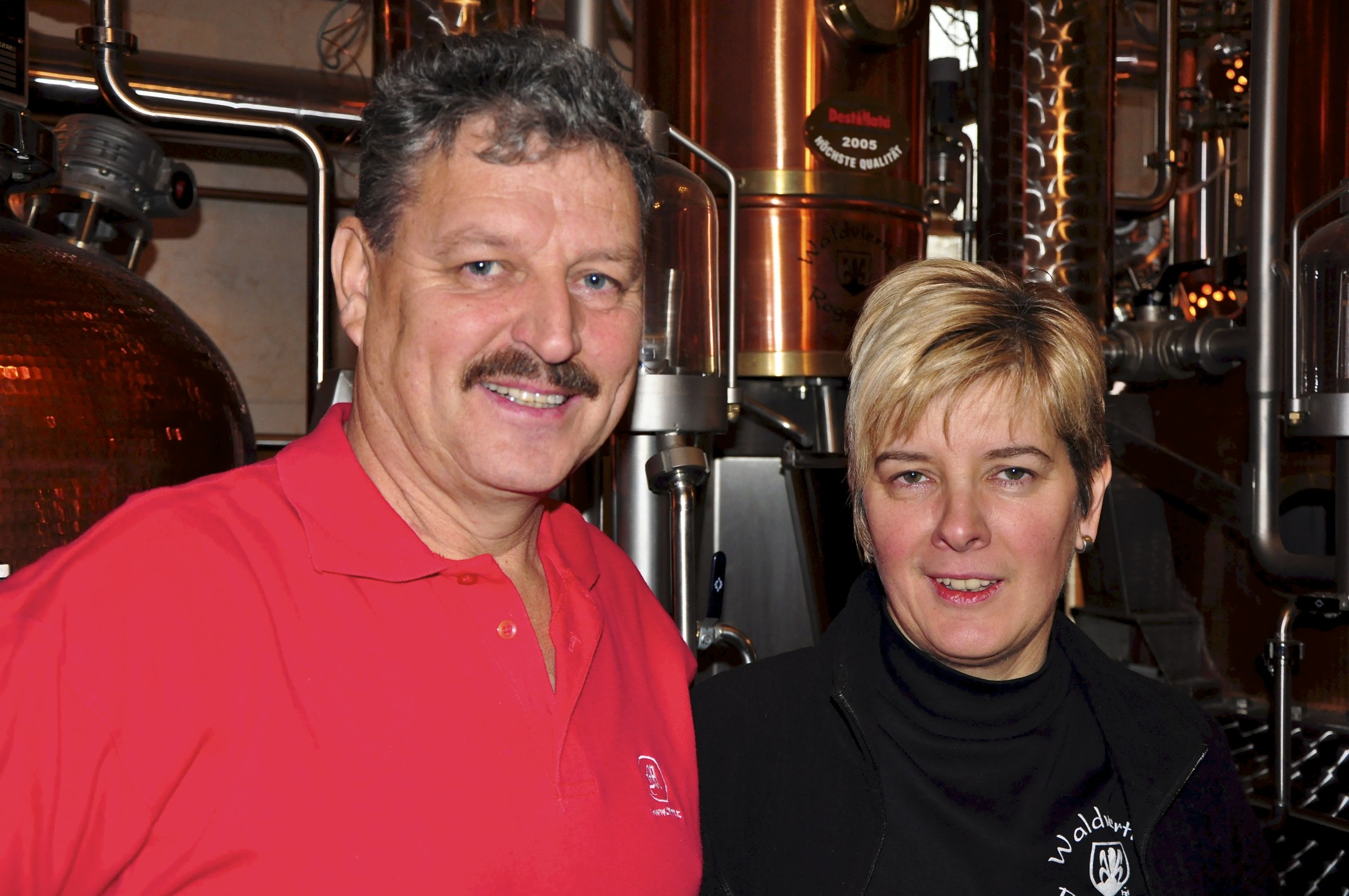
To be or not to be, that is the question? Johann Haider worked in the vibrant Austrian capital Vienna when he inherited his father’s dairy farm in 1990. He and his wife Monika moved back to a very remote and hilly countryside which lies between southern Czechia and north of the Danube River, about 120km west of Vienna. They changed from an urban way of life to a farmer’s life in the middle of nowhere. The region which is called Waldviertel (literally translated forrest quarter) is reowned in Austria for its remoteness, its legends and fairy stories. There is some resemblence to Scotland’s landscape and mythology. The exposed border situation resulted in many fortified castles. When driving to the distillery the narrow roads meander uphill through thick woods, sometimes with open meadows dotted by dairy cattle. The climate resembles Scottish weather, rain in spring and some sunshine in summer.
What a change! From milk to whisky! From a metropolis of culture back to country roots with its traditional folklore and quiet Sunday life: a village with eighty inhabitants. Right from their return it had been quite clear that the Haider Family could not live from dairy farming alone. The farm was just to small and an immense investment was needed to modernize production facilities. They even faced a financial crisis when Austria joined the EU in 1995. “We were just not able to make a living from farming, we were forced to develop new ideas.” recalls Johann Haider. As farm distillation of Schnaps – a white spirit from apples, pears or rye – has a long tradition in the area of Roggenreith and the Waldviertel, the new idea became real. A television-documentary about Scotland promoted the new project. Let’s distil whisky, tells Monika Haider, “why shouldn’t we distil rye, which we are still growing on our farm?” Whisky from cattle feed, that seemed to be the solution. Thought and done, the Haiders started a new distillery producing rye whisky in 1995. Learning by doing was the basis of their future success. Three years later the media, television, radio and press made the first Austrian Whisky Distillery known to a wider public in Austria. Journalists, among them Jim Murray, flocked in and thereby promoted the Haider business. Dairy Farming was abandoned. Whisky replaced milk.
What a huge success! Nobody knew then, that thousands of coaches and cars would drive along the narrow roads to Roggenreith. In 2011 about 79.000 visitors learned the story of whisky distillation (The Glenlivet Distillery counted 42.000). The once fancy idea changed into a most impressive Whisky World where visitors experience the production of whisky. They smell the aromas of malt, feel the heat of the stills and taste Rye Single Malt. The Waldviertler Roggenhof Whisky Erlebniswelt became a major employer in the area and a prime highly graded tourist attraction of Austria. The film From Fields to Whisky Tumbler introduces with empathy the world of whisky making to the visitor. The unexpected became real. Major investment set the pace. Expansion took place. The dairy farm with its small distillery has changed to a most professional World of Whisky Experience with cinema, warehouses, tasting rooms, restaurant and a Celtic Fire and Water Garden in 2012. And above all, a new helicopter landing, which was opened in June, makes the Austrian distillery absolutely unique in the whisky industry. A wonderful 7.000 m2 Celtic Garden teaches the understanding of the Celtic Year and the importance of flora and fauna to the ancient Celts who once lived in the area. The visitor feels the elements of nature and studies their symbolic features. A Druid’s playground welcomes the children. On May 1st the Beltane, the Festival of the Mother Earth, is celebrated as well as Summer Solistice (September), Autumn Equinox (November) and Winter Solistice (December). We just live whisky, says Monika Haider. During festival days hundreds of people flock in to share ideas of Celtic tradition and lifestyle…and they enjoy the water of life. In September 2012 a new comfortable tasting lounge will be specially opened for the whisky enthusiasts to appreciate the Waldviertler whiskies.
Let’s distil rye! The village of Roggenreith (820m above sea level) is as lonely as some areas of the Highlands of Scotland. It has been famous for the good quality of its rye, hence its place name is derived from ,Roggen‘ (=rye). “Yes, it’s a very ideal place for distilling whisky, about 30 % of the rye requirements are produced on our own land, the production water comes from a nearby spring and is excellent,” explains the Master Distiller Johann Haider. The malt is produced locally by the malster Plohberger of Grieskirchen and is specially roasted between 95 degree Celcius and at 110 degree Celcius “This roasting of the malt generates intense malty flavours of toffee or nougat in our whisky.” Today, about one million litres of whisky mature in three modern racked warehouses, the temperature is moderate in summer and very cold in winter. “Usually, there is a 2% Angels’ share, but strangely in some of our casks the water evaporates faster than the alcohol with the effect of higher concentration of alcohol,” reports the farmer-distiller. This loss is obviously owed to the dry micro climate of the warehouses in summer where small fountains are installed to moisturise the maturation atmosphere.
State-of-the-Art Production! A Gruber hammer malt mill grinds the malt into grist which is kept in wooden boxes. There are two 6.000 litre mash tuns which were manufactured by Speidel Tank- und Behälterbau GmbH, Ofterdingen in Germany. The Roggenreith mash tun is a very simple lauter tun, one part of grist meets four parts of water. Slow stirring is done by a single propeller like agitator. The production of wort is rather unique at Roggenreith. The mash tuns function also as fermenters. There is no underback to recover the drained worts or sugary liquids. The mash, the draff and the wort are not separated but kept together, both are cooled down to 28 degree C and then yeast is added to the mixture. The fermentation period is 75 hours. The yeast quality is pressed Reinzuchthefe, which is some sort of brewer’s yeast. “Our first mash was made of 60% rye and 40% barley malt.”
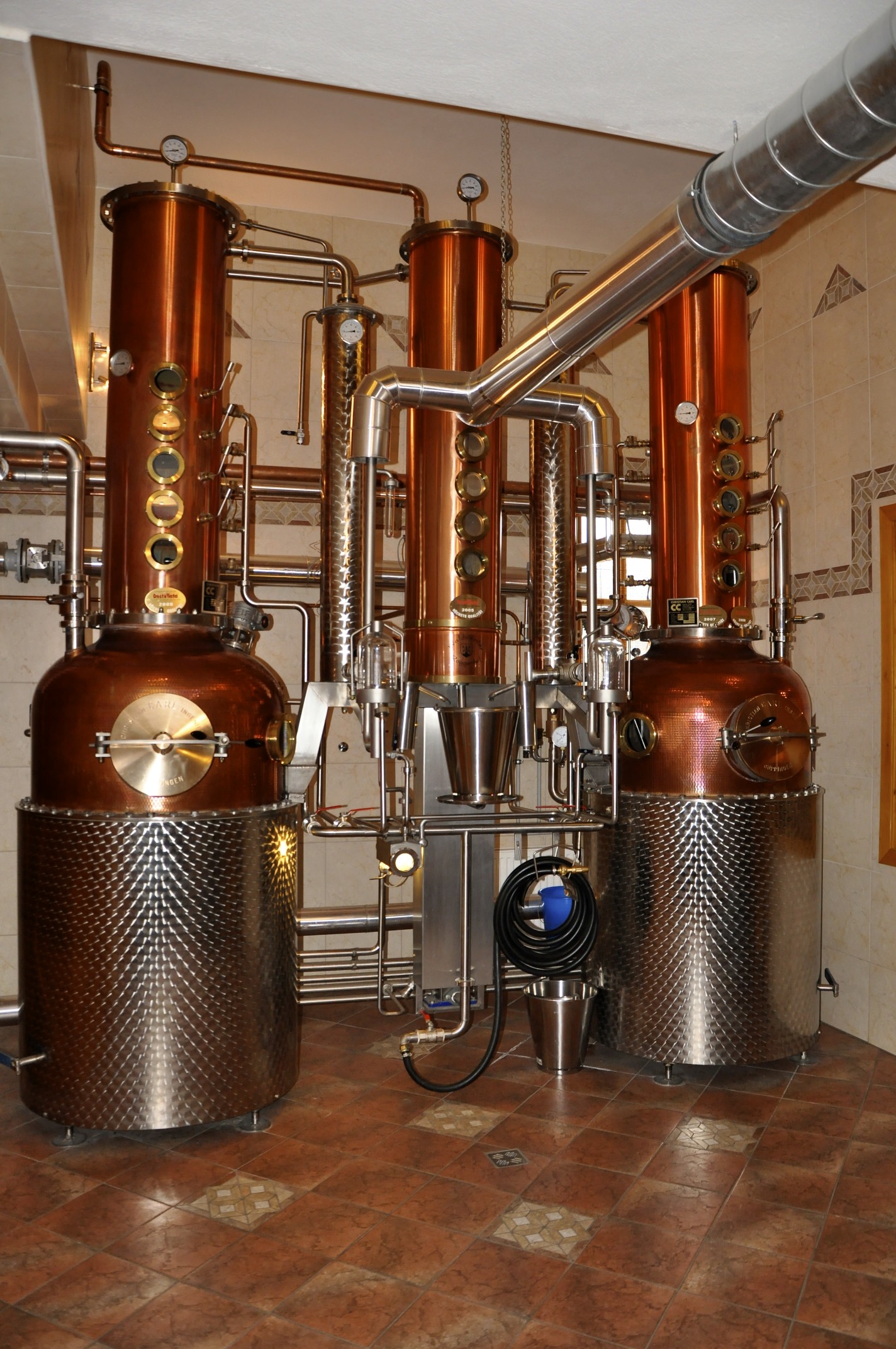
“Our spirit is very, very clean! Our still room is a real surprise. The distillation equipment was supplied by the German manufacturer Christian Carl. It is perfect German craftsmanship, we use only the best material, they are the Rolls Royce of the distilling industry,” states Johann Haider proudly. The two stills are a mix of traditional pot stills and column stills. There is a boil pot with a column on top of it. This exceptional piece of technology allows a continuous process of distilling with steam. “The right distillation pressure is vital for the quality of the spirit” describes the stills operator the process, the exact temperature level is also vital. Within the column five aroma plates make for more and longer copper contact and enrichment of the spirit. These plates allow a very precise cut, foreshot, middle cut and feints can be cut absolutely precisely. The character of the spirit is very pure and clean, sulphury compounds were retained by the unorganic catalysor copper. The copper plates in the column are very special, unique and have been patented by CARL Distilleries and Artisan Distillery Systems. They have little holes and make it very hard for the alcohol vapours to reach the Geistrohr or lyne arm at the top. There is no spirit safe like in Scottish distilleries. “Testing of the middle cut point is just done by my nose,” says the Master Distiller. The spirit is usually produced by quadruple fractional distillation. 10.000 litres of mash result in about 1.200 litres of new make spirit. Austrian distilling laws are very strict and tight. The excise officer seals every access to any spirit, every step of production is monitored, every step of distillation process has to be documented in a diary by the distiller as excise control takes place at the distillery at least once a month. Sometimes by surprise! Roggenreith Distillery is very uniqiue regarding its distilling process. The mash, i.e. the draff and the wort are distilled together, therefore it has to be stirred to prevent baking in the boil pot when distilling. Thus temperature control is very tight although the Roggenreith wash is heated externally by hot boiling water. “We are able to separate precisely the foreshots, the methyl alcohol, the middle cut, the ethyl alcohol, and the feints. We produce perfect quality” says Johann Haider. The foreshot run of only two litres alcohols takes about 10 minutes, the cut point is defined by nosing. Toxins are more efficiently separated in one single distillation process, and the flavours are preserved. The heart of the run is very slow and results in about 300 litres. The spirit run is four to five hours hours, the middle cut goes directly into eleven 525 litre excise sealed receivers where thestillman has no right of access. The cut points are from 90 % to 80 % A.B.V. During the fourth distillation water has to be added to the boil pot. The foreshot pipe leads into a special individual receiver. The strong foreshots are not recycled or redistilled as in Scottish distilleries, the undesired compounds and alcohols are pure waste and will be completely disposed. About 25% of the run is waste and is treated in a neighbour‘s biomass reactor. The feints also go into four special receiver tanks, and again they are not redistilled as in Scotland, like the foreshos they are also treated in a biomass reactor. Austrian distilling tradition just keeps the heart of the run.
Austrian oak makes for good whisky! The spirit matures in about 500 casks in three racked warehouses. The casks are made of oak from the region. The famous Manhartsberger Summer oak is dried and set up by local coopers. Traditionally the Summer or Sessile oak is also used for making 224 litre! wine casks which are used in the famous Austrian Wachau wine region. Austrian traditional messure for a cask is four Eimer at 56 litres each, which is a total of 224 litres. However, the whisky cask are heavily charred at the cooperage Schneckenleitner just like Aligator skin. The first fill juvenile barrique type of casks generate a strong vanilla flavour and a deep golden colour in the whisky. The cask filling strength is 60% A.B.V. and the spirit is dilluted by natural local spring water. After three years of maturation the whisky is bottled at 41% A.B.V. The spirit filled in second-fill casks matures for five to six years. Third time fillings may be kept for 12 up to 18 years. Thereafter the casks will be totally rejuvenated, explains Monica Haider. Some of the whiskies mature in toasted wine casks from famous Austrian winemakers like Schloss Gobelsberg, Paul Jurtschitsch, Willi Bründelmayer and Thomas Leithner. Special single casks bottlings are also released which contain 50 to 60% A.B.V. Selectionen-bottlings contain 46% A.B.V. The whisky is bottled at natural colour, non-chillfiltered and reduced by natural spring water with a hardness range of 1 (soft). Before bottling the reduced whisky matures for another period in casks to marry water and spirit. Vintage bottles are also released at cask strength. A wide range of whiskies is on offer: single malt, single rye or a Waldviertler which is distilled from 60% malted rye and 40% malted barley. The Northern Dream a mix of rye whisky with honey, fruit and herbes pleases the tongue. 80 % of the annual production of 25.000 litres are sold directly to the visitor of the Whisky Erlebniswelt Waldviertler Roggenhof. The rye whisky enthusiast Jim Murray was full of praise of the Waldviertler Pure Rye Malt: “Some of the most beautifully made whisky I have come across for a little while.”
The Gateway to Distillery Tasting Notes.
Waldviertler Pure Rye Malt, six years old, 41% A.B.V., non-cloured, non-chillfiltered.
Colour golden Nose honey, fresh, ripe plums Palate nice and wonderful sweetness with some maltiness and hints of honey. A perfect unique whisky made of 100% rye malt, there is complete harmony between nose and palate. Very surprising and long lasting mouthfeel.
Waldviertler Special Peated Single Rye Malt, four years old, 46% A.B.V., no age statement, non-cloured, non-chillfiltered. Limited bottling.
Colour dark golden, amber. Nose pungent, some varnishing, rubber, hints of tobacco smoke, hints of medicine and chemistry, opens up and gets better after leaving it untouched for a while in the glass. Palate nice caramel notes, vanilla, dry finishing, long mouthfeel, hints of sweet chocolate and nougat, some smoked bacon.
The first peated rye whisky in the world was released by Johann Haider in September 2011. The spirit matured in Austrian barriques (224 litres) which were made of Manhartsberger Summer oak. The toasted casks previously contained Grauburgunder (Pinot Gris) from the organic wine producer Fred Loimer of Langenlois, Kamptal. The spirit was distilled from dark roasted malt which was peated after it had arrived at the distillery. The peat was from Roggenreith’s woods. The four year old whisky of four casks was bottled for the first release in September 2011. Some more years of maturation would have done better and taken away the pungent aroma notes which are not in full harmony with the complex taste. It is a whisky of character which convinces after a few drams. The longer it stays in the glas the better the peated Waldviertler whisky gets. Magic!
Waldviertler Roggenhof, Destillerie J. Haider www.roggenhof.at
About the Author: Ernie – Ernst J. Scheiner was a manager in an adult education centre and teaches “Germans how to drink whisky.” Ernie offers courses on whisky distilling and writes for newspapers and magazines in Germany.
He is the editor of The Gateway to Distilleries at www.whisky-distilleries.net which gives an excellent insight to the whisky industry.
All photographs and text Copyright Ernst J. Scheiner, 2012. Kindly donated to Angels Whisky Club. This article is published on Whisky Intelligence at the request of the Angels Whisky Club.

With this small B&W article/post www.whiskyintelligence.com has achieved a milestone of 5,000 articles/posts dedicated to all types of whisk(ey) since the launch in 2009. Whisky Intelligence would like to take this opportunity to extend a sincere thank you to everybody who has contirbuted, encouraged, read, commented and supported this effort since inception. Work continues apace on the next 5,000 articles & posts…
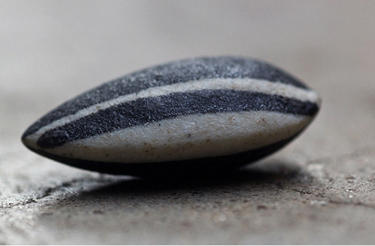
Art thieves steal one of the 8,000,000 porcelain sunflower seeds
Police are on the lookout for art thieves who broke into Tate Modern in the early hours of yesterday morning and made off with a single porcelain sunflower seed, one of the eight million that form part of an installation recently acquired from the contemporary…please click on the link below to read the remainder of the article….
Whisky Intelligence didn’t have a suitable April Fools Spoof but this will do nicely!
Whisky Intelligence is celebrating Christmas with family, friends, a few drams and would like to take the opportunity to wish the myriad of Whisky Intelligence readers a Merry Christmas and may all your drams come true! Whisky Intelligence will be back at full cask strength after Christmas and Boxing Day (depending on the availability of whisky news!).
Merry Christmas!