Canadian Whisky News by Davin de Kergommeaux – Canadian Whisky News

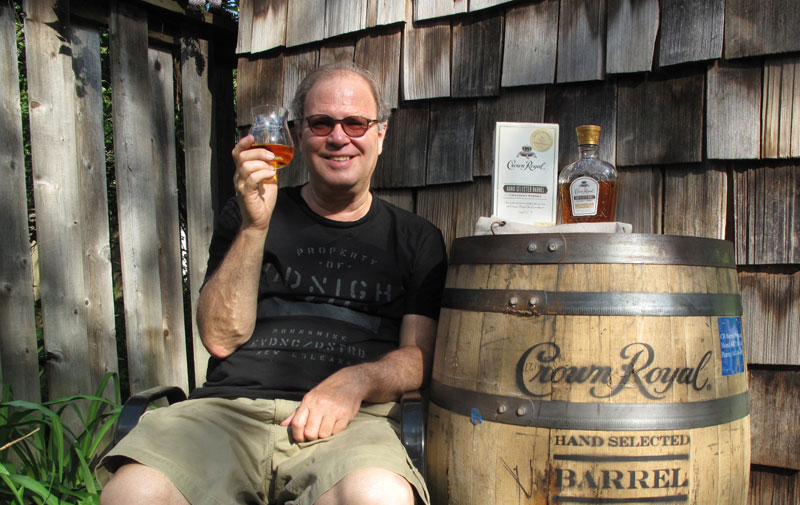
Crown Royal’s High-Proof Single Barrel Whisky
Connoisseurs Laud New Approach to Making Whisky
Growing interest in high-end Canadian whisky is prompting big changes in the styles of whisky going into the newest bottlings. Until recently, Canadian whisky has been considered a light mixer by many drinkers, and not the stuff to inspire connoisseurs.
However, that image is changing as richly flavourful bottlings, until now available only in Canada, join the better-known mixing whiskies and gain broader distribution outside their homeland.
More than that, on the prodding of hard-core whisky lovers, producers have begun to introduce new, robust bottlings that cater specifically to aficionados and connoisseurs. The latest, and one of the most innovative, comes from Crown Royal.
Yes, whisky lovers spoke and the makers of Canada’s best-selling whisky listened. A new version of Crown Royal currently rolling out across the US has two qualities rarely seen in Canadian whisky, and unheard of from a major distiller.
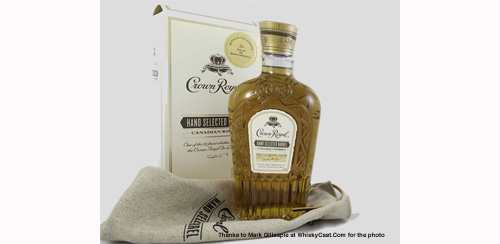
Crown Royal Hand Selected Barrel – photo by Mark Gillespie, WhiskyCast.com.
Not only is Crown Royal Hand Selected Barrel genuine single barrel whisky, it is bottled at high proof – a full 51.5% abv. Until now such a thing was just a connoisseur’s dream. Of course single barrel bourbons and Scotches have been around for some time. However, Canadian producers have just dabbled in this area.
A few years ago, Sazerac demonstrated a demand for single barrel Canadian whisky with their successful Caribou Crossing. Pernod Ricard found they could barely keep up with sales of Lot 40, a powerful Canadian whisky they make using just rye grain, at their distillery in Windsor, Ontario.
With Alberta Premium Dark Batch (it’s called Dark Horse in Canada) Beam Suntory demonstrated that the massive rye flavours bartenders covet abound in Canadian whisky.
When they released the value-priced Canadian Club 100% Rye, Beam Suntory scored a bullseye with the much-courted Millennial generation. CC 100% Rye has put Canadian Club and Canadian whisky front and centre on the upscale younger drinker’s radar.
Crown Royal Hand Selected Barrel is clearly the next giant step forward in the 21st-century evolution of Canadian whisky.
Initially, release was limited to Texas where Crown Royal is a perennial best seller. The team at Diageo, which owns the brand, wanted to reward top individual retailers with bottlings specific to their own store. Enthusiasm for the new whisky spread quickly though, and now it is being rolled out barrel by barrel to retailers right across America.
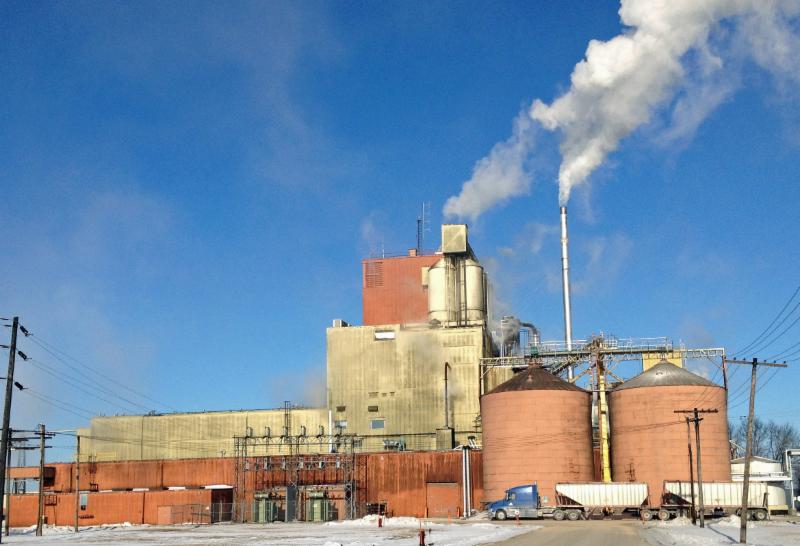
Diageo’s Gimli, Manitoba distillery where Crown Royal is made.
I’m tickled to be able to say I had a hand in introducing this new concept to Diageo. In May 2014, I visited Diageo’s distillery in Gimli, Manitoba, with whisky guru, Dave Broom. Gimli is where Crown Royal is made.
Among the many samples we tasted, a rye whisky made in North America’s last operating Coffey still stood out. We were blown away by its hearty well-balanced flavours and told plant manager, Pauline Rooney she needed to get this to market.
Rooney has since moved to the US Diageo organization and is chairwoman of the Kentucky Distillers’ Association. However, before she left she passed our enthusiasm on to Crown Royal’s brand managers. Low and behold, by Christmas the first barrels were bottled and on store shelves.
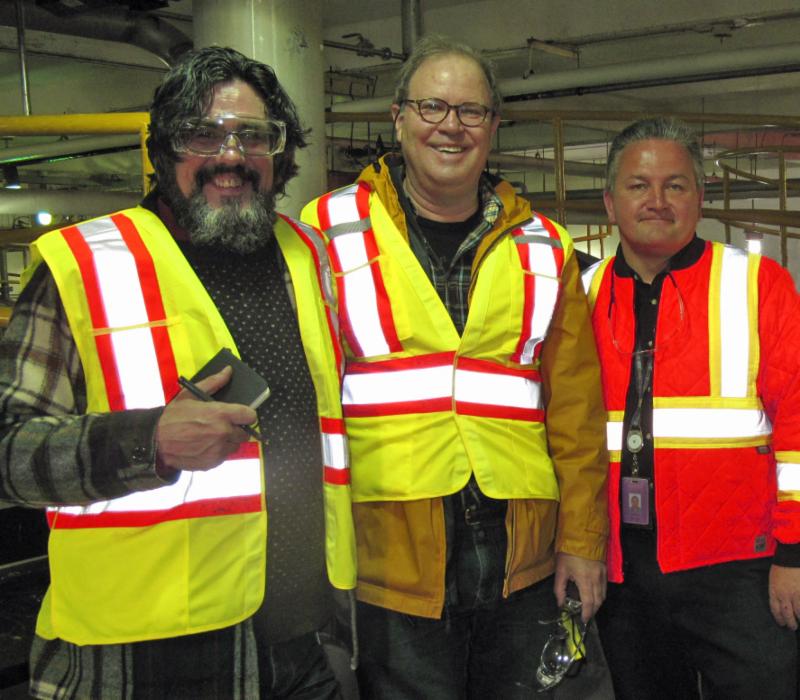
Inside the GImli distillery discovering the joys of Coffey Rye along with Dave Broom and Dwayne Kozlowski.
Normally, this “Coffey Rye” is one of the 50 whiskies that are blended together to make the various versions of Crown Royal. It is also one of the very few Canadian whiskies made using a mash bill.
In a process found only in Canada, a fermented mash of 64% corn, 31.5% rye, and 4.5% malted barley is distilled in a Coffey still, then matured in brand new, charred, American white oak barrels.
During distillation, the still house is overwhelmed with the fragrances of milk chocolate and ripe bananas. When mature, the whisky shows remarkably robust baking spices, dark fruits, butterscotch, milk chocolate, clean crisp oak, simmering white pepper and citrus zest. It’s a conoisseur’s delight.
It is a pretty good feeling to have helped come up with the idea. Then, to top things off, by way of a thank you, Diageo invited me to help them celebrate the success of Hand Selected Barrel by giving me a barrel of my own.
On a cold winter’s day I sat down at the Gimli distillery with manager, Dwayne Kozlowski to taste samples from various barrels in three of their warehouses. After much to-ing and fro-ing Crown Royal has bottled my selection for distribution to key spirits media across the US. And, as the picture above attests, along with a few bottles just for me, they sent the empty barrel.
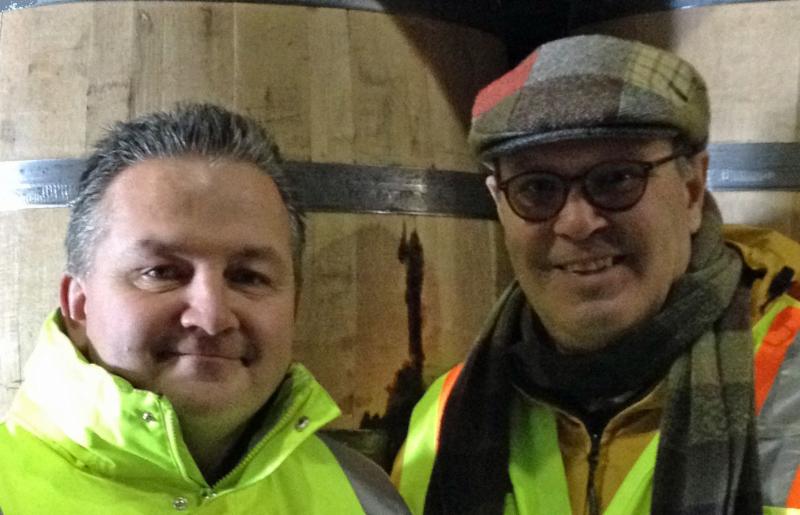
Dwayne Kozlowski and I sampling barrels in the maturing houses in Gimli, Manitoba.
Thank you Dwayne. It was a very cool ending to a great learning experience.

Will you be in New Orleans for Tales of the Cocktail this July 15 to 19? If so you’ll join more than 20,000 bartenders and spirits professionals. They’ll be there to share their knowledge and learn what’s new in the world of spirits and cocktails.
I expect to be in New Orleans for the week, talking about Canadian whisky. If you are one of their 80 apprentices, I’ll be joining you for lunch to tell you about Canada’s newest whisky, Alberta Rye Dark Batch.
For those not in the apprentice program, why not join Shawn Soole, Dave Mitton and me at 10:00 on Friday, July 17 for our seminar Canadian Whisky: The Giant Awakens? Learn all about the great Canadian whiskies from Pernod Ricard and Campari – that’s Wiser’s, Lot 40, Pike Creek and the full Forty Creek range.
As well, I’ll be signing books at the Octavia book shop in the lobby of Hotel Monteleone. We’re bound to run into one another, and when we do, I hope you’ll stop me and say ‘Hi.”
Ontario Whisky = Ontario Grain = Ontario Jobs
Canada is a large country with a small population. Nearly 40% of Canada’s 36 million residents live in the province of Ontario. From the beginning, Ontario’s economy has been strongly supported by its distilling industry. Until just before Canada’s Confederation, the largest source of government revenue was Toronto’s Gooderham and Worts, a distillery.

Spirits Canada CEO, Jan Westcott explains the benefits of selling whisky in convenience stores to Christine McMillan and Yvan Baker, Ontario Liberal MPP for the riding of Etobicoke Centre. Centre: Ontario Agriculture Minister, the Hon. Jeff Leal dons a Canadian whisky tee-shirt. Right: Westcott purchases Canadian whisky in an LCBO agency store located in Comber Food Market, a small grocery store in the Village of Comber near Windsor, Ontario. Windsor, incidentally is the home of Hiram Walker distillery, the largest beverage alcohol distiller in North America.
Today, the spirits industry supports some 6,000 good, full-time jobs in Ontario and, in so doing, contributes about $1.5 billion to Ontario’s gross domestic product annually. Even in today’s burgeoning global economy that’s far from chump change.
Remarkably, there is only one source of beverage alcohol in Ontario and that is a government agency called the Liquor Control Board of Ontario (LCBO).
Through the LCBO, beverage alcohol continues to make a significant economic contribution to the province. According to their website, “… in 2013-14, LCBO sales exceeded $4.997 billion and delivered a $1.74 billion dividend to the Ontario government, not including taxes. This revenue helped pay for health care, education, infrastructure and other important government services.”
The LCBO tells us it is “one of the world’s largest buyers and retailers of beverage alcohol. Through 639 retail stores, catalogues, special order services and over 217 agency stores, the LCBO offers nearly 24,000 products annually, from more than 80 countries.” Today, according to their website, these 24,000 products include just 67 Canadian whiskies.
For decades whisky drinkers have lamented the limited selection of whiskies available in Ontario. While a single private store “out west” in Alberta, where the private sector handles retail sales, stocks over 300 whiskies, the LCBO, among all its 639 stores, carries just 438. That includes, Scotch, Irish, bourbon and everything else.
Some cynics believe that the token regard LCBO gives to whisky is a deliberate attempt to move Ontario drinkers away from spirits to wine. A walk through any LCBO store confirms what these numbers suggest: LCBO is a wine store that tolerates whisky. Today, LCBO stocks more than 7,300 wines.
The Government of Ontario is proposing to expand sales of wine and beer, but not spirits, to private retailers. Research has shown that in Ontario, most beverage alcohol is purchased for immediate consumption. People pop by the LCBO on their way to a party or event.
Thus, when convenience stores begin selling wine and beer, this can’t help but boost sales of these products, at the expense of spirits. Once again, this could be seen as a next step in weaning the public off spirits. Moreover, the economic benefit of favouring largely foreign beverages over those made in Ontario is questionable.
According to Statistics Canada, in Ontario whisky exports alone were worth $45 million to the province in the first 3 months of 2015. Adding in all the other spirits distilled in Ontario brings the value of first quarter exports to almost $100 million. All of these spirits are made from Ontario grain.
Export revenues do a lot of good in Ontario. Farmers especially, benefit from reliable long-term markets for their grain. Fears that their farm businesses could be destabilized by the proposed changes are real.
Despite LCBO disinterest, Ontario remains one of the largest markets in the world for Canadian whisky. If the government chooses to make it more convenient for consumers to buy wine and beer than spirits, the market for grain is bound to shrink.
Every day politicians are faced with tough choices. They have many competing interests to consider. But as they ponder the welcome extension of beverage alcohol sales into convenience stores, it is important that they remember that Ontario spirits and particularly Canadian whisky are made right here in Ontario, by Ontario workers, using Ontario-sourced grains.
Already, the LCBO operates 217 agency stores, most of which are located in convenience stores in areas too remote for the LCBO to service directly. There is a precedent: selling spirits in convenience stores can work. Rather than hamstring Ontario’s spirits industry, when the government extends sales of wine and beer to the private sector, they need also include spirits. It just makes good economic sense.
Let’s hope Spirits Canada’s efforts to educate decision makers about the economic benefits of Ontario’s spirits industry succeeds.
********
This newsletter has been somewhat intermittent lately as I work on a new book with Toronto spirits writer, Blair Phillips. The book, called Liquid Six, takes an amusing look at drinking customs and anomalies across Canada. It’s still a ways away, so I’ll remind you when we get closer to publication date.
Meanwhile, watch here for upcoming features on the Kentucky Bourbon Trail, Authentic Caribbean Rum making on the Caribbean island of Hispaniola, and of course the latest news about Canadian whisky.
********
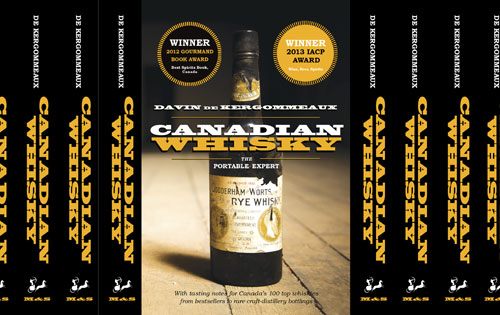
Canadian Whisky: The Portable Expert
The world’s first in-depth book about Canada’s national spirit.
WINNER, GOURMAND BOOK AWARDS
BEST SPIRITS BOOK CANADA 2012
WINNER, 2013 IACP BOOK AWARDS
WINE, BEER AND SIRITS
Canadian Whisky: The Portable Expert is published by McClelland & Stewart and distributed by Penguin Random House. It is available from most book shops and on-line book sellers.