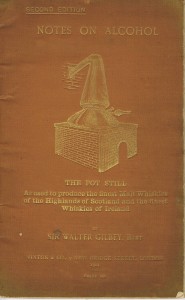
Notes on Alcohol (1904) A New Book Project by Classic Expressions
Classic Expression’s new venture is an exceedingly rare little pamphlet, Notes on Alcohol (1904) which provides a contemporary view of the importance of:
“THE POT STILL as used to produce the finest Malt Whiskies of the Highlands of Scotland and the finest Whiskies of Ireland.”
Sir Walter Gilbey (1831 – 1914) was a distiller of note. His family firm of wine and spirit merchants owned Gilbey’s Gin and, at that time of this publication, Glen Spey, Strathmill and Knockando distilleries.
For a long time, Gilbey’s refused to admit that anything but pure malt could be called ‘Scotch Whisky’ and Sir Walter argues in the text that direct firing of the still is critically important to the final flavour:
“It is a curious fact that the heat of the fire also imparts a Flavour to the vaporised matter. The fire heat gives the Spirit a character which distinguishes it from Spirits distilled by the Patent Still. It imparts to the Spirit the character known as empyreumatic, which is easily recognised in the product of the Pot Still and which is quite absent in Spirit produced by the Patent Still.”
The text also includes a brief description of the distillation of brandy, rum, Irish whiskey and a careful description of grain distilling with an excellent diagram of Coffey’s Distilling Apparatus. Gilbey is, however, quite clear that the spirit produced in this way is “nearly free from taste and smell”, and concludes that:
” … this being the case, it is obvious there is no possible justification of the statement that Pot Still Whisky is improved by the addition of Patent Spirit, even when this is disguised under the fanciful title ‘Fine Old Grain Whisky.”
We have reproduced the 2nd edition of this work, as it was revised and enlarged immediately after the first publication.
It is intended to include a colour portrait of Sir Walter Gilbey (courtesy of the Diageo archive) as a frontispiece. Founder Subscriber price £25 + shipping. £30 after publication.
Visit Classic Expressions at http://www.classicexpressions.co.uk/ and contact via info@classicexpressions.co.uk