Distillery Profiles: Millburn by Mark Davidson (aka The Jolly Toper) – Lost Scotch Whisky News
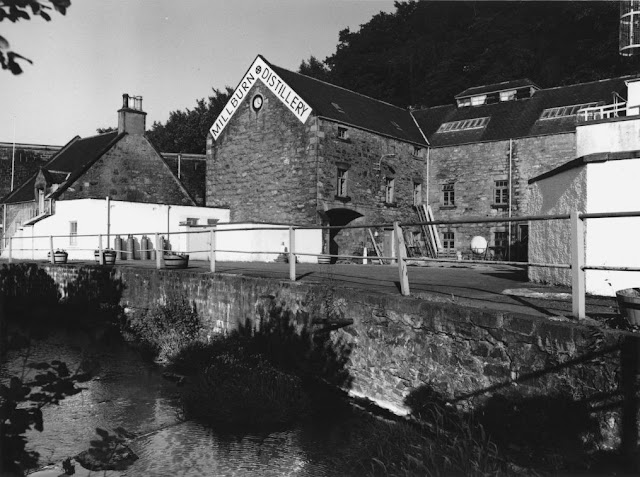
Photo Credit www.millburnwhisky.com
Distillery Profiles: Millburn
Millburn distillery may have started as ‘Inverness Distillery’ and was possibly founded or at least owned by a Mr Walsh from 1807 but it is not certain if this distillery was indeed an earlier version of the one we understand today. Regardless, for the distillery that can, in the main, still be seen a location about one mile east of the centre of Inverness was chosen in order to take advantage of the stream from where it took its name.
What is known is that :
Alexander McCallum & Co. were registered owners between 1817 and 1821.
Between 21.12.1825 and 1829 ownership was with James Rose and Alexander McDonald under the trading name Rose & McDonald Co. This is the earliest recorded reference held by United Distillers.
The Millburn Distillery Company took over the lease of the property in 1829 on a 14 year agreement although it appears their tenure did not extend beyond 1837. Somewhat confusingly between 1829 and 1832 it was run by McDonald Leslie & Co., presumably the distillery was sub-let over this period.
Perhaps the same arrangement was in place between 1832 and 1837 when ownership was credited to McDonald & Co.
This stint of ownership was followed by another under Colin Chisholm from 1837 when the name appears to have reverted to Inverness Distillery. There was a recognised period of dormancy following Chisolm’s tenancy but I’ve been unable to establish if this started in 1837 or later.
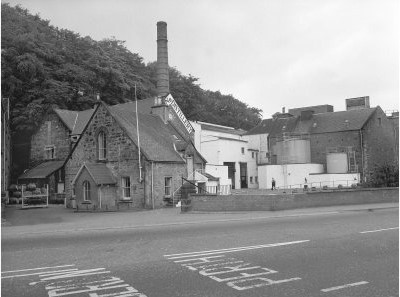
From 1853 Invernessian corn merchant David Rose “obtained a feu of the site” turning the building’s function to a flour mill. There were another 4 mills of various types using the same water source at this time.
In 1872 Swede Gottfrid Olsen visited a number of Scottish distilleries including Millburn to learn how to make whisky. He put his research to work producing whisky in Sweden in the 1880s, however according to references quoted earlier the site was used for milling in 1872 not distilling. See the link at the end of this post for more information on Olsen’s story.
The distillery was rebuilt in 1876 when Rose employed a local architect and builder by the name of Ross to design the new distillery. Production re-started on 28.9.1876. At this stage process water from the Mill Burn was augmented by a supply from Lochashie.
Encouragingly for trade in 1878 the distillery was awarded the contract to supply the British garrison in Cyprus.
Photo Credit www.millburnwhisky.com
Between 1881 and 1892 George Rose, son of David ran the distillery. From 1892 two members of the Haig distilling dynasty, Alexander Price Haig and Lt. Col. David Price Haig, a territorial officer for 30 years, took charge of the business. Under this Andrew Haig & Co.’s ownership there were a number of improvements in 1898 in order to boost capacity. New utensils and a “remodelling” of the interior were the result, power was supplied by a steam engine and a water turbine. The business was renamed Millburn Distillery Co. from 1904.
From 1921 to 1937 Millburn was owned by Booth’s, the gin distillers, having purchased the distillery for £25,000 during a lull in the industry. ‘Cabinet’ was one of the company’s blended whisky brands. Booth’s also owned nearby Royal Brackla distillery and Stromness distillery on Orkney.
Fire broke out on 26 April 1922, but the local fire brigade, “greatly assisted” by the Cameron Highlanders, whose barracks were nearby, saved the stillhouse and warehouses, at the time storing £70,000 worth of whisky. Unfortunately most other buildings were lost, damage was put at £40,000.
In 1922 the distillery was rebuilt by Charles Doig’s company of architects although he himself had passed away in 1918. The new arrangements were capable of producing about 675kl per annum, two and a half times the output of the original distillery.
The four warehouses could store 1 million gallons of spirit. A gas engine was installed and a fire engine was also located on site. New maltings were required to be constructed following the fire.
Booth’s took over Wm. Sanderson & Sons Ltd in 1935 then were in turn bought by DCL in 1937.
The distillery was closed during the Second World War and used as a billet for troops. Another consequence of war was that a walk-in safe was installed in the manager’s office to store important Booth documentation from their London headquarters during the hostilities.
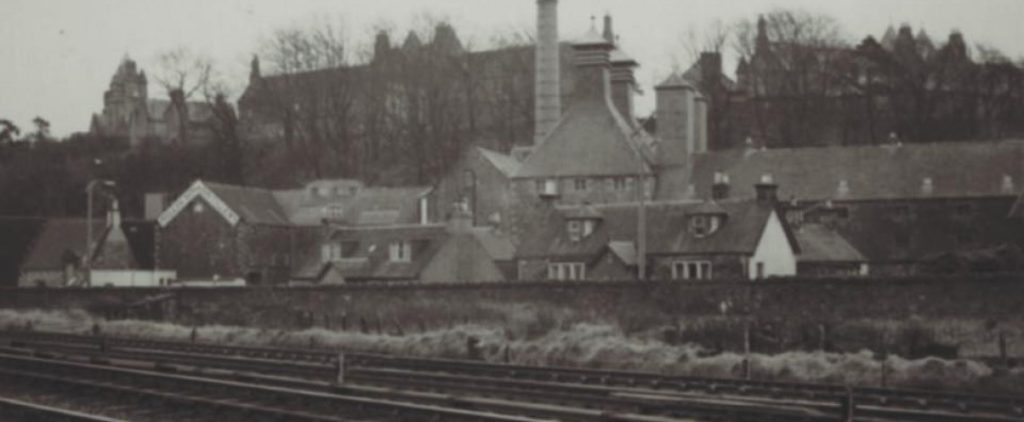
Control of the distillery was transferred to SMD in 1943 with production restarting about 1945.
Mechanical stoking of the coal fired stills was introduced in 1958 whilst also in this year the distillery was connected to the national electricity grid superseding the steam engine.
The floor maltings were replaced by Saladin boxes in 1964, not an uncommon development for the post war period of rising demand and the resulting pressure to increase output via mechanisation. Millburn supplied Royal Brackla and Teaninich with malt at this stage. A new receiver room was also built around this period. On site traditional warehousing accommodated 13,000 casks with Menstrie being used for surplus storage.
The Saladin maltings closed in 1984 with nearby Ord distillery subsequently supplying any malt requirements. Like other DCL facilities faced with declining demand production was latterly at 30% of capacity before the final closure of the site in March 1985. Maximum output was 2 MLPA. Acting against the distillery’s survival were the facts that the site it occupied was unsuitable for expansion being bordered by a road, the stream and a steep hillside. The outdated nature of the buildings and equipment would not have helped either.
At the time of the closure Golden Promise and Triumph strains of barley were employed. There was a Porteus mill, a cast iron mash tun and 4 wooden wasbacks. The two onion shaped stills were each about 13.5kl in capacity and were connected to worm tubs. The stills were heated by steam coils from 1966 when the stillroom was rebuilt. The coal fired boiler for heating the stills was converted to oil in 1970.
Latterly Loch Duntelchaig 8 miles south of Inverness, the town’s supply, was used for process water, the Mill Burn continued to be used for cooling water.
From 1943 the licence to distil was held by Macleay Duff, a subsidiary of DCL since 1933. This business was established in 1863 and had their registered office at 75 Hope St , Glasgow from 1943 to 1985. They bottled a 12yo vatted malt, The Mill Burn, which was a major brand in New Zealand.
The last manager, Mr Watson, had started his career at Linlithgow, moved to Glenesk then was assistant manager at Ord before running Millburn for 8 years.
Happily after closure the distillery escaped demolition, a fate which befell the other two Inverness distilleries, when it was sold for property development in 1988. The new owners, Beefeater, converted the buildings into a steak house. At this point all equipment was removed and the kiln and pagoda were demolished. The spirit safe was ‘recycled’ when Benromach reopened in the 1990s.
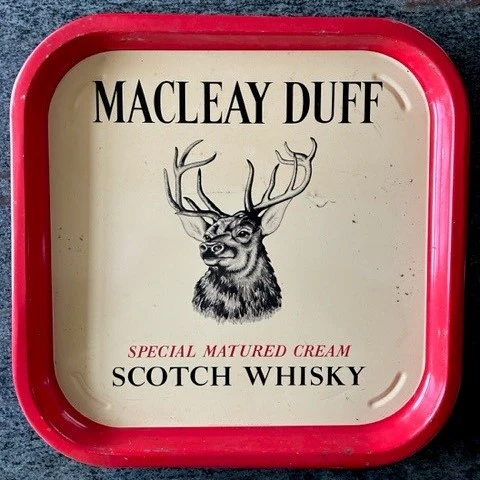
As regards official bottlings: there were 3 expressions in the Rare Malts series: 1975 18yo 58.9%, 1975 25yo with the final bottling being a 35yo from 1969 which was released in 2005 at 51.2%. The make also featured in the blend Macleay Duff.
Mark Davidson, aka The Jolly Toper Profile