Distillery profiles : Convalmore by Mark Davidson (aka The Jolly Toper) – Lost Scotch Whisky News
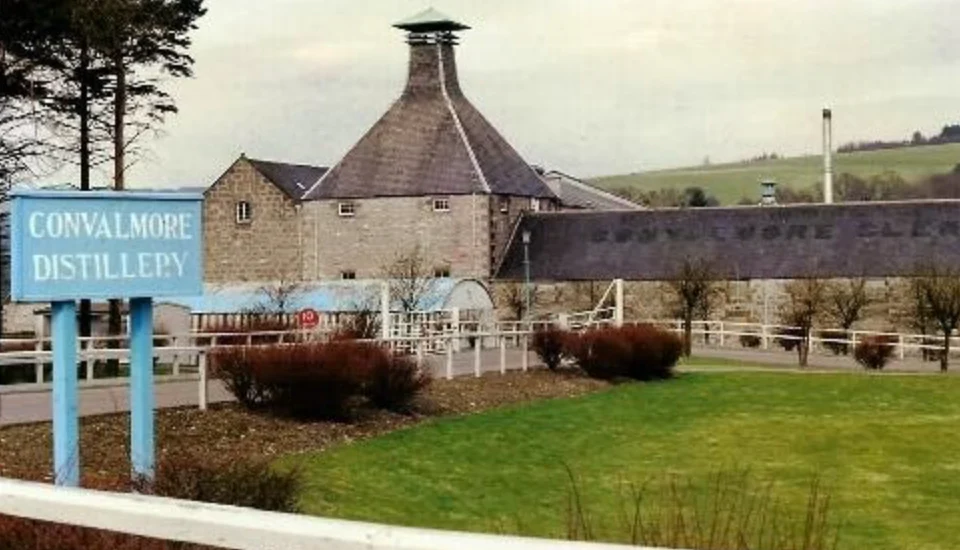
PHOTO CREDIT The Really Good Whisky Company
Convalmore
The Convalmore-Glenlivet Distillery Company was formed on 24.6.1893 with full production commencing on 19th February 1894. It was the fourth distillery to be built in Dufftown, Speyside. The buildings are to an extent still intact and were built close to the railway station which would have been a great benefit for reducing cartage fees. Dufftown architect Donald Mackay designed the distillery. Thanks to the use of gradient gravitation meant only one pump was required within the whole building. Originally power was mainly via a steam engine although, as was quite typical, the wash still rummager was powered by a small water wheel fed by the overflow from the worm tank. Process water came from the Conval Hills as did the distillery name whilst cooling water was from the river Fiddich. Initial shares in the business were mainly taken up by Glasgow brokers and merchants. Peter Dawson, a local from Glenrinnnes, was the managing director. He was formerly a grain and seed merchant in Dufftown learning distilling at Tullymet distillery in Perthshire. Peter Dawson Ltd were established in 1882 and were incorporated into DCL in 1925. Dawson built Towiemore distillery between Dufftown and Keith in 1896. This was a short lived venture, closing in 1930. In 1923 Dawson took over Balmenach in association with James Watson & Co. Ltd. of Dundee as well as MacDonald, Greenlees & Williams. Peter Dawson was also a director in SMD, he is buried at St Ninian’s, Enzie near Buckie.
In 1904 Convalmore Distillery Company went in to voluntary liquidation as a result of the down turn in the industry. March 1905 saw W. P. Lowrie & Co., a Glasgow based warehousing, blending and bottling firm that supplied merchants without such facilities, purchase the company for £6,000. Lowrie also owned Lochruan distillery in Campbeltown where experiments into continuous distillation with malted barley were carried out in 1910. Lochruan closed in 1925.
Lowrie was formerly manager at Port Ellen distillery and had in 1869 set himself up as a whisky broker. There are disputed claims that he was the first to blend malt and grain. It is also said his company was the first to bottle under bond.
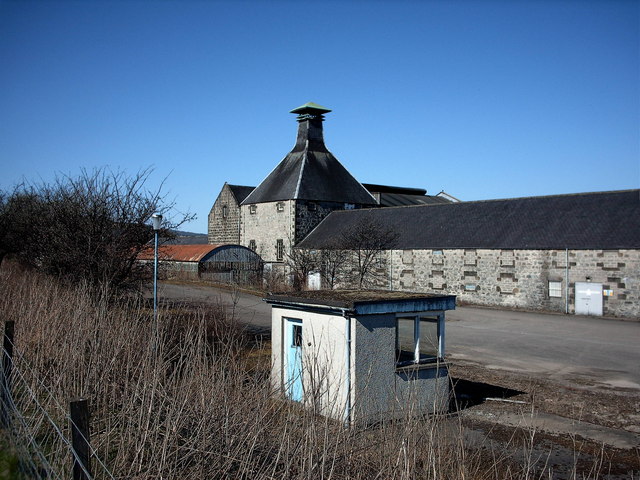
After financial difficulties experienced in 1906 by the company Lowrie’s best customer, James Buchanan who got all his stock from Lowrie, bought the business. Lowrie was ready to retired being 75 years old and “invited Buchanan to succeed him as the chairman” of Lowrie’s. The offer meant Buchanan avoided potential supply issues. They had already acquired Bankier distillery in 1903.
A fire devastated Convalmore distillery on 29.10.1909. It seems due to the intensity of the flames and the position of equipment the hoses were unable to be connected to their water sources. As a result locals assisted the fire fight with buckets of water. Between £5,000 and £8,000 of damage was done but the distillery was back operating the following year. Luckily the business was Insured against this eventuality. It is thought the fire may have started due to an electrical fault. Malt barns, the malt mill, mash-house, kiln and tun room were all lost. The stillroom was however saved and the warehousing was also spared the flames. “At its height the flames rose to between 30 and 40 feet. Snow also began to fall, providing a never to be forgotten spectacle.”. It was the worst distillery fire in the area up to that point. Rebuilding of the distillery started promptly after the devastation.
During the post-fire rebuild the single pair of stills were joined by a column still, similarly to the trial at Lochruan, but the experiment was abandoned in 1916 after 6 years due to the resulting poor quality of spirit. It seems the scheme was to make malt rather than grain whisky.
After Buchanan’s became a part of DCL in 1925 Convalmore was transferred to Scottish Malt Distillers (SMD) in 1930. William Smith, a Campbeltown man was transferred from managing Lochindaal distillery on Islay to taking charge at Convalmore in 1931.
Like many distilleries no production was seen during the Second World War. From Brian Spiller’s profile of Convalmore: “The distillery accommodated a signals detachment of the 51st (Highland) Division from 1940 to 1942 and then gunners of the 52nd (Lowland) Division until 1944.” The use of offices and malting floors at distilleries by the military during hostilities was not uncommon.
The distillery was connected to the electric grid in the late 1940s although electric light had for some decades been powered via a dynamo driven by a steam engine.
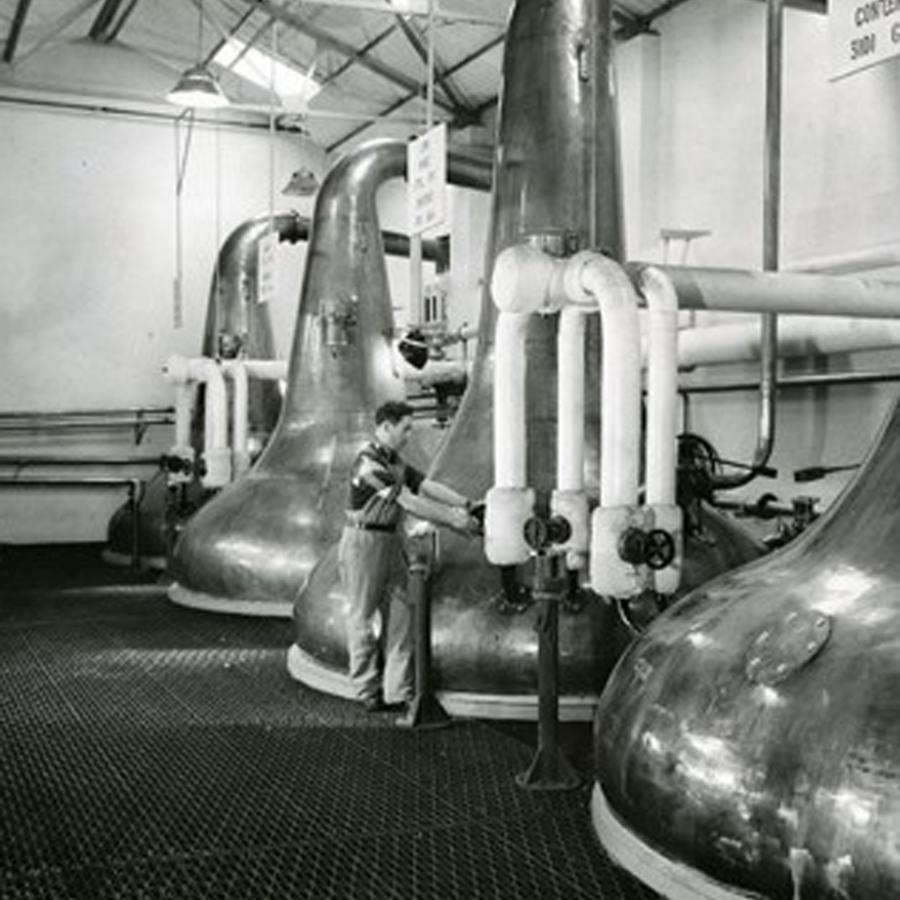
Photo credit https://www.lost-distilleries.ch/
In 1964 the number of stills were doubled to 4, the number of wash backs were also increased at this point from 4 to 6. A new boiler joined the earlier one during these improvements. Another development was that the direct firing of the stills was replaced by steam coil heating around this time. Cooling was via worms in a cast iron tank, unlike many other sites shell and tube condensers never replaced this traditional method. All the stills were onion shaped and roughly held the same capacity. Output did not exceed 1mlpa.
As was common at the time the boilers were converted to oil firing in 1970.
A dark grains plant was built in 1972 but closed in 1983. The plant also handled waste from Craigellachie, Glendullan and Mortlach. There were 32 staff employed when both dark grains and distillery were working.
In 1975 the warehousing was expanded whilst a new stainless steel mash tun was added to the newly built mash house replacing the cast iron original. 6 worker’s houses were located at the distillery.
Production ended in 1985 with output being reduced in the lead up to the closure.
The dormant facility was sold to William Grant, owner of neighbouring Glenfiddich and Balvenie Distilleries, in the early 1990s for use as a maturation and storage facility there being space for 17,000 casks. The dark grains plant was dismantled in 1995. Convalmore’s last manager was a J. Marshall.
Diageo own the rights to the brand.
Among official bottlings there has been a 24yo Rare Malt from 1978 released in 2003. Also a 28yo was bottled in 2005 then a 36yo from 1977 came out in 2013.
Mark Davidson, aka The Jolly Toper Profile