Distillery recreates extinct Native Oyster reefs in the Dornoch Firth, an environmental first – Scotch Whisky News
Distillery recreates extinct Native Oyster reefs in the Dornoch Firth, an environmental first
Glenmorangie returns 20,000 oysters to the sea near its home
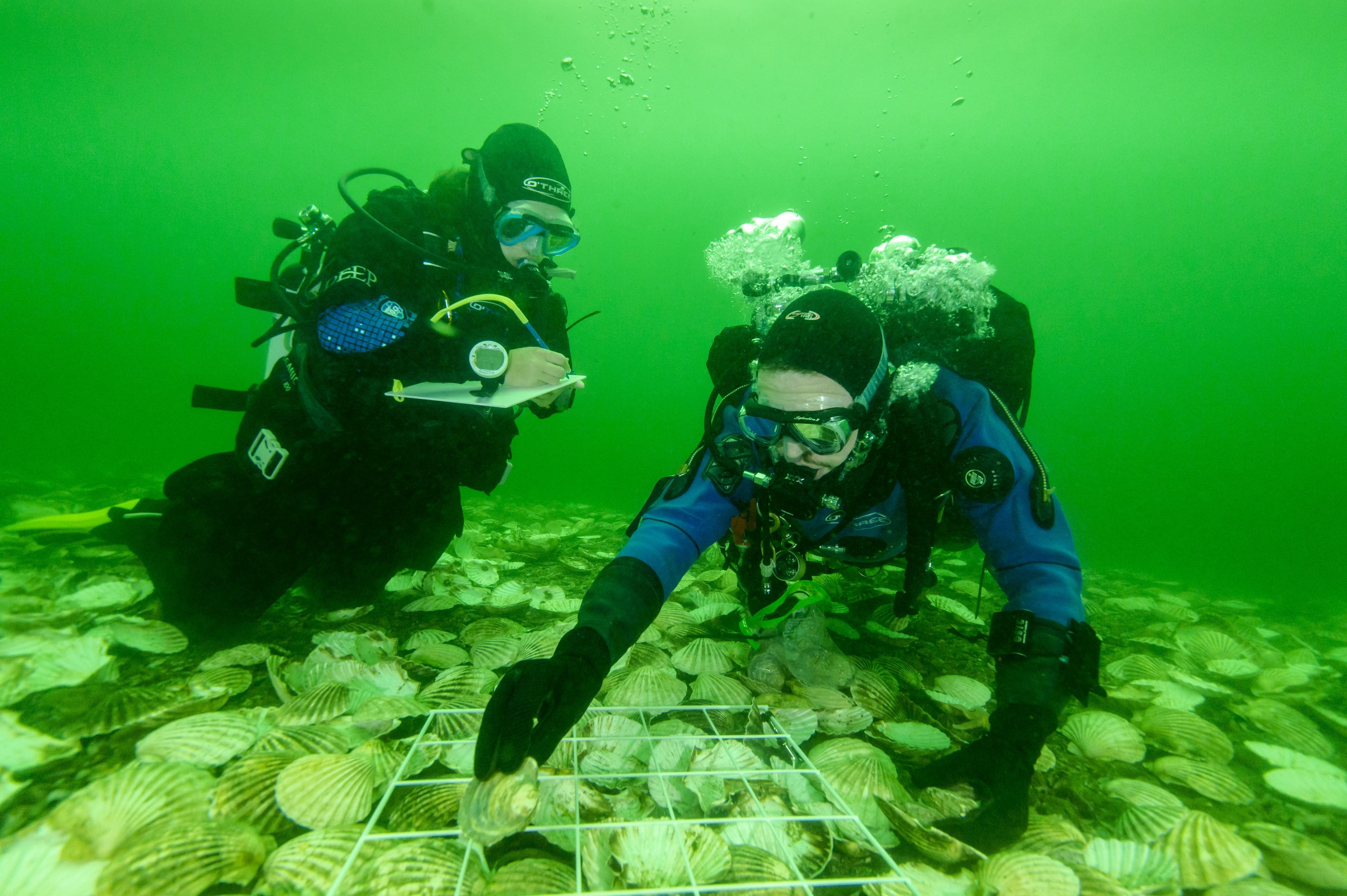
Photo caption: Scientists lay Native European Oysters on the recreated reef in the Dornoch Firth as part of Glenmorangie’s DEEP project.
12th October 2018. A total of 20,000 oysters are to be introduced into the sea near Glenmorangie’s Highland home, as part of the Single Malt whisky’s ground-breaking project to restore oyster reefs fished to extinction a century ago. In pursuit of its vision to enhance the marine biodiversity of the Dornoch Firth, Glenmorangie and its partners last year placed 300 oysters in its protected waters, to confirm the species could survive. Now, for the second phase of the project, they are to recreate entire reefs – the very first time this has been attempted anywhere in Europe.
Glenmorangie is dedicated to protecting and improving the beautiful surroundings which have been its home for 175 years. With this commitment in mind, it forged the Dornoch Environmental Enhancement Project (DEEP), with Heriot-Watt University and the Marine Conservation Society in 2014, to bring oysters back to the Firth. Established reefs in the Firth will increase biodiversity and act in tandem with Glenmorangie’s anaerobic digestion plant, to purify the surrounding seas of their distillation.
Researchers introduced the first 300 native European oysters in 2017. These oysters thrived, paving the way for a feat never before attempted in Europe – recreating natural reefs. From this month, 20,000 oysters will be carefully placed on the first of these reefs, specially created from waste shell, to mimic their natural habitat. The native oysters, all grown in the UK, painstakingly cleaned and checked for disease and unwanted hitchhikers, will be regularly monitored. Based on a successful outcome of this 20,000 oyster trial numbers will be increased to 200,000 over three years. Over five years, the population will be built up to four million, spread over 40 hectares restoring the self-sustaining oyster reefs that existed in the Firth, until they were fished out in the 1800s.
An Independent Research Advisory Panel (IRAP) of leading European Marine scientists has also been created. Led by Professor John Baxter the panel will have oversight of the DEEP project.
Hamish Torrie, Glenmorangie’s CSR Director, said: ‘We are very excited to move DEEP to its next stage and have been hugely encouraged by the enthusiastic support that our meticulous, research-led approach has received from a wide range of Scottish Government agencies and native oyster growers – it is a truly collaborative effort. We are all very proud that in our 175th year the Distillery has such a pioneering environmental project right on its doorstep.’
Dr Bill Sanderson, Associate Professor of Marine Biodiversity at Heriot-Watt, said: “This is the first time anyone has tried to recreate a natural European oyster habitat in a protected area. Working closely with Glenmorangie, we hope to create an outstanding environment for marine life in the Firth – and act as a driving force behind other oyster regeneration work across Europe.”
Thomas Moradpour, President and CEO of The Glenmorangie Company, said: “DEEP is a vital part of our vision for a fully sustainable business. Supported by Moët Hennessy Louis Vuitton and our partners, we’ll do all we can to champion this innovative project, soon to be showcased at our Open Weekend
at The Glenmorangie Distillery.’
For each bottle sold of limited-edition Glenmorangie Dornoch, a donation is made to the Marine Conservation Society to support DEEP. RRP: £69.
Follow Glenmorangie on:
Facebook: https://www.facebook.com/Glenmorangie
Twitter: https://twitter.com/TheGlenmorangie
Instagram: https://www.instagram.com/glenmorangiecom
NOTES:
About Glenmorangie:
Glenmorangie Single Malt Scotch Whisky originates in the Scottish Highlands where, at
the Glenmorangie Distillery, it is distilled in the tallest malt whisky stills in Scotland for a purer spirit, expertly matured in the finest oak casks for great depth, and perfected by the Men of Tain, who have passed their skills down the generations, often from father to son. These select craftsmen go to unseen lengths to ensure that Glenmorangie is made in the same unhurried, uncompromising way as it always has been. The Distillery was founded in 1843 and is renowned as a pioneer in its field, uniting tradition with innovation.
About DEEP:
This innovative project is the first attempt to restore the endangered Native European oyster to a protected area where it has become extinct. Begun in 2014, DEEP is delivered through a ground-breaking partnership between Glenmorangie, which has provided seed funding, Heriot-Watt University through research and field work led by Dr Bill Sanderson, and the Marine Conservation Society, which delivers community engagement, communications support and advocacy. The project’s first phase, led by Dr Sanderson, trawled archaeological records, ancient literature and fisheries records, then sampled shell material, to show that oysters had existed in the Dornoch Firth up to 10,000 years ago – and that reintroducing them was feasible. In 2017, 300 oysters from the UK’s only sizeable wild oyster population in Loch Ryan, were carefully placed on two sites in the Dornoch Firth in ballasted bags, to confirm that they would thrive in the water. Researchers were delighted to see a survival rate in line with their highest expectations – up to 86% on one site.
For the next phase of the project, a total of 20 tonnes of waste shell from the scallop and mussel industry will be placed in two locations on the seabed this month (October 2018), to form reefs for the oysters. This will help to stabilise the sediment and allow the oysters to grow on top, mimicking the conditions in which the species would have grown before they became extinct in the Firth. As this is the first attempt to establish a natural habitat for the native European oyster, scientists will vary shell type, shell density, the way it is laid and the location, to inform their research. Between October and the following spring, they then will place a total of 20,000 oysters, grown by suppliers across the UK, on these reefs. The scientists, who will monitor the oysters every six months, then plan to increase the numbers to 200,000 within three years and to some four million, over around 40 hectares, in five years. At this stage, they believe the reefs will cover an area and density large enough to ensure a self-sustaining oyster population – replicating the numbers which would have existed before the species was wiped out in the 19th century.
IRAP visited Glenmorangie earlier in October to validate DEEP’s work. Their support will be invaluable to the project as it moves forward. The panel includes:
Professor John Baxter – chair of the Scottish Blue Carbon Forum (former Principal Marine Adviser SNH), Scottish Government, Adviser to the IUCN Global Marine and Polar Programme and member of the World Commission on Protected Areas.
Francois Simard – Deputy Director of the Global Marine and Polar Programme
IUCN (International Union for Conservation of Nature).
Professor Dan Laffoley – Principal Adviser on Marine Science and Conservation at IUCN,
Marine Vice Chair for the World Commission on Protected Areas.
Dr Matt Frost – Deputy Director Marine Biological Association Director of Policy and Knowledge Exchange, President of the European Network of Marine Research Institutes and Stations (MARS) and Chair of the Marine Climate Change Impacts Partnership.
Dr Henning von Nordheim – Professor for Marine Nature Conservation, at the University of Rostock.
About DEEP’s benefits:
The success of DEEP would offer many benefits to the marine environment. Oysters filter water as they feed, soaking up nitrogen and improving the water quality (one oyster can filter up to 200 litres of water a day). Established reefs, together with Glenmorangie’s anaerobic digestion plant, would account for 100 per cent of the organic material in the water that the Distillery releases into the Firth. Native Oysters also create microhabitats for other marine life, which increases an area’s biodiversity. Oyster reefs are amongst the most endangered marine habitats on Earth – and scientists hope that the research conducted as part of DEEP might one day enable conservationists around the world to reintroduce the species to other areas where it has become extinct. Furthermore, DEEP is helping to sustain oyster-growing businesses across the UK, creating demand for the native European oyster.
About Biosecurity:
The researchers are taking every precaution to ensure that the oysters destined for the Firth are free from disease – and are not accompanied by any invasive alien species. Grown by oyster farmers across the UK, they will be tested for disease, and held behind a biosecurity firewall at Heriot-Watt University. There, every single oyster will be thoroughly checked and cleaned – its shell scrubbed and sterilised, with water passed through the inside.
About the Dornoch Firth:
The Dornoch Firth, on the banks of which Glenmorangie Distillery is located, is an Area of Outstanding Natural Beauty, a Site of Special Scientific Interest, an internationally important Special Area of Conservation, and a Special Protection Area. Conditions are today regarded as favourable for marine life in the Firth. DEEP aims to improve water quality and biodiversity even further. The native European oyster is thought to have thrived in the Firth for around 8,000 years, until being decimated by overfishing in the 19th century – as was commonplace for oyster populations around the world. Today the species is all but extinct in the wild.
About Glenmorangie’s anaerobic digestion plant:
Glenmorangie’s treatment plant is part of its long-term commitment to protecting and improving the beautiful surroundings in which its Distillery will always be rooted. Glenmorangie has always been fully compliant with Scottish Environmental Protection Agency guidelines for the chemical oxygen demand (COD – a measure of organic compounds in water) of the water it releases into the Dornoch Firth. But inspired to increase its sustainability even further, Glenmorangie began to build an anaerobic digestion plant in 2015. This unique plant, opened in 2017, treats the Distillery’s pot ale (the solids which remain after primary distillation), spent lees (residue from the spirit distillation) and washing water (the waste water used when cleaning the mash tun and washbacks). The plant reduces the COD of the water that Glenmorangie releases into the Dornoch Firth by 95 per cent. Within a few years, established oyster reefs will account for the remaining 5 per cent – ensuring that Glenmorangie’s nutrient-rich outflow is entirely accounted for. The plant’s other by-products are a copper-rich sludge and biogas. The biogas is used to create steam which helps power the Distillery, reducing Glenmorangie’s reliance on fossil fuels by 15 per cent. Meanwhile, the sludge, which contains copper from Glenmorangie’s signature stills – the tallest in Scotland – is passed to local barley farmers. It helps to reduce their reliance on fertilisers for land which is naturally copper deficient.
About Heriot-Watt:
Heriot-Watt is a specialist university, globally minded and calibrated to the needs of society. A leading technological and business university, renowned for innovation in business, engineering, design and the physical, social and life sciences, Heriot-Watt defines its presence on the international stage in areas of world importance and value. Its communities of scholars come from across the world and are leaders in ideas and solutions; delivering innovation and educational excellence, the University is ranked in the top 10 for Research Impact in the UK. With roots in Scotland and a truly international reach, Heriot-Watt is a leader in transnational education and a powerful driver and engine of the economy, transforming people and the world. Within the University’s Centre for Marine Biodiversity and Biotechnology, Dr Bill Sanderson’s work concentrates on the marine biodiversity research needed to support sensitive management and sustainable development, often concentrating on species and habitats of high nature-conservation importance, such as biogenic reefs.
About MCS:
The Marine Conservation Society (MCS) is the UK’s leading charity for the protection of our seas, shores and wildlife. MCS champions a vision of sustainable fisheries, abundant marine life and clean seas and beaches for the enjoyment of all. As part of DEEP, Glenmorangie has funded a part-time role at the Distillery for an MCS information officer. The post-holder, in place for six months every year, engages visitors with the work of MCS, runs beach cleans, education workshops, and encourages wildlife watching, including the wading birds and seals that sun themselves on the Firth’s sand banks. MCS has a dedicated Scotland conservation programme based at its Edinburgh office that was established in 2000.