Independent, Family-owned Distillers support Traditional Skills as Apprentice Coopers Graduate – Scotch Whisky News
Top of the Cask
Independent, Family-owned Distillers support Traditional Skills as Apprentice Coopers Graduate
Independent, family-owned distillers William Grant & Sons has pledged its commitment to continuing traditional skills with plans to recruit two new apprentice coopers for its Girvan Distillery this year.
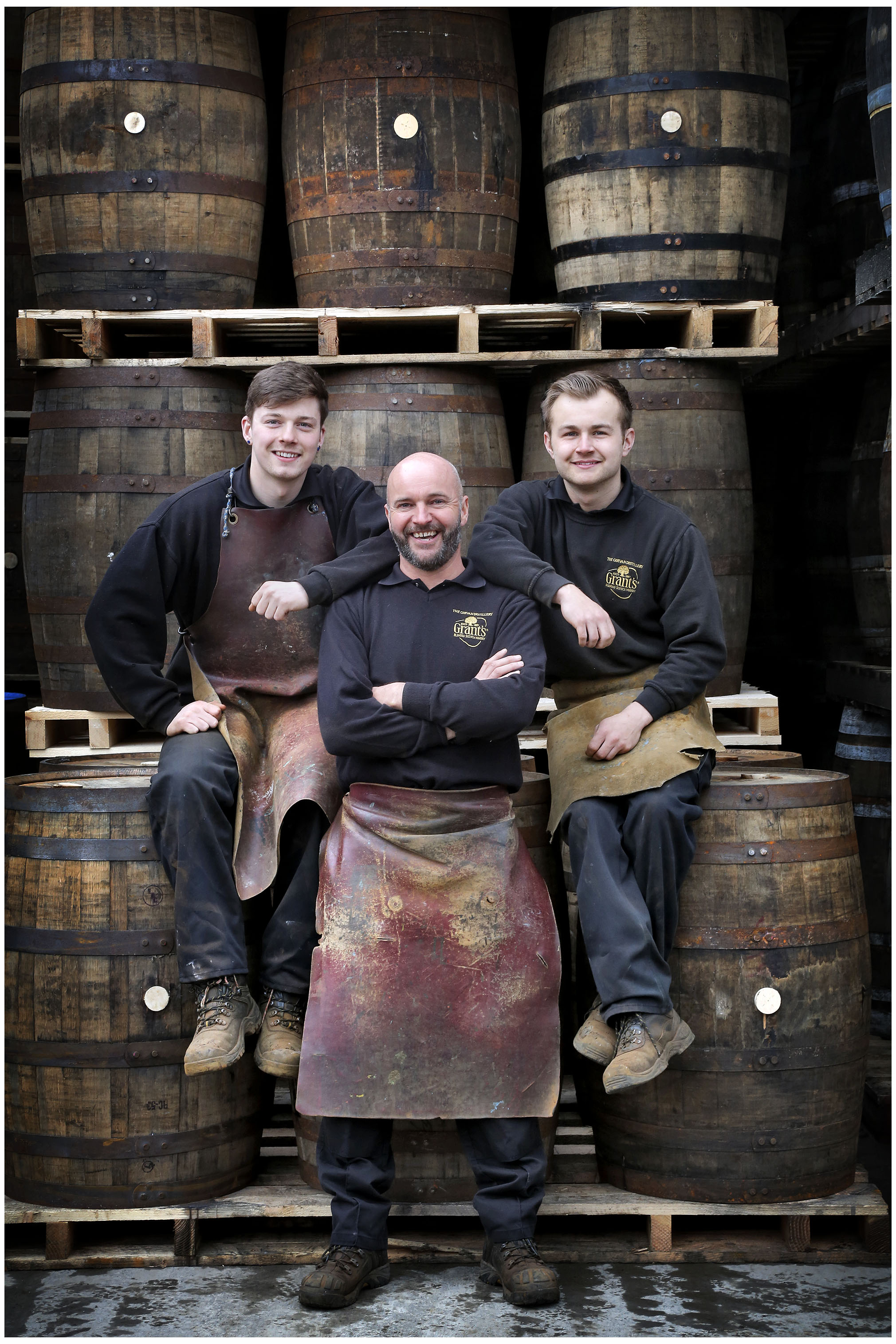
The promise comes after the first two apprentice coopers in 24 years passed their Trade Test at the Girvan Distillery. Coopering is an ancient trade dating back to Roman times and is a physical job that requires great precision.
Stewart Millarvie (19) and Fraser Henderson (21) had completed three years and two months of their four-year apprenticeship when they passed their Trade Test in February 2017.
Two experts from the National Cooperage Federation did the final assessment. Fraser and Stewart will now complete their final ten months adjusting to their future work environment.
Girvan site leader Stuart Watts said: “Traditional skills are at the heart of the continuing success of our business. Our company has two cooperages, one in Girvan for our Grant’s whisky and another in Dufftown, home of Glenfiddich and The Balvenie single malts.
“The quality of the wood and casks used in whisky maturation is critical to the final characteristics of the spirit and we’re committed to retaining our own coopers to ensure our exacting standards are consistently met.”
The company’s latest graduate coopers are both from Girvan and joined the Distillery four years ago.
Fraser Henderson said: “We learned all our skills from our mentor, Paul Ross, who has worked for the company for 29 years. As well as learning how to repair casks and make them, we work with different cask types from miniatures to 2,000 litre tuns.”
Stewart Millarvie (19) added: “We feel honoured to be able to carry on this traditional skill. To pass this stage of our training we had to sit a practical test for the National Cooperage Federation.
“It was bit nerve racking, but after four years of training we were ready for the challenge and we’re both delighted that we passed!”
John Gaffney is the Secretary and Treasurer of the National Cooperage Federation, which monitors the progress of apprentices through their four years and offers help and advice when it’s required.
John – who’s known Fraser and Stewart since they started their apprenticeship – is delighted at the news:
“I understand that they passed with flying colours, which is a fine testimonial to their tutor. It also offers up encouragement to the other apprentices who may be following along after them.”
There are currently 182 coopers and 49 apprentices in training in the UK – the highest number in 14 years.
John added: “We’re pleased to work with William Grant & Sons, both at Girvan and Glenfiddich, who are playing an active part in the work and duties of The National Cooperage Federation. This is all good news for the trade and will help it to prosper for the foreseeable future.”
William Grant & Sons will begin the search for its two new apprentices later this year. The vacancies will appear on the company’s website.
Stuart Watts explained: “Most young people have no idea what a cooper does, let alone consider becoming one. It can offer a very rewarding career and the fact that one of our Girvan coopers, Brian McKenzie, has been with us for 47 years shows it really can be a job for life. At William Grant & Sons we believe that combining traditional age-old whisky making skills with the latest technological advances will enable us to build upon our reputation for producing world-class spirits for generations to come.”
Coopering facts and figures
- The Distiller’s Girvan cooperage was established in 1963 to provide casks primarily for maturing Grant’s whisky.
- The company currently employs eight coopers and four apprentices at its Girvan cooperage and a further eight at its Dufftown cooperage.
- On average a cooper can check and rebuild a cask in under thirty minutes and works on between 20 and 22 casks a day.
- A barrel contains, on average, 24 to 30 staves, two ends and six steel hoops. It is held together by pressure alone. There are no nails, screws or glue – just the skill of the cooper to get every joint exactly right to contain the spirit within.
- Nowadays casks are mainly used for maturing whisky, beer and rum. But in the past they were also used to transport all manner of goods around the world, for example fish, butter and salt.