“TOMINTOUL DISTILLERY” by Mark Davidson – Scotch Whisky News
TOMINTOUL DISTILLERY
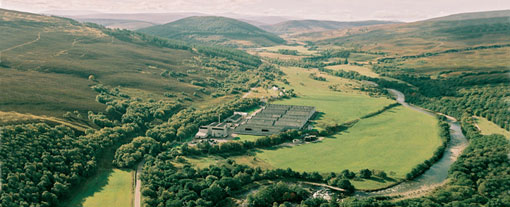
Tomintoul distillery’s story start’s in a time of post war optimism for the Scotch whisky industry. After the lifting of first government then self imposed restrictions on sales the healthy increase in demand for the drink led to upturn in production. These measures included an all hands on deck approach to ensuring full capacity of stills was realised, when round the clock distilling wasn’t sufficient to meet projected demand expansion was often the solution then finally new distilleries started to appear. Tomintoul was the first time a Speyside distillery was built in the 20th century with Scottish money and the third new Highland distillery since the war. An amalgamation between two whisky brokers, W. & S. Strong & Co. and Hay & Mcleod, under the banner Tomintoul Distillery Ltd., began a year long search for a water source of reliably sufficient quality and quantity. By November 1964 the search was over and building started with the first production coming in July 1965. The setting of the distillery was not chosen for the sake of convenience being remote in the hills of Glenlivet near the river Avon a few miles from the village it shares it‘s name with. The architecture is functional but despite being approved by The Royal Fine Art Commission and designed by the National Fuel Efficiency Service it is hard to imagine permission being granted these days for any building of this magnitude in the area regardless of it’s socio-economic value being as it is in the Cairngorm national park. Pylons and wind farms might be another matter. Despite there only being three distilleries situated in the glen of the Livet whilst Tomintoul is within the Glenlivet parish 17 stills lay claim to the designation- presumably hoping by association a bit of the magic of the area might rub off. Few distilleries share such a lofty position, 880 feet (268 meters) above sea level, and the area is well known for snow and low temperatures with 2010 being particularly challenging.
Regarding ownership there has been a strong pattern of changing hands: the first sale, to Scottish and Universal Investment Trust or ‘S.U.I.T.S.’ (owned by the House of Fraser family), coming in 1973. Later that year Whyte and MacKay was also purchased by the organisation. Four years later there is a doubling of capacity thanks to the number of stills increasing from two to four. This followed a doubling in the size of the mash tun in 1972/73- it is of the semi-lauter variety. 1978 sees S.U.I.T.S. being taken over by investment conglomerate Lonhro, a company with interests as diverse as mining, textiles, hotels printing and newspapers. A decade later (February 1989) Lonhro sells on it’s whisky wing, known as Whyte and MacKay (W&M) since 1975, to Brent Walker. The following year American Brands Inc. buys W&M then a change of name in 1996 has the distillers known as JBB – Jim Beam Brands- (Greater Europe) Plc.. Current ownership under merchants, bottlers and blenders Angus Dundee dates from the first of August 2000. The company is headed by Terry Hillman an ex-executive of Burn Stewart who re-started his whisky interest via brokering. The Company added the Brechin distillery Glencadam to it’s portfolio in 2003. In the same year a blending centre was installed on site in at Tomintoul with vats ranging in size from 10,000 to 100,000 litres.
The distillery is unusual in that its wide and tall steam kettle heated wash and spirit stills are very nearly the same size as one another, the wash is ~22KL with a 15K charge and the spirit 19.6KL with a 9KL fill. Also perhaps as there are no formal visitor facilities there has never been a need for the cosmetic of lacquering the copper. Reflux bowls are employed while the still’s lyne arms ascend at twenty degrees. These two features combined with use of shell and tube condensers usually indicate the desire to create a lighter spirit. The large mash tun is stainless steel as are the 9 wash backs. Due to its remote location in a sometimes weather effected area barley storage facilities need to be more substantial than the norm. Maturing is in a combination of four six-high racked and some palletised warehouses with a considerable storage capacity for 116,000 casks on site. Maximum production is 3.3 MLPA coming from 15 mashes a week, taking all its brands into consideration the company is responsible for around 5% of Scottish whisky exports although only 2-3% of Tomintoul‘s production is sold as a single malt. Bottlings of the single malt first appeared in 1975 on the distillery’s 10th anniversary however the range available has only just started to blossom. Recent additions include an heavily peated variant named Ballantruan (after one of the springs) introduced in 2000 and produced for two weeks in the distilling calendar. In charge of the twenty staff is current manager, Robert Flemming, coming from a family line of whisky makers he has been overseeing the site since 1990.
‘Tomintoul’ means little hill of the barn.

Mark Davidson…
Of a distinguished Banff 1968 vintage Mark Davidson has a short but full body and so marries well (& subsequently producing two limited editions), frequently seen at whisky fairs in Scotland yet curiously difficult to find outside his domestic market it is hoped his inaugural launch on the Canadian scene will be well received. He is at home in independant bottling circles being most commonly found in the William Cadenhead livery where he has enjoyed a 13 year finishing period, however as a stand alone single expression under the Jolly Toper brand he can come into his own while being a fine mixer.