Milk or Whisky? Austria’s First Distillery Waldviertler Roggenhof by Ernie – Ernst J. Scheiner, The Gateway to Distilleries
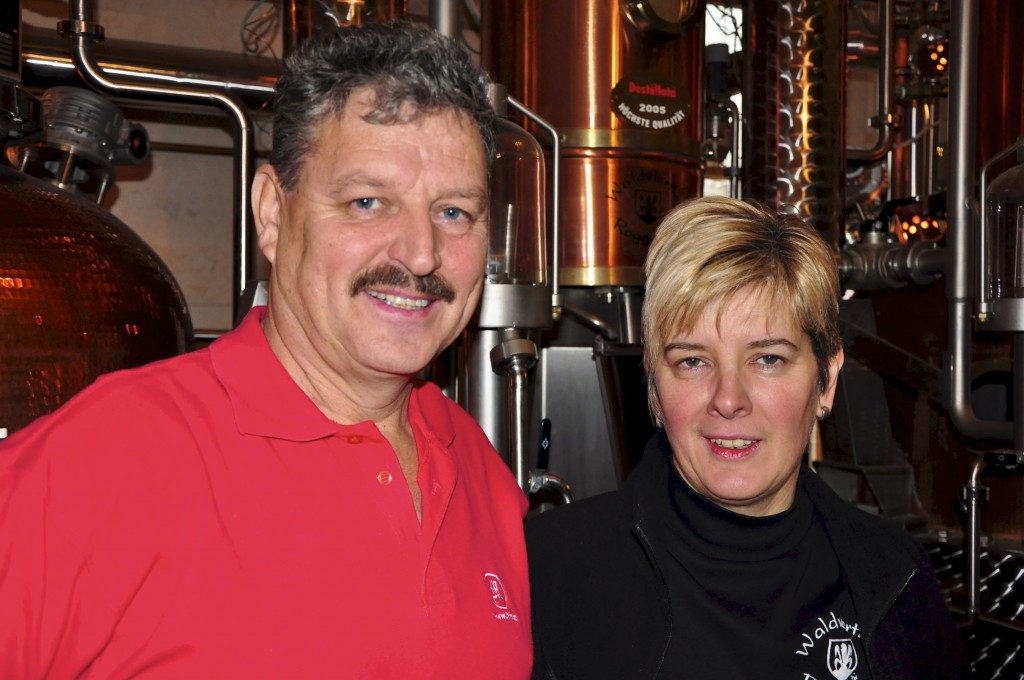
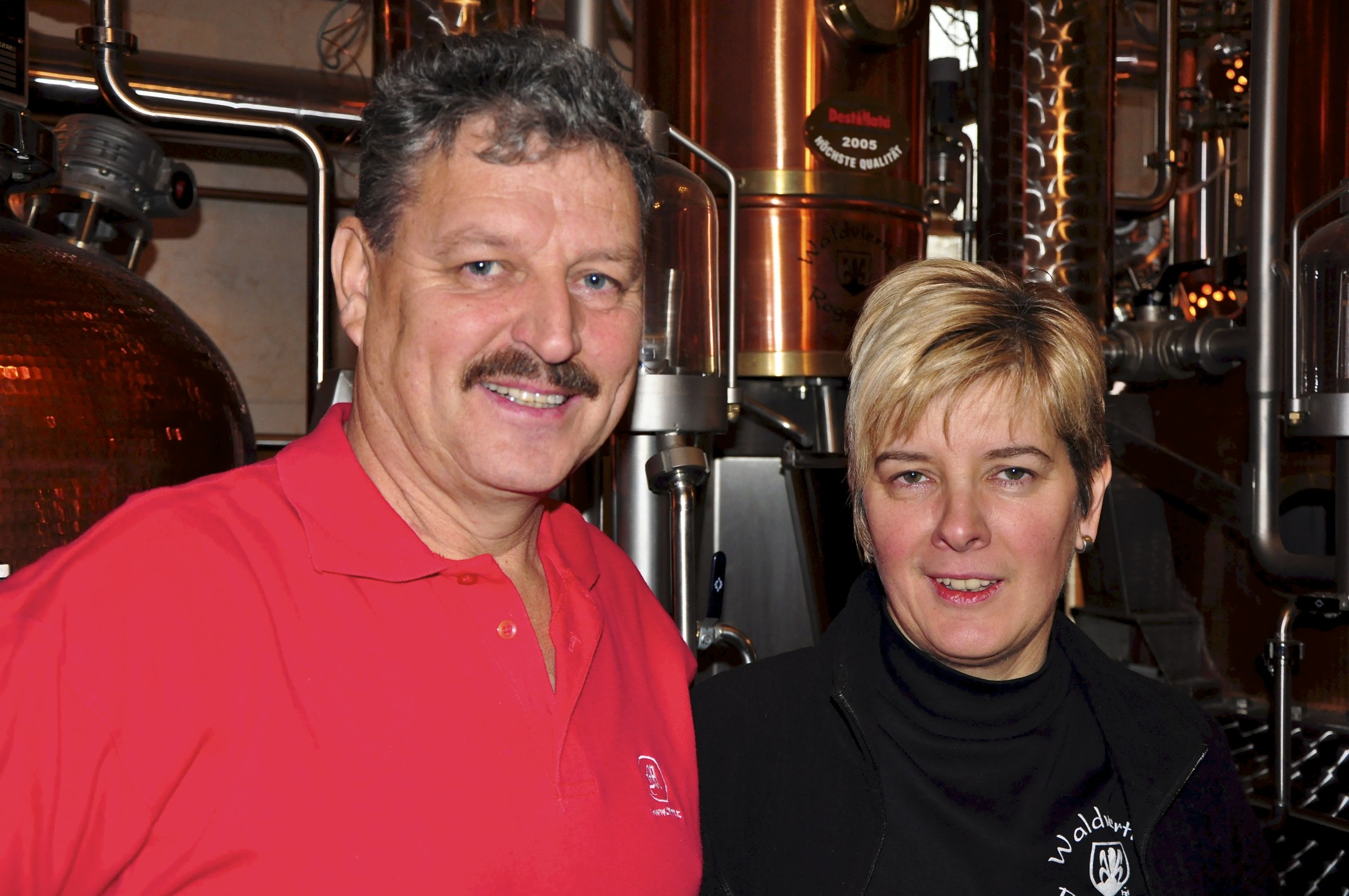
To be or not to be, that is the question? Johann Haider worked in the vibrant Austrian capital Vienna when he inherited his father’s dairy farm in 1990. He and his wife Monika moved back to a very remote and hilly countryside which lies between southern Czechia and north of the Danube River, about 120km west of Vienna. They changed from an urban way of life to a farmer’s life in the middle of nowhere. The region which is called Waldviertel (literally translated forrest quarter) is reowned in Austria for its remoteness, its legends and fairy stories. There is some resemblence to Scotland’s landscape and mythology. The exposed border situation resulted in many fortified castles. When driving to the distillery the narrow roads meander uphill through thick woods, sometimes with open meadows dotted by dairy cattle. The climate resembles Scottish weather, rain in spring and some sunshine in summer.
What a change! From milk to whisky! From a metropolis of culture back to country roots with its traditional folklore and quiet Sunday life: a village with eighty inhabitants. Right from their return it had been quite clear that the Haider Family could not live from dairy farming alone. The farm was just to small and an immense investment was needed to modernize production facilities. They even faced a financial crisis when Austria joined the EU in 1995. “We were just not able to make a living from farming, we were forced to develop new ideas.” recalls Johann Haider. As farm distillation of Schnaps – a white spirit from apples, pears or rye – has a long tradition in the area of Roggenreith and the Waldviertel, the new idea became real. A television-documentary about Scotland promoted the new project. Let’s distil whisky, tells Monika Haider, “why shouldn’t we distil rye, which we are still growing on our farm?” Whisky from cattle feed, that seemed to be the solution. Thought and done, the Haiders started a new distillery producing rye whisky in 1995. Learning by doing was the basis of their future success. Three years later the media, television, radio and press made the first Austrian Whisky Distillery known to a wider public in Austria. Journalists, among them Jim Murray, flocked in and thereby promoted the Haider business. Dairy Farming was abandoned. Whisky replaced milk.
What a huge success! Nobody knew then, that thousands of coaches and cars would drive along the narrow roads to Roggenreith. In 2011 about 79.000 visitors learned the story of whisky distillation (The Glenlivet Distillery counted 42.000). The once fancy idea changed into a most impressive Whisky World where visitors experience the production of whisky. They smell the aromas of malt, feel the heat of the stills and taste Rye Single Malt. The Waldviertler Roggenhof Whisky Erlebniswelt became a major employer in the area and a prime highly graded tourist attraction of Austria. The film From Fields to Whisky Tumbler introduces with empathy the world of whisky making to the visitor. The unexpected became real. Major investment set the pace. Expansion took place. The dairy farm with its small distillery has changed to a most professional World of Whisky Experience with cinema, warehouses, tasting rooms, restaurant and a Celtic Fire and Water Garden in 2012. And above all, a new helicopter landing, which was opened in June, makes the Austrian distillery absolutely unique in the whisky industry. A wonderful 7.000 m2 Celtic Garden teaches the understanding of the Celtic Year and the importance of flora and fauna to the ancient Celts who once lived in the area. The visitor feels the elements of nature and studies their symbolic features. A Druid’s playground welcomes the children. On May 1st the Beltane, the Festival of the Mother Earth, is celebrated as well as Summer Solistice (September), Autumn Equinox (November) and Winter Solistice (December). We just live whisky, says Monika Haider. During festival days hundreds of people flock in to share ideas of Celtic tradition and lifestyle…and they enjoy the water of life. In September 2012 a new comfortable tasting lounge will be specially opened for the whisky enthusiasts to appreciate the Waldviertler whiskies.
Let’s distil rye! The village of Roggenreith (820m above sea level) is as lonely as some areas of the Highlands of Scotland. It has been famous for the good quality of its rye, hence its place name is derived from ,Roggen‘ (=rye). “Yes, it’s a very ideal place for distilling whisky, about 30 % of the rye requirements are produced on our own land, the production water comes from a nearby spring and is excellent,” explains the Master Distiller Johann Haider. The malt is produced locally by the malster Plohberger of Grieskirchen and is specially roasted between 95 degree Celcius and at 110 degree Celcius “This roasting of the malt generates intense malty flavours of toffee or nougat in our whisky.” Today, about one million litres of whisky mature in three modern racked warehouses, the temperature is moderate in summer and very cold in winter. “Usually, there is a 2% Angels’ share, but strangely in some of our casks the water evaporates faster than the alcohol with the effect of higher concentration of alcohol,” reports the farmer-distiller. This loss is obviously owed to the dry micro climate of the warehouses in summer where small fountains are installed to moisturise the maturation atmosphere.
State-of-the-Art Production! A Gruber hammer malt mill grinds the malt into grist which is kept in wooden boxes. There are two 6.000 litre mash tuns which were manufactured by Speidel Tank- und Behälterbau GmbH, Ofterdingen in Germany. The Roggenreith mash tun is a very simple lauter tun, one part of grist meets four parts of water. Slow stirring is done by a single propeller like agitator. The production of wort is rather unique at Roggenreith. The mash tuns function also as fermenters. There is no underback to recover the drained worts or sugary liquids. The mash, the draff and the wort are not separated but kept together, both are cooled down to 28 degree C and then yeast is added to the mixture. The fermentation period is 75 hours. The yeast quality is pressed Reinzuchthefe, which is some sort of brewer’s yeast. “Our first mash was made of 60% rye and 40% barley malt.”
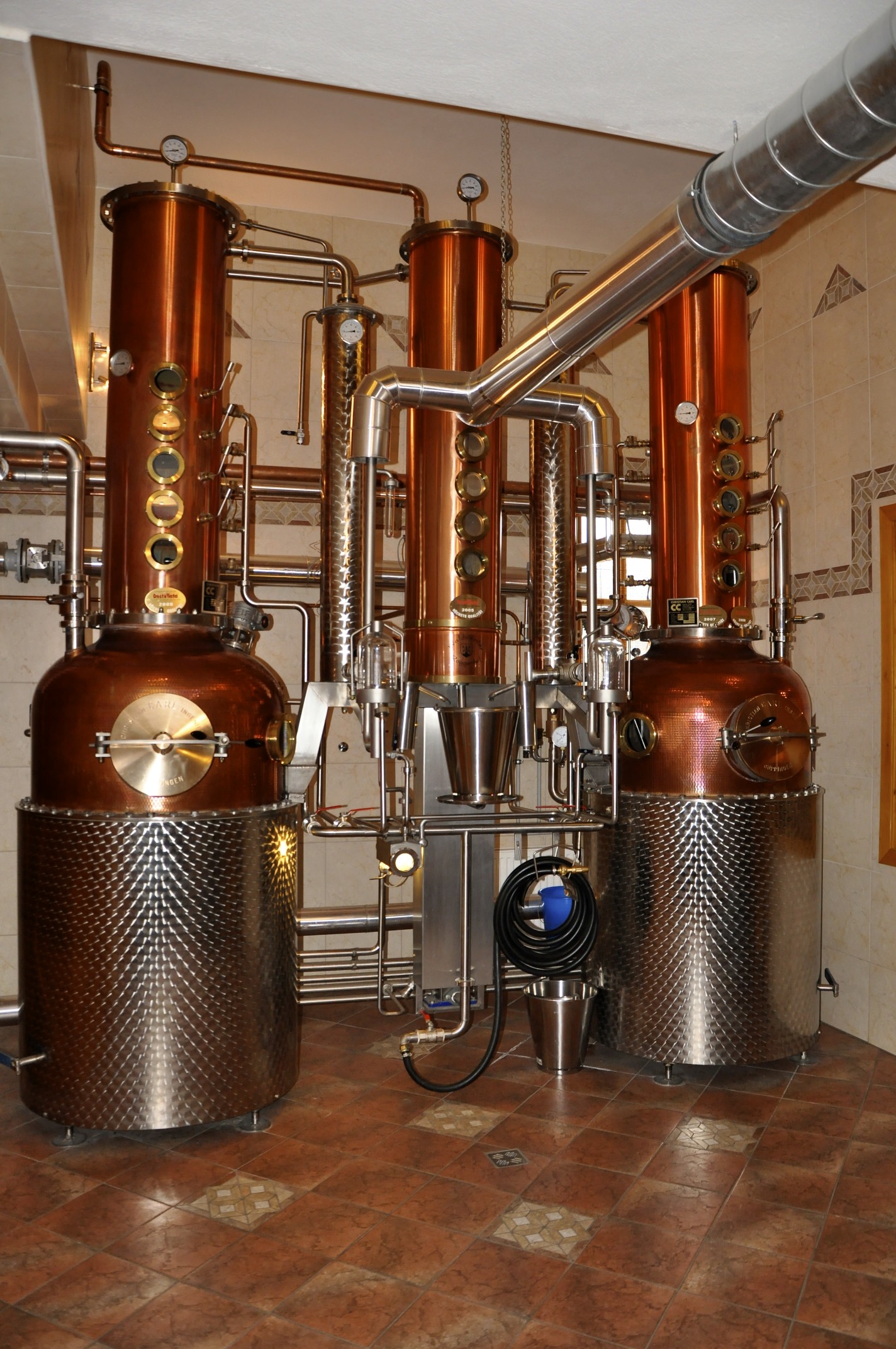
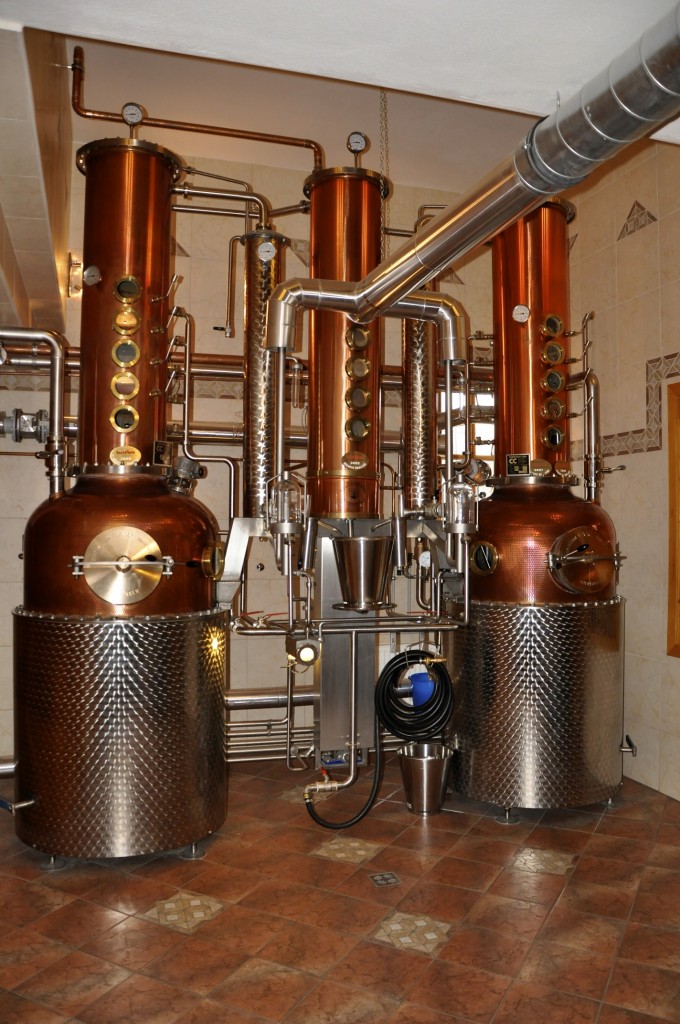
“Our spirit is very, very clean! Our still room is a real surprise. The distillation equipment was supplied by the German manufacturer Christian Carl. It is perfect German craftsmanship, we use only the best material, they are the Rolls Royce of the distilling industry,” states Johann Haider proudly. The two stills are a mix of traditional pot stills and column stills. There is a boil pot with a column on top of it. This exceptional piece of technology allows a continuous process of distilling with steam. “The right distillation pressure is vital for the quality of the spirit” describes the stills operator the process, the exact temperature level is also vital. Within the column five aroma plates make for more and longer copper contact and enrichment of the spirit. These plates allow a very precise cut, foreshot, middle cut and feints can be cut absolutely precisely. The character of the spirit is very pure and clean, sulphury compounds were retained by the unorganic catalysor copper. The copper plates in the column are very special, unique and have been patented by CARL Distilleries and Artisan Distillery Systems. They have little holes and make it very hard for the alcohol vapours to reach the Geistrohr or lyne arm at the top. There is no spirit safe like in Scottish distilleries. “Testing of the middle cut point is just done by my nose,” says the Master Distiller. The spirit is usually produced by quadruple fractional distillation. 10.000 litres of mash result in about 1.200 litres of new make spirit. Austrian distilling laws are very strict and tight. The excise officer seals every access to any spirit, every step of production is monitored, every step of distillation process has to be documented in a diary by the distiller as excise control takes place at the distillery at least once a month. Sometimes by surprise! Roggenreith Distillery is very uniqiue regarding its distilling process. The mash, i.e. the draff and the wort are distilled together, therefore it has to be stirred to prevent baking in the boil pot when distilling. Thus temperature control is very tight although the Roggenreith wash is heated externally by hot boiling water. “We are able to separate precisely the foreshots, the methyl alcohol, the middle cut, the ethyl alcohol, and the feints. We produce perfect quality” says Johann Haider. The foreshot run of only two litres alcohols takes about 10 minutes, the cut point is defined by nosing. Toxins are more efficiently separated in one single distillation process, and the flavours are preserved. The heart of the run is very slow and results in about 300 litres. The spirit run is four to five hours hours, the middle cut goes directly into eleven 525 litre excise sealed receivers where thestillman has no right of access. The cut points are from 90 % to 80 % A.B.V. During the fourth distillation water has to be added to the boil pot. The foreshot pipe leads into a special individual receiver. The strong foreshots are not recycled or redistilled as in Scottish distilleries, the undesired compounds and alcohols are pure waste and will be completely disposed. About 25% of the run is waste and is treated in a neighbour‘s biomass reactor. The feints also go into four special receiver tanks, and again they are not redistilled as in Scotland, like the foreshos they are also treated in a biomass reactor. Austrian distilling tradition just keeps the heart of the run.
Austrian oak makes for good whisky! The spirit matures in about 500 casks in three racked warehouses. The casks are made of oak from the region. The famous Manhartsberger Summer oak is dried and set up by local coopers. Traditionally the Summer or Sessile oak is also used for making 224 litre! wine casks which are used in the famous Austrian Wachau wine region. Austrian traditional messure for a cask is four Eimer at 56 litres each, which is a total of 224 litres. However, the whisky cask are heavily charred at the cooperage Schneckenleitner just like Aligator skin. The first fill juvenile barrique type of casks generate a strong vanilla flavour and a deep golden colour in the whisky. The cask filling strength is 60% A.B.V. and the spirit is dilluted by natural local spring water. After three years of maturation the whisky is bottled at 41% A.B.V. The spirit filled in second-fill casks matures for five to six years. Third time fillings may be kept for 12 up to 18 years. Thereafter the casks will be totally rejuvenated, explains Monica Haider. Some of the whiskies mature in toasted wine casks from famous Austrian winemakers like Schloss Gobelsberg, Paul Jurtschitsch, Willi Bründelmayer and Thomas Leithner. Special single casks bottlings are also released which contain 50 to 60% A.B.V. Selectionen-bottlings contain 46% A.B.V. The whisky is bottled at natural colour, non-chillfiltered and reduced by natural spring water with a hardness range of 1 (soft). Before bottling the reduced whisky matures for another period in casks to marry water and spirit. Vintage bottles are also released at cask strength. A wide range of whiskies is on offer: single malt, single rye or a Waldviertler which is distilled from 60% malted rye and 40% malted barley. The Northern Dream a mix of rye whisky with honey, fruit and herbes pleases the tongue. 80 % of the annual production of 25.000 litres are sold directly to the visitor of the Whisky Erlebniswelt Waldviertler Roggenhof. The rye whisky enthusiast Jim Murray was full of praise of the Waldviertler Pure Rye Malt: “Some of the most beautifully made whisky I have come across for a little while.”
The Gateway to Distillery Tasting Notes.
Waldviertler Pure Rye Malt, six years old, 41% A.B.V., non-cloured, non-chillfiltered.
Colour golden Nose honey, fresh, ripe plums Palate nice and wonderful sweetness with some maltiness and hints of honey. A perfect unique whisky made of 100% rye malt, there is complete harmony between nose and palate. Very surprising and long lasting mouthfeel.
Waldviertler Special Peated Single Rye Malt, four years old, 46% A.B.V., no age statement, non-cloured, non-chillfiltered. Limited bottling.
Colour dark golden, amber. Nose pungent, some varnishing, rubber, hints of tobacco smoke, hints of medicine and chemistry, opens up and gets better after leaving it untouched for a while in the glass. Palate nice caramel notes, vanilla, dry finishing, long mouthfeel, hints of sweet chocolate and nougat, some smoked bacon.
The first peated rye whisky in the world was released by Johann Haider in September 2011. The spirit matured in Austrian barriques (224 litres) which were made of Manhartsberger Summer oak. The toasted casks previously contained Grauburgunder (Pinot Gris) from the organic wine producer Fred Loimer of Langenlois, Kamptal. The spirit was distilled from dark roasted malt which was peated after it had arrived at the distillery. The peat was from Roggenreith’s woods. The four year old whisky of four casks was bottled for the first release in September 2011. Some more years of maturation would have done better and taken away the pungent aroma notes which are not in full harmony with the complex taste. It is a whisky of character which convinces after a few drams. The longer it stays in the glas the better the peated Waldviertler whisky gets. Magic!
Waldviertler Roggenhof, Destillerie J. Haider www.roggenhof.at
About the Author: Ernie – Ernst J. Scheiner was a manager in an adult education centre and teaches “Germans how to drink whisky.” Ernie offers courses on whisky distilling and writes for newspapers and magazines in Germany.
He is the editor of The Gateway to Distilleries at www.whisky-distilleries.net which gives an excellent insight to the whisky industry.
All photographs and text Copyright Ernst J. Scheiner, 2012. Kindly donated to Angels Whisky Club. This article is published on Whisky Intelligence at the request of the Angels Whisky Club.
www.angelswhiskyclub.com