Glen Grant Distillation – Glen Grant Sunday – Scotch Whisky News
The Difference, Distilled
Quite simply, Glen Grant is a combination of highland spring water, heat, malted barley and yeast, experience and utmost dedication. No tricks or gimmicks, just a time-honoured process that has been perfected over generations.
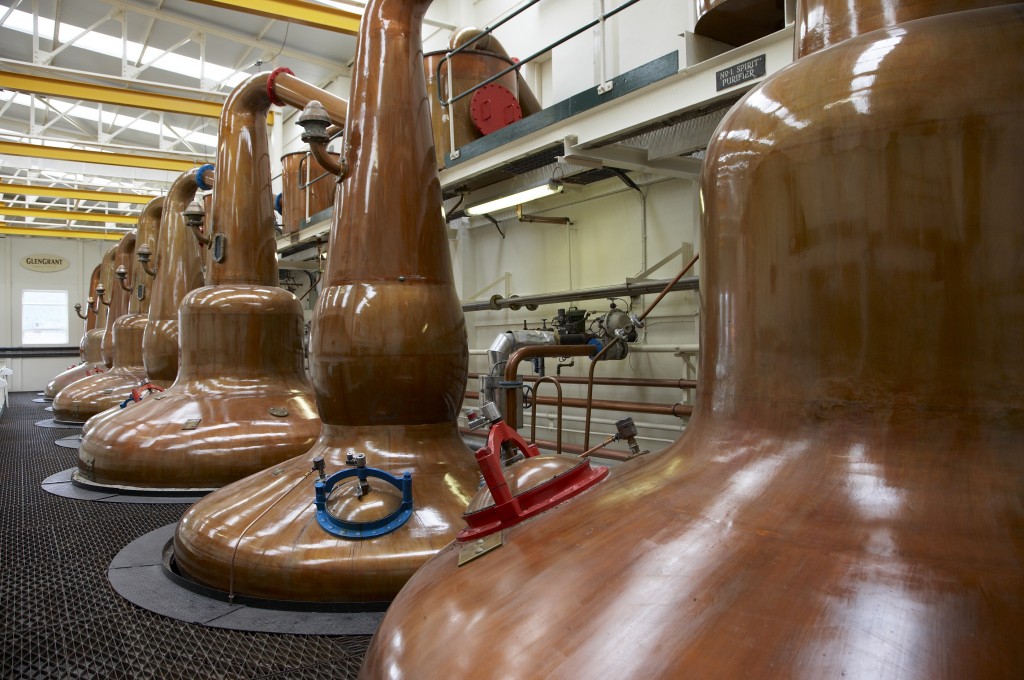
So what makes Glen Grant so distinctively different? We have James ‘The Major’ Grant to thank for that. The light, yet complex spirit is the result of the tall slender stills and special purifiers he introduced over a century ago and are still used to this day. He knew his customers were looking for an alternative to the heavy, assertive whiskies but unlike many other whisky makers, he wasn’t prepared to compromise by developing a blend.
Glen Grant’s unique colour develops as it is stored carefully in oak casks and matures over time, creating clear, fresh, natural single malt Scotch whisky. Just as it should be.
1) Milling
Single Malt Scotch Whisky is made from malted barley, spring water and yeast. The distillery receives deliveries of malt which is stored until required – storage capacity: 340 metric tonnes. To produce malt, barley is first steeped in warm water then drained. This starts the germination process which generates natural enzymes within the grain and releases protein and starch. Starch is the raw material from which sugar and spirit is obtained.
The Mill room
The milling machine has two pairs of rollers, one above the other. The top pair cracks open the malt and the lower pair grinds the malt into grist (ground malt).
2) Mashing, the Mash
Inside the mash tun the grist is mixed with heated spring water which is added in four stages of increasing temperatures to extract the sugar. The contents are left to soak (mash) for several hours, producing a sugary liquid called wort. This is drained off through a mesh floor at the base of the mash tun, leaving the draff (residual grain) to be collected.
The first two waters are cooled and transferred to the next stage, while the third and fourth waters make a final extraction of sugar and are returned to the hot water tank to be recycled as the first and second waters of the next mash. After the final water has drained off, the remaining draff is conveyed to the dark grains plant, located next to the distillery, where it is converted to animal feed.
3) Fermentation, the Tun Room
The Tun Room is made up of ten large wooden vats called wash backs (made from Oregon pine) that are used to collect the cooled wort (sugary liquid). It is here that yeast is added as they fill. During the next 42-48 hours the action of the yeast on sugar produces alcohol, generating a frothy head at the peak of fermentation. This frothy head is controlled within the wash backs by switchblades driven by motors on top of the wash backs. Once fermentation is complete, the contents, now called wash, are pumped to the wash charger (holding tank) in the still house ready to be distilled.
4) First Distillation, the Still House
In the Glen Grant Still House there are four wash stills and four spirit stills arranged in pairs to produce four distillation units. The first stage of distillation takes place in the larger wash still where fully fermented wash is carefully boiled by passing steam through stainless steel heating pans inside the still. Alcohol vapours rise to the head of the still, pass down through a purifier, then a condenser and finally through a spirit safe below to be collected as low wines. The purifiers, unique to Glen Grant, ensure the spirit produced in light but at the same time complex, allowing only the purest vapour to pass from the still to the condenser. The cooling water for the condensers is provided from the cooling dam outside the still house.
5) Second Distillation, the Still House
The low wines go through a second distillation in smaller spirit stills, but this time collection is split into three parts. The first part called “foreshots” and the last part called “feints” are collected and mixed with the low wines in the low wines receiver ready to be re-distilled. Only the middle cut (spirit) is taken off to be filled in oak casks, which will eventually become Glen Grant Single Malt Scotch Whisky. – Low wine and feints strength (30% by volume) – New spirit strength (70% by volume) – Wash still volume (15,000 litres each) – Spirit still volume (10,000 litres each)
6) Maturation, The Warehouse
There are three methods of storing casks in warehouses, Traditional, Racked and Palletised. The Glen Grant Warehouse is a traditional warehouse and allows storage to a height of three casks. The new spirit is filled into oak casks, and is then left undisturbed until fully matured. During this time a portion of the whisky will evaporate, approximately 2% per year – this is called the Angel’s Share. By law, the spirit must mature for a minimum of three years before it can be called Scotch whisky. The tall slender stills, unique purifiers and the special selection of casks used for maturation all combine to give Glen Grant its light fresh character. This was the vision of one extraordinary individual, Major James Grant, and is what still makes Glen Grant clearly different from any other whisky.