Springbank Distillery Newsletter (Late April 2010) – Scotch Whisky News
SOCIETY NEWSLETTER APRIL 2010
Greetings to all Society Members. We hope you are all well and that the sun is shining down on you where ever you are.
Things are certainly going on here at Springbank, as no doubt you will have heard. Springbank and Mitchell’s Glengyle Distilleries are getting a new Distillery Manager. As you will have seen if you logon to the Forum or Springbank’s page on Facebook, Gavin McLachlan will be taking over as Distillery Manager in a few weeks time. Gavin is a “wee toon” boy, having been born and bred in Campbeltown. He is 36 years old and has worked for Springbank since 2002, and for the last four years has been assistant manager. Gavin will be working alongside Frank McHardy, our Director of Production to oversee the day-to-day operations at Springbank and Glengyle. I am sure Gavin will also have the support of all his fellow workers when he takes over the reins from Stuart Robertson who is leaving us to take up a new post in the north east of Scotland. Stuart goes on to a new challenge with the best wishes of everyone here at Springbank.
NEW SOCIETY BOTTLE NEWS AT THE END……..DON’T SCROLL DOWN!!!!! BE PATIENT AND READ THE REST FIRST.
Springbank Open Day
We are well on the way to being almost organised for the open day. Things are starting to fall into place, we just have to hope for lots of visitors and good weather – in that order!! I am sure everyone knows what we are having on the day, but I will remind you anyway.
The doors open at 11.00 am and close when we are all exhausted about 4.30 pm. There will be a Kilkerran masterclass at 11.30 am and a Springbank masterclass at 1.45 pm. Tickets will cost £5 for each masterclass, payable on the day. We will also have a Cadenhead Tasting in the Tasting Room, but unfortunately this is fully booked as we are restricted for space in the Tasting Room.
We will be bottling a single cask of Springbank and a single cask of Longrow.
Music will be provided by Campbeltown Brass and also Frank Rochford (fiddle). There will be some people from the Farmers Market with a selection of Food from Argyll, also Eaglesome Sandwich Shop will be there with some tempting food.
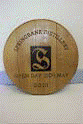
John Brown will be there with a selection of his wood carvings. John has made us a sign from the top of an old cask and we will auction it for charity on the day.
It really is very impressive.
Of course there will be the winners of the Local Barley competition being whisked in by boat on the Kintyre Express from Troon. Winners will be announced in a day or two – the results are in, so the closest six will be informed.
Hope to see lots of Society Members at the Open Day!!!
New Bottling Hall
Again, if you’ve been on facebook and into the Springbank Whisky page you will have seen that we have a new bottling hall. Jenny was there with her camera during the change over, clicking away for us. The new bottling hall is very bright and airy and a lot wamer than the old one. There are also new windows, so we can have a wee peek into the bottling hall now – hope we don’t put them off their work.
Society Glasses
A wee reminder that we have beautiful Glencairn Glasses for sale to Society Members only. They cost £5 each or a set of 6 for £25.

Society Bottles
We have a few of the Springbank 1828 anniversary bottles for sale at £30 plus p&p and a few of the Longrow 12y/o for £45 plus p&p. If you are interested in buying any of these two bottles please let me know.
Latest Society Bottle
At last the latest Soceity Bottle is just about ready to go. This time we have a Springbank 14y/o for you from a Fresh Sherry Pipe at 57.1%ABV.
The cost will be £45 plus p&p.
We will be sending bottles to the USA this time, so our American members will be able to purchase Society bottles for the first time. I will send a separate e mail to our American members next week to tell them how to order their bottle.
Tasting Note:
To follow later in the week.
As usual if you wish to order please e mail me at society@springbankwhisky.com
Out and about with Jenny
Jenny will be on her travels from the 6th May as follows: Berlin – Ka De We whisky department on 6th and 7th May, Baden – Cadenhead’s shop 8th & 9th May – all day both days and Zurich on 10th to 12th May – unsure where she is going to be but will pass on the info as soon as she knows.
Hip Flasks
Some time ago we were asked about getting hip flasks with the Society Logo for sale to members. As you can imagine this might be quite costly to have done, but if enough members are interested I could take this forward and find out how much this would be. Let me know what you think and I’ll have a look around for a good deal.
and finally, the technical bit from Stuart Robertson
Distillation
Distillation for Single Malt Scotch Whisky is carried out in copper pot stills by “batch“ distillation. Copper is important as it removes highly volatile compounds including sulphur from the distillate. Still design is unique to each distillery but they all have a basic “onion “ shape. Heating of the liquid contained within the still is normally by internal steam coils, external gas or oil burners. Condensing of the alcoholic vapour coming from the still takes place in shell and tube condensers or in some cases, worms.
Condensers are linked to the “Spirit Safe“ where distillate is monitored by use of hydrometers and thermometers prior to being collected in the receivers . The stillhouse usually also contains vessels known as “ chargers “ where liquid is held prior to being distilled.
Each distillery in Scotland carries out its own unique form of distillation and we will look at the methods carried out at Springbank Distillery. Springbank`s stillhouse contains three stills, one Wash Still, and two Low Wines or Spirit Stills.
The Wash Still is heated with internal steam coils and an external oil fired burner. The two Low Wines Stills are heated by internal steam coils. The wash still and No 2 Low Wine Stills are connected to shell and tube condensers. No. 1 Low Wines Still is connected to a Worm. The two Low Wines Stills also have after coolers.
Springbank Distillery produces three different spirit styles.
Hazelburn : Triple Distilled Lowland style with no peat influence.
Springbank : Two and a half distillations, lightly peated.
Longrow : Double distilled, heavily peated “ Islay Style Whisky “.
Wash
Distillation in The Wash Still is carried out in the same fashion for each of the spirit styles. Fermented wash is filled into the still up to the level of the man door. The man door and air valve are then closed the steam valves opened and the oil fire lit. The rummager within the still is checked to make sure that it is running. The purpose of the rummager is to slowly stir the wash during distillation in order that the bottom of the still does not become fouled. A certain amount of caramelisation also takes place due to unfermented sugars present in the wash burning on to the copper bottom.
Once the wash within the still begins to boil and produce distillate the application of heat must be controlled in order that wash does not travel up the neck of the still and out through the condenser to the Spirit Safe. The wash still has a sight glass mid way up the neck and froth from the wash should be kept within the confines of this glass.
Distillate, known as Low Wines, flowing from the still is monitored through the spirit safe and collected in the Low Wines Receiver. Once the strength of the distillate has fallen to 1% by volume, indicated by a combination of readings taken from hydrometers and thermometers contained within the spirit safe, the oil fire and flow of steam to the still are turned off, the air valve and man door are opened and the remaining contents of the still known as pot ale are discharged to drain. The cycle is then repeated. A batch of wash takes around six hours to be distilled.
Longrow
Low Wines from the wash distillation which have been collected in the combined Low Wines and Feints receivers is charged to No 1 Low Wines still. The first part of this distillation is returned to the combined receiver and is known as “ Foreshots “. This part of the distillation carries with it a high proportion of highly volatile components which are regarded as impurities that lend themselves to off notes in the new make spirit. The time running foreshots varies from distillery to distillery and is generally 20 – 30 minutes. During this initial part of the distillation water is sometimes added to the distillate in the spirit safe and the strength reduced to 40 – 46% alcohol, this is known as the water test or demisting test. The distillate when mixed with water will initially run “milky“, which is a result of the reaction to long chain fatty acids and their esters remaining in the condenser and inner surfaces of the still from the previous distillation being dissolved in the initial high strength alcohol. Once the distillate runs clear when water is added it can be diverted to the spirit receiver where it is collected as new make spirit. At this point heating of the still contents should be kept to a minimum so that the flow of distillate is slow and the temperature of the distillate collected kept below 20ºC. The flavour compounds required for Longrow production are captured more favourably at a temperature of below 20 degrees Centigrade. This also applies to the other two spirit types produced at Springbank.
The original strength of the distillate collected will be around 70% alcohol. Distillate is usually collected until the strength drops to 58% alcohol at 20ºC at which point the remainder is diverted to the combined receiver. The average strength of Longrow spirit collected in the intermediate spirit receiver (ISR) is 65 – 67% alcohol by volume. Distillation continues until a reading of 1% alcohol remaining in the distillate is achieved at which point the steam is turned off and the remaining contents known as spent lees are discharged to drain. The cycle is then repeated. One distillation cycle takes around 10 hours.
Springbank
Springbank spirit is said to be distilled 2 and a half times and the way that this is achieved is as follows. Wash is distilled , as with Longrow and Hazelburn production, to produce Low Wines. Low Wines are distilled, as with Hazelburn production, to produce Feints.
A mixture containing 90% Feints and 10% of Low Wines is processed in No 2 Low Wines Still and the middle cut of this distillation is collected as Spirit.
The strength of spirit cut collected from Springbank production will be between 76% and 60% alcohol with the average being 68-70% alcohol in the ISR. One distillation cycle for Springbank is around 13 hours.
Hazelburn
This spirit was first distilled during 1997 and is produced using a “triple Distillation“ process. During this distillation Low Wines and Feints are collected in separate receivers known as The Low Wines Receiver and The Feints Receiver. Low Wines from the wash distillation is collected in The Low Wines Receiver and distilled in No 1 Low Wines Still. The total of the distillate produced is collected as Feints in The Feints Receiver.
No 2 Low Wines Still is then charged with only Feints and Spirit is produced from the “ middle cut “ of this distillation. Foreshots and feints are returned to The Feints Receiver. The strength of spirit from Hazelburn distillation collected will be between 80 – 63 % alcohol with the average strength being 70 – 72% alcohol in the ISR. One distillation cycle for Hazelburn takes around 13 hours.
New Make Spirit
The Spirit collected in The Intermediate Spirit Receiver is transferred to The Spirit Receiver Warehouse Vat where an “account“ of the spirit is taken. An “account“ consists of the vat being dipped and the bulk litres and strength of the spirit ascertained. Spirit is then normally reduced to 63.5% alcohol by volume by the addition of water prior to being filled into casks. The spirit is nosed to ensure that the characteristics associated with each new make spirit is as it should be. Samples are taken for comparison with previous samples to ensure continuing adherence to character.
As always please email any questions and we will try to answer them.
All the very best to you all in the future
Stuart Robertson Distilleries Manager
As always, if there’s anything you would like to ask, or comment on please feel free to get in touch with me. I like to be busy, so don’t be shy – get in touch.
Slainte
Janet
for Springbank Society (contact Janet at society@springbankwhisky.com for information on how to join the Society)